Short answer
The answer, before the reasoning
An SME does not need a dedicated ESG department to produce a credible EU Voluntary Standard report. It needs a clear accountable owner, functional data owners, a controlled evidence and calculation process, independent review of higher-risk claims and a disciplined release cycle.
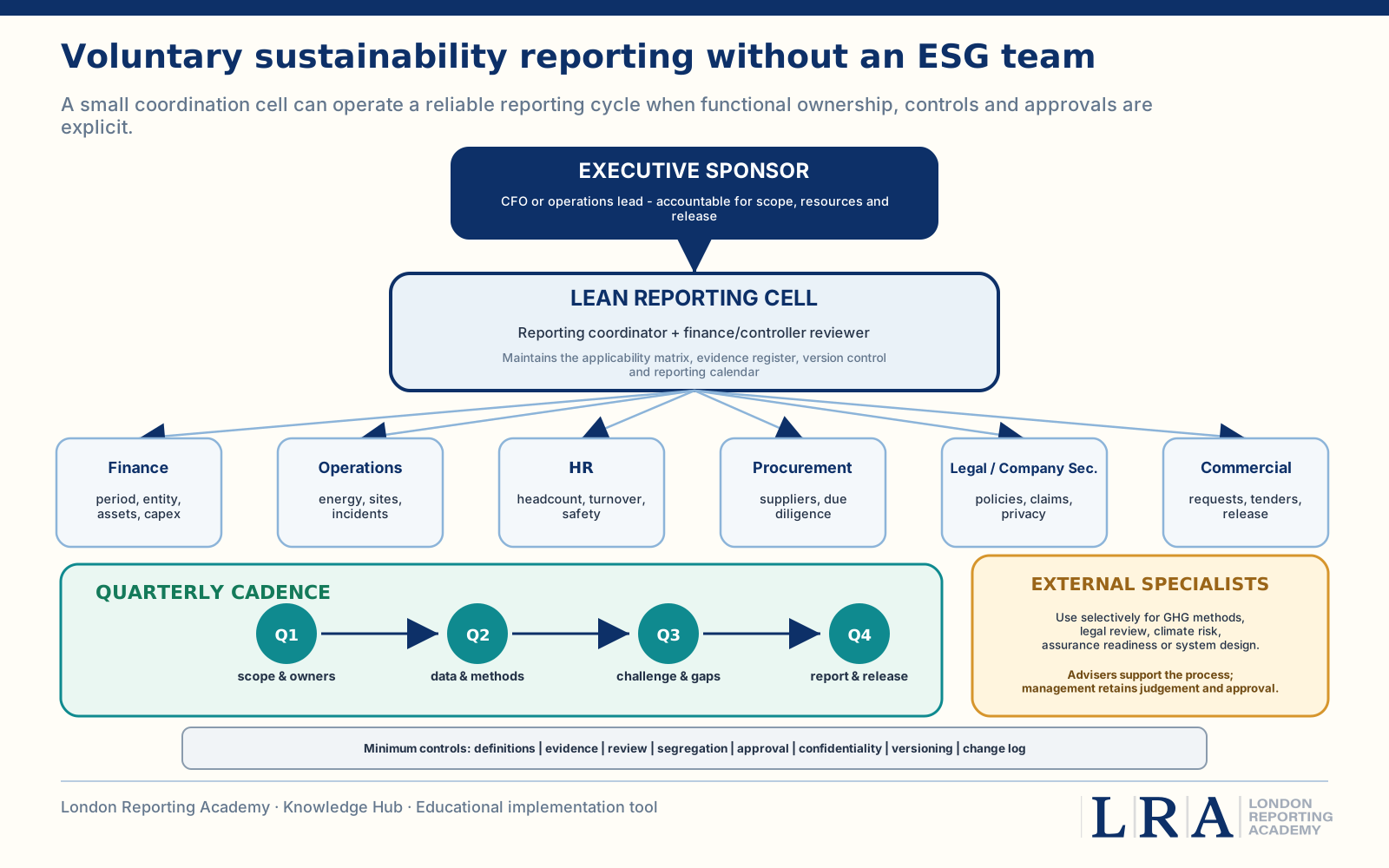
A practical model is led by the CFO or operations director, coordinated by finance or operations, and supported by HR, facilities, health and safety, procurement, compliance and commercial owners. External specialists should be used for technical gaps — for example GHG measurement, climate risk, legal review or assurance — without taking ownership away from the undertaking. A quarterly cadence and a small set of minimum controls are usually more valuable than a large annual reporting project.
Rule
EU-IMP-002
Voluntary Sustainability Reporting Without an ESG Team: A Practical Model for SMEs A lean CFO- or operations-led operating model with functional owners, external specialist support, quarterly cadence, minimum controls, RACI and resource estimates
In practice
Type
| Type | Tier | Audience — Current context |
|---|---|---|
| Operating model and implementation guide | Tier 3 — Deep guide | SME directors, CFOs, operations leaders, finance teams and external advisers — Lean implementation of the EU Voluntary Standard without a dedicated sustainability department |
The Standard asks for controlled information, not a particular department
The EU Voluntary Standard sets reporting principles, modules, datapoints, timing and basis-of-preparation requirements. It does not prescribe an ESG team, a sustainability committee, specific software or a designed public report. The operating model should therefore be proportionate to the undertaking’s size and risk while still protecting the quality of the data and public claim.
LRA lean operating model: a small reporting cell coordinates functional owners through a quarterly cycle and minimum controls.
Rule
MINIMUM VIABLE PRINCIPLE
One accountable owner + named functional owners + a data dictionary + evidence + calculation review + release approval is a reporting system. One enthusiastic employee collecting unverified numbers at year end is not.
In practice
The lean operating model
| Role | Typical SME owner | Core responsibility |
|---|---|---|
| Accountable sponsor | Managing director, board member or executive committee | Approves reporting objective, resources, high-risk judgements and final release. |
| Reporting owner | CFO or operations director | Owns scope, option, timetable, basis of preparation, cross-functional challenge and public claim. |
| Coordinator | Finance manager, controller, operations analyst or company secretary | Maintains data dictionary, request register, evidence index, timetable, draft and issue log. |
| Functional data owners | HR, facilities/energy, H&S, procurement, compliance/legal, finance, operations and commercial | Provide data and evidence; confirm definitions, completeness, limitations and corrective actions. |
| Technical reviewer | Internal controller, senior finance professional or independent adviser | Recalculates higher-risk metrics, challenges methods and checks consistency with source evidence. |
| External specialists | GHG accountant, climate-risk adviser, lawyer, engineer or assurance provider | Fill defined capability gaps and document methods; do not become the undisclosed owner of company data. |
| Release approver | Executive sponsor, CFO and/or board according to policy | Approves report version, counterparty pack, confidentiality and statement of use. |
In practice
A practical RACI
| Activity | Sponsor | CFO/COO owner — Coordinator — Functional owner — External specialist |
|---|---|---|
| Select Option A/B and scope | A | R — C — C — C |
| Maintain data dictionary and request map | I | A — R — C — C |
| Provide source data and evidence | I | A — C — R — C |
| Perform GHG/climate or specialist calculation | I | A — C — R/C — R where engaged |
| Draft narrative disclosures | I | A — R — C — C |
| Review calculations and limitations | I | A — R/C — C — R/C |
| Approve omissions/confidentiality/legal wording | A | R — C — C — C/R |
| Approve final report or response pack | A | R — C — I — I |
| Archive evidence and monitor update triggers | I | A — R — C — C |
Rule
RACI NOTE
R = Responsible; A = Accountable; C = Consulted; I = Informed. Combine roles in a small company where necessary, but avoid having the same person prepare, approve and publicly release every high-risk metric without challenge.
In practice
Quarterly cadence instead of an annual scramble
| Quarter | Focus | Minimum outputs |
|---|---|---|
| Q1 — Scope and prior-year close | Confirm users and requests; choose option; update boundary, data dictionary and methods; close prior-year evidence. | Approved scope; owner list; request map; prior-year issue log; timetable. |
| Q2 — Data and risk review | Collect first-half data; test meters, HR populations and incidents; refresh policies, certifications, climate and legal changes. | Interim dataset; evidence gap log; methodology updates; remediation actions. |
| Q3 — Dry run and challenge | Run calculations; draft core disclosures; test tender/lender responses; challenge targets and claims. | Draft report; reconciliation; reviewer findings; management decisions. |
| Q4 — Year-end close and release | Complete annual data; resolve gaps; approve omissions; finalise narrative, comparatives and release packs. | Approved report; evidence archive; release log; next-year improvements. |
The eight minimum controls
1. Controlled scope and basis. Document Option A/B, individual or consolidated basis, included entities/sites, reporting period and intended users.
2. Data dictionary. Define each datapoint, population, unit, formula, owner, evidence and framework version.
3. Evidence register. Keep source location, period, owner, review status, confidentiality and retention.
4. Standard calculation files. Lock formulas, factors, assumptions, estimate shares and change history.
5. Owner confirmation. Functional owners confirm completeness and known limitations — not merely the final number.
6. Independent challenge. Recalculate material or judgement-heavy metrics and review sensitive narrative claims.
7. Reconciliation and consistency. Compare financial statements, HR totals, site registers, prior periods, customer responses and website claims.
8. Release and version control. Approve the exact report/pack, record recipient and purpose, archive it, and assign update triggers.
Rule
PLANNING ASSUMPTION
The ranges below are LRA planning estimates, not requirements of the Standard. They assume one annual EU report, controlled evidence and a moderate number of counterparty requests. Scope 3, climate modelling, complex groups, multiple languages, remediation or assurance can increase effort substantially.
In practice
Illustrative resource estimates
| SME profile | First-cycle internal effort | Recurring internal effort — External specialist support |
|---|---|---|
| Single entity, one or two sites, data-ready, Option A | 12–20 person-days | 6–12 person-days per year — 2–5 days for set-up/review if internal capability is limited. |
| Multi-site SME, moderate data gaps, Option B | 25–45 person-days | 12–25 person-days per year — 5–12 days for GHG, climate, legal or technical review. |
| Group, complex boundary, significant Scope 3 or climate exposure | 45–80 person-days | 20–45 person-days per year — 10–25+ days depending on modelling, remediation and assurance readiness. |
In practice
| Role | Typical first-cycle time | Typical recurring annual time |
|---|---|---|
| Executive sponsor | 4–8 hours | 3–6 hours |
| CFO/COO reporting owner | 20–40 hours | 12–24 hours |
| Coordinator | 60–120 hours | 35–70 hours |
| Functional owners combined | 40–100 hours | 25–60 hours |
| Internal reviewer | 16–40 hours | 12–24 hours |
In practice
When to use an external specialist
| Use external support when… | Keep internally… |
|---|---|
| The method requires specialist competence: GHG factors and boundary, climate hazards, legal privilege, engineering, human-rights review or assurance. | The purpose, reporting option, ownership, source evidence, management judgement and final public claim. |
| The company needs a repeatable template, training or independent challenge. | The data dictionary, source-system access, owner confirmations and remediation decisions. |
| A lender, customer or assurance provider needs technically defensible documentation. | Approval of what can be shared, with whom, for what purpose and under what limitation. |
Hypothetical scenario
ILLUSTRATIVE SCENARIO
A 90-employee facilities-services company has no ESG team. The CFO owns the report, a finance manager coordinates it, HR owns B8–B10, the operations manager owns energy and waste, H&S owns accidents, compliance owns B11 and C6/C7, and the managing director approves release. A consultant sets up the GHG method and reviews the first calculation. The team meets for 60 minutes each quarter, maintains one evidence register and closes data alongside the financial year. In the first cycle it uses 28 internal person-days and six external days. In year two, with definitions and evidence already controlled, the internal effort falls to 15 person-days.
Illustrative only. It shows how the decision is made, not wording that can be copied or relied on.
Common mistakes
Making the CFO the sole preparer and reviewer. Finance can coordinate, but source ownership belongs with the functions that operate the process.
Giving sustainability to marketing. Marketing can publish approved content; it should not own technical definitions, incidents or evidence.
Outsourcing ownership to a consultant. External files become unusable when the company cannot reproduce the calculation or explain the judgement.
Collecting once a year. Missing invoices, staff-population changes and incident evidence become expensive to reconstruct.
Starting with the designed report. Build the dataset, methods and approvals before layout.
No minimum control because reporting is voluntary. Voluntary publication still creates contractual, reputational and greenwashing exposure.
Overbuilding a committee structure. A lean RACI and quarterly control meeting are often enough; governance should match risk and complexity.
In practice
Myth and reality
| Myth | Reality |
|---|---|
| “We cannot report until we hire an ESG manager.” | The Standard can be implemented through existing finance and operations roles if ownership, evidence, review and approval are controlled. |
| “A consultant can produce the report from interviews.” | Interviews can explain processes, but the undertaking still needs source evidence, reproducible calculations and owner confirmations. |
| “Because it is voluntary, board or director approval is unnecessary.” | The exact approval level is an internal governance decision, but the undertaking should assign accountability for the public option statement, omissions and high-risk claims. |
Readiness
Lean reporting readiness checklist
- An executive sponsor and accountable reporting owner are named.
- Every B/C disclosure has an owner or a documented non-applicability/voluntary decision.
- The coordinator has a current timetable, request map and issue log.
- Definitions, populations, units and methods are recorded.
- Evidence is accessible to the company, not only to an adviser.
- Higher-risk calculations and claims receive independent challenge.
- Quarterly checkpoints are scheduled.
- Financial statements, HR totals and other public statements are reconciled.
- Confidentiality, privacy and release permissions are controlled.
- Final approval and archive responsibilities are assigned.
- Resource assumptions are approved and revised after the first cycle.
The Standard does not prescribe a fixed first-report duration. The article's LRA planning estimate for a data-ready single entity using Option A is 6–12 internal person-days, while data gaps, group complexity, Scope 3 work, climate modelling, remediation or assurance can increase the effort substantially.
The article's lean model uses a quarterly reporting cycle, with checkpoints for scope, interim data, a dry run and year-end close. In its illustrative scenario, the team meets for 60 minutes each quarter; the exact meeting format is an implementation choice, but the controlled checkpoints should remain.
Self-check
- Which responsibilities can be combined in a small SME, and which review conflicts should still be managed?
- What makes an external specialist’s work transferable back to the undertaking?
- Why is quarterly evidence maintenance usually more efficient than annual data collection?
Questions
Questions people ask
Does an SME need an ESG manager to use the EU Voluntary Standard?
An SME does not need a dedicated ESG department to produce a credible EU Voluntary Standard report. It needs a clear accountable owner, functional data owners, a controlled evidence and calculation process, independent review of higher-risk claims and a disciplined release cycle.
Who should own the report?
It needs a clear accountable owner, functional data owners, a controlled evidence and calculation process, independent review of higher-risk claims and a disciplined release cycle. A practical model is led by the CFO or operations director, coordinated by finance or operations, and supported by HR, facilities, health and safety, procurement, compliance and commercial owners.
How much time does a first report take?
The Standard does not prescribe a fixed first-report duration. The article's LRA planning estimate for a data-ready single entity using Option A is 6–12 internal person-days, while data gaps, group complexity, Scope 3 work, climate modelling, remediation or assurance can increase the effort substantially.
What should be outsourced?
A practical model is led by the CFO or operations director, coordinated by finance or operations, and supported by HR, facilities, health and safety, procurement, compliance and commercial owners. External specialists should be used for technical gaps — for example GHG measurement, climate risk, legal review or assurance — without taking ownership away from the undertaking.
How often should the team meet?
The article's lean model uses a quarterly reporting cycle, with checkpoints for scope, interim data, a dry run and year-end close. In its illustrative scenario, the team meets for 60 minutes each quarter; the exact meeting format is an implementation choice, but the controlled checkpoints should remain.
Take it with you
The checklists as a working spreadsheet
Every checklist and table on this page, with empty status, owner and evidence columns for your team to fill in and keep.
✓ Knowledge Hub AI Assistant · Human-in-the-loop

Ask about this guide
It answers from this page, and reaches into the linked disclosure cards when your question is about the standard itself.
Go deeper · EU Voluntary Standard 2026
Certified VSME Sustainability Reporting (EU Voluntary Standard for SMEs)
This page settles one datapoint. The VSME course turns the EU voluntary standard into a proportionate reporting process for a non-listed SME, on your own data.
Available as Guided Flex, Live Cohort, 1:1 Expert Mentorship or Corporate Programme.