Short answer
The answer, before the reasoning
Prepare the report as a controlled reporting project, not as a questionnaire-filling exercise. First identify the users, requests and intended publication channel; confirm that the Voluntary Standard is an appropriate basis; select Option A (Basic Module only) or Option B (Basic and Comprehensive Modules); and build a disclosure-level applicability matrix.
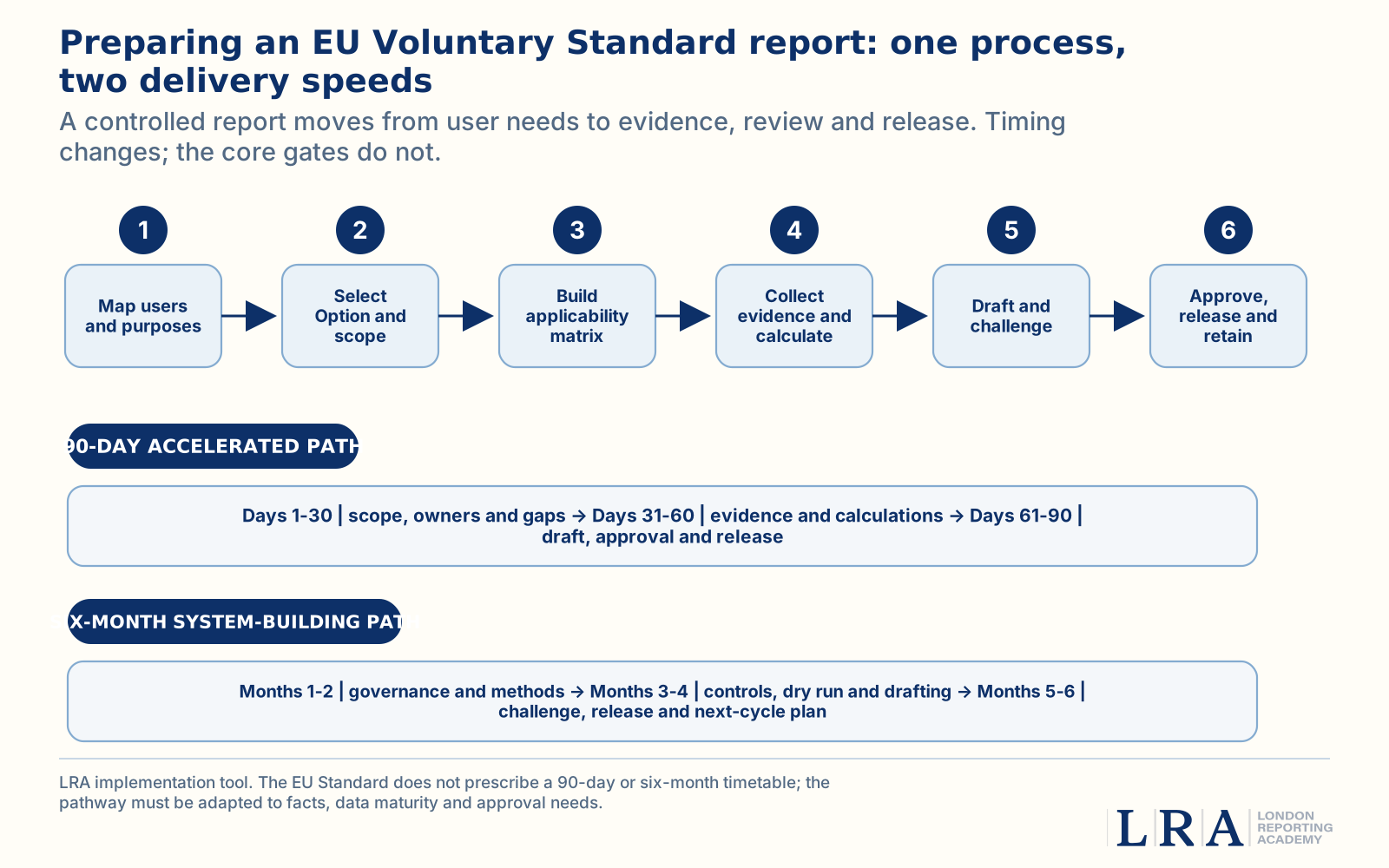
Then assign data owners, document methods and evidence, perform calculations and reconciliations, draft the report, challenge omissions and claims, obtain management approval and release a version-controlled output. A 90-day path is possible where data already exist; a six-month path is more suitable where systems, methodologies or controls must be built.
From user and request mapping to module selection, data ownership, evidence, calculations, review and release
Why this question matters
The Voluntary Standard is deliberately proportionate, but it still combines corporate information, environmental metrics, workforce data, policies, climate information and business-conduct disclosures. A team that starts with the template can collect too much, overlook an applicable condition, use inconsistent reporting periods or make a formal compliance statement before the supporting evidence has been reviewed.
A well-designed project starts with the decisions the report must support. The same undertaking may need a concise Basic Module response for a customer, a fuller package for a bank, an internal management dashboard and a public report. These uses can share data and evidence, but they do not automatically require the same output, level of detail or publication route.
Quick orientation
Quick orientation
- Applies to
- Undertakings outside mandatory CSRD reporting that are considering the Commission-adopted EU Voluntary Standard, particularly those with no more than 1,000 employees.
- Primary decision
- Which users and requests the report will serve, whether Option A or Option B is appropriate, and what controlled evidence is required before release.
- Key sources
- C(2026) 5011, Annex I paragraphs 1-64, and Directive (EU) 2026/470 for the separate value-chain-cap mechanism.
- Common confusion
- Assuming that completing a digital template is the same as completing the reporting, judgement, evidence and approval process.
Technical status
CURRENT LEGAL STATUS
Current legal status at 24 September 2026. The European Commission adopted C(2026) 5011 on 3 July 2026. It was published in the Official Journal on 21 September 2026 as Commission Delegated Regulation (EU) 2026/1560 and entered into force on 24 September 2026. Its value-chain-cap article applies for financial years beginning on or after 1 January 2027. Directive (EU) 2026/470 is in force at EU level, but Member States have until 19 March 2027 to transpose the relevant reporting amendments. Confirm the current national-law position before relying on a statutory right, prohibition or formal compliance statement.
1. Map users and requests before selecting a module
The standard's primary function is to inform actual or potential business counterparties. An undertaking may also publish the report publicly, but public publication is a choice rather than an automatic requirement of the Voluntary Standard. Start by registering who is asking, why the information is needed, when it is needed and whether the request is recurring.
In practice
| User or request | Decision to document | Likely reporting response |
|---|---|---|
| CSRD-reporting customer | Which Annex II datapoints are genuinely needed for the customer's reporting and whether the undertaking is protected by the cap. | Provide the relevant controlled data or a report extract; do not assume the customer needs every disclosure. |
| Bank or investor | Whether the information is for lending, investment, the user's own CSRD reporting or another legal purpose. | The Comprehensive Module may be useful, but the statutory cap analysis must be performed separately by purpose. |
| Corporate procurement | Whether the request supports supplier selection, contract monitoring, due diligence or CSRD reporting. | Map each request line to its purpose and respond through the appropriate data channel. |
| Management or board | Which sustainability issues affect decisions, resilience, cost, people or market access. | Use the report as a controlled management output, supplemented by internal evidence and actions. |
| Public audience | Whether the organisation is prepared to make methods, limitations and performance visible. | Publish a separate report or include it in the management report, with accessible cross-references and approved claims. |
2. Confirm eligibility, reporting basis and timing
1. Confirm whether the undertaking is subject to mandatory sustainability reporting under Articles 19a or 29a of the Accounting Directive. A mandatory reporter should not substitute the Voluntary Standard for ESRS.
2. Identify the responding legal entity and record its employee status. Annex I states that the standard is intended for undertakings that do not exceed an average of 1,000 employees during the preceding financial year.
3. Choose individual or consolidated reporting. A parent is recommended to report on a consolidated basis; subsidiaries included in that consolidated report are exempted from separate reporting under the Voluntary Standard.
4. Fix the reporting period. Where the undertaking prepares financial statements, the sustainability period should be consistent with them. From the second reporting year, comparative information is required except for metrics disclosed for the first time.
5. Decide whether the report will be annual. It is required annually where it is prepared to meet annual update needs of large undertakings or banks; otherwise the reporting cadence should be agreed and disclosed.
Technical status
TECHNICAL BOUNDARY
The regulation's Article 2 permits undertakings outside mandatory reporting to use Annex I, while Annex I describes the Standard as intended for undertakings with no more than 1,000 employees. An undertaking above that level but outside CSRD should obtain technical advice before presenting a formal compliance claim.
3. Select Option A or Option B
Annex I paragraph 25 permits an undertaking that has completed B1-B11 to add selected disclosures from the Comprehensive Module. B1 paragraph 27, however, says that a selected module is to be complied with in its entirety. The defensible reading is that selected C disclosures may be added as voluntary information, while a formal Option B statement should be reserved for a complete Comprehensive Module, subject to applicable conditions and permitted omissions. This is an LRA technical interpretation that should be confirmed during final review.
In practice
| Option | Contents | Best fit — Control point |
|---|---|---|
| Option A | Basic Module: B1-B11. | First-time reporters, smaller undertakings, concise counterparty needs and foundational data systems. — Complete the Basic Module as a module, subject to the if-applicable principle and permitted omissions. |
| Option B | Basic Module plus Comprehensive Module: C1-C9. | Undertakings facing recurring bank, investor or corporate-client requests and those seeking a fuller risk profile. — Do not use the Option B compliance statement until the Comprehensive Module has been completed and reviewed. |
| Selected C information | One or more Comprehensive disclosures added to a Basic report. | A targeted response to a specific user need where a full Comprehensive report is not yet justified. — Treat the additions as voluntary information unless the conditions for the full Option B statement are met. |
4. Build a disclosure-level applicability matrix
Do not use a single yes/no column for the whole Standard. Classify every datapoint by its status and the facts that activate it. The matrix should distinguish essential datapoints, information required only if specified circumstances apply, voluntary information, sector considerations and datapoints that are voluntary for undertakings with 10 employees or fewer.
In practice
| Matrix field | What to record |
|---|---|
| Disclosure and paragraph | B1-B11 or C1-C9, exact paragraph and subpoint. |
| Datapoint category | Essential, necessary if applicable, voluntary, sector consideration, or voluntary for undertakings with 10 employees or fewer. |
| Applicability question | The fact or condition that determines whether the datapoint is required. |
| Conclusion | Required, not applicable, voluntary addition, omitted under paragraph 22, or pending evidence. |
| Boundary and period | Legal entities, sites, employees, activities and reporting period covered. |
| Owner and reviewer | Person responsible for preparation and a separate reviewer or approver. |
| Evidence and calculation file | Source record, methodology, formula, assumptions, reconciliation and version. |
| Publication location | Report section, data book, policy link or controlled cross-reference. |
In practice
5. Assign owners, evidence and calculation controls
| Disclosure area | Typical owner | Core evidence and control |
|---|---|---|
| B1 basis and company information | Finance, company secretariat, legal | Legal-entity register, accounts, NACE code, group chart, site list, employee reconciliation and reporting-basis approval. |
| B2 and C2 practices, policies and initiatives | Sustainability and policy owners | Current approved policies, action plans, target approvals, implementation records and public-claim reconciliation. |
| B3-B7 and C3-C4 environment | Facilities, EHS, operations, risk and finance | Utility bills, meter extracts, emission-factor register, calculation workbook, site logs, risk assessment, assumptions and review evidence. |
| B8-B10 and C5-C7 social | HR, payroll, health and safety, legal | HR system extracts, payroll checks, accident records, training logs, policy register, grievance records and privacy review. |
| B11, C8 and C9 governance | Compliance, legal, finance, company secretariat | Legal register, fines and conviction records, revenue mapping, governance-body composition and approval. |
6. Calculate, draft, review and release
In practice
| Stage | Action | Output and control |
|---|---|---|
| 1 | Freeze source data and reporting cut-off. | Controlled data extract, period definition and late-adjustment process. |
| 2 | Document methods, units, factors, estimates and assumptions. | Methodology register with preparer and reviewer. |
| 3 | Recalculate and reconcile material metrics. | Signed calculation files and variance explanations. |
| 4 | Draft narrative and tables from approved evidence. | Traceable draft with source references and limitation wording. |
| 5 | Perform technical, finance, legal and consistency review. | Issue log covering completeness, methods, claims, privacy and cross-references. |
| 6 | Approve Option, reporting basis, omissions and compliance wording. | Management or governance approval record. |
| 7 | Release the report and controlled data extracts. | Versioned PDF/digital report, response pack and publication record. |
| 8 | Archive evidence and start next-year change log. | Evidence pack, retention owner and update triggers. |
In practice
90-day accelerated implementation path
| Timing | Priority work | Release gate |
|---|---|---|
| Days 1-15 | Map users and requests; confirm legal status, scope and reporting basis; select provisional Option A or B. | Approved project charter and request register. |
| Days 16-30 | Build the applicability matrix, assign owners and identify evidence and calculation gaps. | Owner-approved gap register. |
| Days 31-60 | Collect source data, document methods, complete calculations and resolve priority gaps. | Reviewed data and evidence pack. |
| Days 61-75 | Draft the report, cross-references, limitations and basis-of-preparation wording. | Complete first draft and open-issue log. |
| Days 76-90 | Perform challenge review, obtain approvals, finalise design/digital output and release. | Signed publication checklist and archived version. |
In practice
Six-month implementation path
| Month | Primary objective | System-building benefit |
|---|---|---|
| 1 | Scope, governance, request mapping and module decision. | Clear ownership and fewer late scope changes. |
| 2 | Applicability assessment and methodology design. | Stable definitions, boundaries and calculation rules. |
| 3 | Data collection, evidence remediation and control design. | Repeatable source-to-report process. |
| 4 | Calculation dry run and narrative drafting. | Early detection of data and consistency issues. |
| 5 | Management challenge, legal/privacy review and user testing. | Better balance, usability and defensibility. |
| 6 | Final approval, digital/publication production and next-cycle plan. | Controlled release and annual reporting calendar. |
Hypothetical example: a manufacturer preparing its first report
A hypothetical components manufacturer has 180 employees. Two customers request emissions, water, workforce and human-rights data; its bank also requests climate targets and risk information. The company chooses Option B because the requests are recurring and it already has reliable utility, HR and compliance data. It maps each disclosure, identifies that Scope 3 is a sector consideration rather than an Annex II cap item, and separates the bank's credit-risk request from customer CSRD requests.
The first draft reveals inconsistent site boundaries between energy and water data. Finance and EHS agree a site register, the GHG workbook is recalculated, and the limitation is removed before approval. The company releases a public report and a controlled counterparty data extract, both linked to the same evidence register.
Hypothetical scenario
CURRENT REGULATION - ILLUSTRATIVE
This sustainability report has been prepared using Option B of the EU Voluntary Sustainability Reporting Standard in Commission Delegated Regulation (EU) 2026/1560: the Basic Module and the Comprehensive Module. It covers [legal entity/group], the period [date-date] and the disclosures and permitted omissions identified in B1. This wording is illustrative and must be adapted to the final facts, reporting period and approved module conclusion.
Illustrative only. It shows how the decision is made, not wording that can be copied or relied on.
Technical status
TRANSITION FROM RECOMMENDATION 2025/1710
This report has been prepared using Commission Delegated Regulation (EU) 2026/1560, adopted as C(2026) 5011 on 3 July 2026 and in force from 24 September 2026. Where prior-year information used Recommendation (EU) 2025/1710, the report identifies that earlier basis and explains the transition in definitions, datapoints and module claims.
In practice
Weak versus stronger implementation evidence
| Weak approach | Stronger approach |
|---|---|
| The template is distributed to departments with no request map or reporting decision. | A project charter records users, purposes, Option, legal entity, period, owners and approval gates. |
| Data owners email figures without methods or source files. | Each metric has a source extract, methodology, calculation, reviewer and version. |
| The report claims Option B because several C disclosures are included. | The full Comprehensive Module is tested before the Option B statement; selected C information is labelled as additional voluntary information where appropriate. |
| A polished public report hides gaps and assumptions. | Limitations, omissions, estimates and cross-references are specific, approved and traceable. |
Common implementation mistakes
Starting with a generic ESG questionnaire rather than a controlled user and purpose register.
Selecting Option B because it appears more credible, without resources to complete and review the module.
Treating 'if applicable' as an undocumented opt-out rather than a factual conclusion.
Combining entities, sites or periods differently across energy, water, HR and revenue metrics without reconciliation.
Using unapproved targets, policies or benefit claims in the narrative.
Publishing without identifying whether the report uses Regulation (EU) 2026/1560 or the earlier Recommendation (EU) 2025/1710 as its basis.
Assuming that a voluntary report must be publicly available or independently assured.
In practice
| MYTH | A Basic Module report will automatically answer every ESG request from customers |
|---|---|
| REALITY | The Basic Module creates a useful common baseline, but each request still needs a purpose and applicability review. Some counterparties may ask for Comprehensive or entity-specific information; some requests may be outside the value chain cap; and no report removes the need to manage current data, evidence and contract-specific responses. |
Readiness
Pre-release checklist
- The requester and user map is complete and each major request has a stated purpose.
- Mandatory CSRD applicability and the reporting period for Regulation (EU) 2026/1560 have been checked.
- Option A or Option B is approved and consistent with the completed disclosures.
- Individual or consolidated reporting basis and the list of subsidiaries are correct.
- The reporting period aligns with financial reporting where applicable, and comparatives are addressed.
- Every datapoint has an applicability conclusion, owner, evidence source and review status.
- Environmental and social calculations are reproducible and reconciled to source systems.
- Omissions under paragraph 22 are identified datapoint by datapoint and scheduled for annual reassessment.
- Narrative claims are supported by policies, actions, outcomes or explicit limitations.
- Cross-references are accessible at the same time and from the same document set.
- Management has approved the report, compliance wording and publication channel.
- The final version, evidence pack and change log are retained under a controlled naming convention.
In practice
Related requirements and next steps
| Relation | Reference | Why it matters |
|---|---|---|
| Direct | Annex I, paragraphs 1-27 | Users, modules, reporting principles, timing, location, omissions and B1 basis for preparation. |
| Direct | B1-B11 and C1-C9 | Disclosure content, applicability conditions and data-owner design. |
| Next step | EU Value Chain Cap Explained | Classify customer requests separately from the voluntary report choice. |
| Next step | Protected Undertaking Test | Document the employee threshold, legal entity and self-declaration. |
| Tool | Applicability and evidence matrix | Turn the Standard into a repeatable annual reporting system. |
Option A applies the Basic Module, while Option B applies the Basic Module plus the Comprehensive Module. This guide's LRA publishing approach treats selected C disclosures as supplementary information and reserves an Option B statement for a complete Comprehensive Module, subject to applicable conditions and permitted omissions.
Using the Voluntary Standard does not itself require an undertaking to obtain assurance over the information it reports. Commission Delegated Regulation (EU) 2026/1560, adopted as C(2026) 5011 on 3 July 2026 and in force from 24 September 2026, says undertakings applying it are not obliged to seek assurance.
Questions
Questions people ask
Who can use the EU Voluntary Standard?
A mandatory reporter should not substitute the Voluntary Standard for ESRS. Annex I states that the standard is intended for undertakings that do not exceed an average of 1,000 employees during the preceding financial year. An undertaking above that level but outside CSRD should obtain technical advice before presenting a formal compliance claim.
What is Option A or Option B?
Option A applies the Basic Module, while Option B applies the Basic Module plus the Comprehensive Module. This guide's LRA publishing approach treats selected C disclosures as supplementary information and reserves an Option B statement for a complete Comprehensive Module, subject to applicable conditions and permitted omissions.
Must the report be public?
The standard's primary function is to inform actual or potential business counterparties. An undertaking may also publish the report publicly, but public publication is a choice rather than an automatic requirement of the Voluntary Standard.
Is assurance required?
Using the Voluntary Standard does not itself require an undertaking to obtain assurance over the information it reports. Commission Delegated Regulation (EU) 2026/1560, adopted as C(2026) 5011 on 3 July 2026 and in force from 24 September 2026, says undertakings applying it are not obliged to seek assurance.
Can implementation be completed in 90 days?
LRA implementation pathway: the same six reporting stages can be delivered through an accelerated 90-day project or a six-month system-building programme. It is not an official EU timetable.
Sources
Primary sources
- Commission Delegated Regulation C(2026) 5011 final of 3 July 2026 - main act — published as Delegated Regulation (EU) 2026/1560 (OJ, 21 September 2026)
- Annexes 1 and 2 to Commission Delegated Regulation C(2026) 5011 final — published as Delegated Regulation (EU) 2026/1560 (OJ, 21 September 2026)
- Directive (EU) 2026/470 (Omnibus I)
- European Commission adoption announcement, 3 July 2026
- Commission Staff Working Document SWD(2026) 500 final
- EFRAG Knowledge Hub - 2026 Voluntary Standard
Take it with you
The checklists as a working spreadsheet
Every checklist and table on this page, with empty status, owner and evidence columns for your team to fill in and keep.
✓ Knowledge Hub AI Assistant · Human-in-the-loop

Ask about this guide
It answers from this page, and reaches into the linked disclosure cards when your question is about the standard itself.
Go deeper · EU Voluntary Standard 2026
Certified VSME Sustainability Reporting (EU Voluntary Standard for SMEs)
This page settles one datapoint. The VSME course turns the EU voluntary standard into a proportionate reporting process for a non-listed SME, on your own data.
Available as Guided Flex, Live Cohort, 1:1 Expert Mentorship or Corporate Programme.