Short answer
The answer, before the reasoning
The EU Voluntary Standard and IFRS S1/S2 can use some of the same underlying data, but they are not interchangeable reporting bases. The EU Voluntary Standard is a proportionate, modular framework intended mainly to answer the needs of business counterparties, banks and investors and to help an undertaking manage sustainability issues.
IFRS S1 and IFRS S2 are investor-focused standards for material sustainability-related risks and opportunities that could affect an entity’s prospects and are designed for general purpose financial reports. An SME facing a specific lender questionnaire will usually start with the EU Voluntary Standard and add a controlled credit-risk supplement. An SME seeking an ISSB compliance statement, preparing for capital markets or reporting under an ISSB-based jurisdiction needs a separate IFRS S1/S2 assessment and disclosure process.
Rule
EU-VS-002
EU Voluntary Standard vs IFRS S1 and IFRS S2: SME Reporting and Investor Information Compared How intended users, materiality, climate content, financial effects and compliance claims differ — with a decision guide for lender- and investor-facing SMEs
In practice
Type
| Type | Tier | Audience — Current context |
|---|---|---|
| Comparison guide and decision tool | Tier 3 — Deep guide | SME finance leaders, reporting teams, lenders, investors and advisers — Commission-adopted 2026 Voluntary Standard compared with current IFRS S1 and IFRS S2 |
Why the two reporting routes are often confused
Both routes speak to lenders and investors, use familiar climate and workforce information, and can draw on the same evidence. That superficial overlap can lead an SME to assume that a completed EU Voluntary Standard report is automatically an IFRS S1/S2 report — or that IFRS S1/S2 is simply a more detailed version of the voluntary EU modules. Neither conclusion is sound. The reporting objective, selection logic, reporting location, required climate analysis and public claim are different.
Rule
VERSION GATE
This article uses the EU Voluntary Standard adopted as C(2026) 5011 on 3 July 2026. It was published in the Official Journal on 21 September 2026 as Commission Delegated Regulation (EU) 2026/1560 and entered into force on 24 September 2026. It builds on Commission Recommendation (EU) 2025/1710; identify the source and reporting period used when transitioning between them.
Comparison at a glance
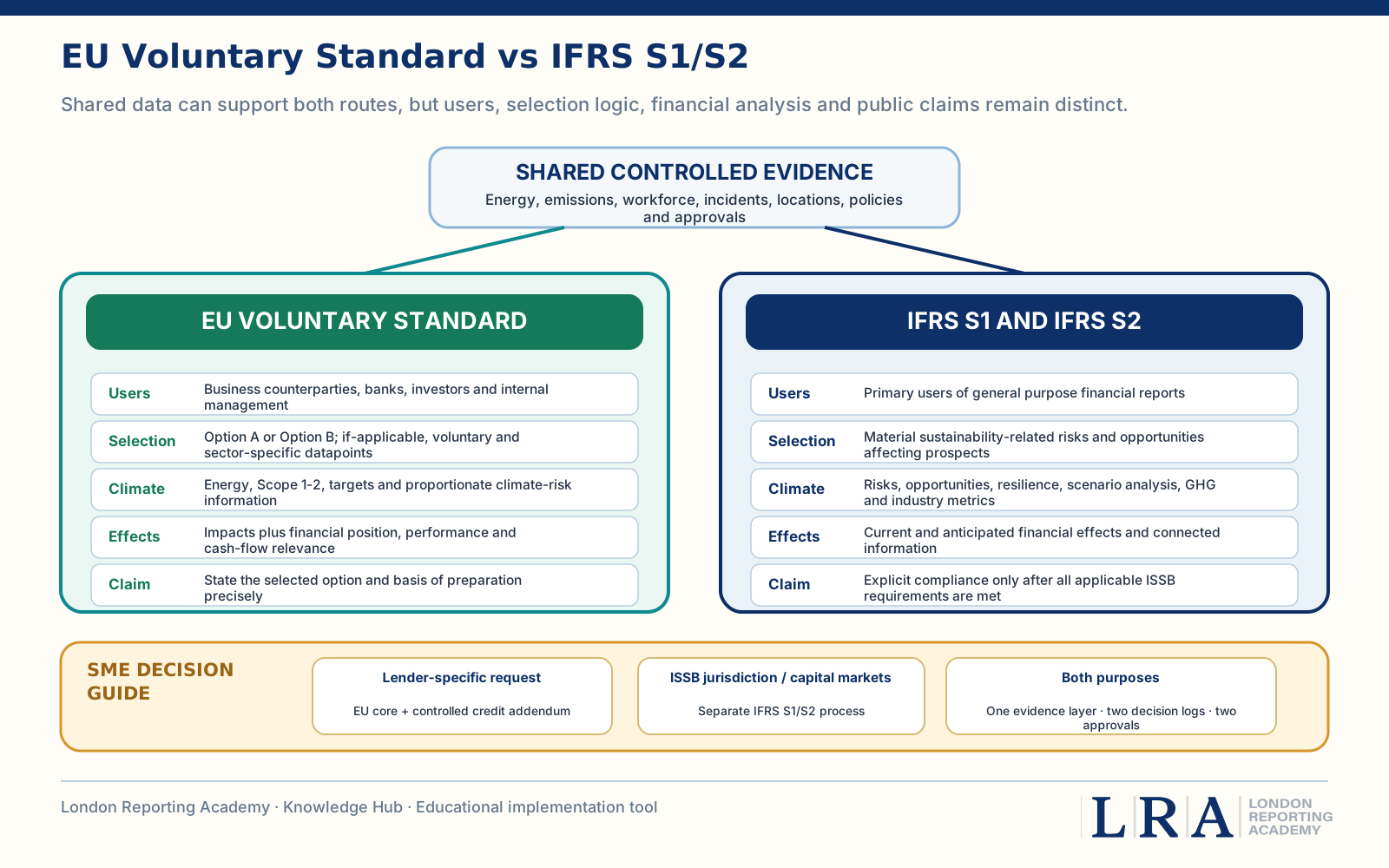
LRA comparison and decision guide: shared evidence does not remove the need for a separate reporting-basis decision.
In practice
| Question | EU Voluntary Standard | IFRS S1 and IFRS S2 |
|---|---|---|
| Primary objective | Provide proportionate sustainability information for business counterparties, banks and investors; support internal management and resilience. | Provide material sustainability-related financial information useful to existing and potential investors, lenders and other creditors in decisions about providing resources. |
| Who can use it | Undertakings outside mandatory EU sustainability reporting that do not exceed an average of 1,000 employees under the adopted text. | Any entity that elects or is required by a jurisdiction to apply the ISSB Standards; the Standards themselves are not limited to SMEs. |
| Selection logic | Choose the Basic Module, or the Basic plus the full Comprehensive Module. Some datapoints are “if applicable”, voluntary or sector-specific; permitted omissions have explicit conditions. | Identify sustainability-related risks and opportunities that could reasonably be expected to affect prospects, then disclose material information. Requirements can be omitted when the information is not material. |
| Impact lens | The report covers how the undertaking has had or is likely to have positive or negative impacts on people or the environment. | Impacts are relevant when they create or inform sustainability-related risks or opportunities that could affect prospects. The reporting objective is not general impact accountability. |
| Financial lens | The Standard also seeks information on how environmental and social issues affect or may affect financial position, performance and cash flows, but several financial-effect datapoints are proportionate or optional. | Financial effects are central: information must enable users to understand current and anticipated effects on financial position, performance and cash flows, subject to materiality and applicable reliefs. |
| Climate content | B3 energy and Scope 1/location-based Scope 2; Comprehensive content on relevant Scope 3, targets, transition and climate risks. Potential adverse financial effects under C4 may be disclosed. | IFRS S2 covers physical and transition risks, opportunities, strategy, current and anticipated financial effects, resilience and scenario analysis, Scope 1–3, capital deployment, industry metrics and targets. |
| Reporting entity | Individual or consolidated basis is disclosed; consolidated reporting by a parent is recommended. | The sustainability-related financial disclosures are for the same reporting entity as the related financial statements. |
| Location and timing | Primary function is to inform actual or potential business counterparties. Public release is optional. Annual reporting is required when large undertakings or banks require annual updates. | Disclosures form part of general purpose financial reports, are clearly identifiable, use the same reporting period as the related financial statements and are reported at the same time, subject to transition reliefs. |
| Comparatives | Required from the second year except for metrics disclosed for the first time. | Comparative information is generally required for amounts and, when useful, narrative information. |
| Compliance claim | B1 requires an explicit statement using Option A or Option B. A selected Comprehensive disclosure does not make the report Option B unless the Comprehensive Module is applied in full. | An explicit and unreserved statement is permitted only when all requirements of IFRS Sustainability Disclosure Standards are met. “ISSB-aligned” is not a substitute for the compliance test. |
| Assurance | The adopted EU text says undertakings applying the Standard are not obliged to seek assurance. | The ISSB Standards do not themselves impose assurance, but jurisdictional law, market rules or the reporting entity may require it. |
The materiality difference is more important than the metric overlap
Under the EU Voluntary Standard, the undertaking chooses a module and follows its architecture. The Basic Module is the minimum for other undertakings and a prerequisite for the Comprehensive Module. A module must be complied with in its entirety, subject to the stated “if applicable” conditions, voluntary datapoints, sector considerations and permitted omissions. The undertaking may also add information needed to make the report relevant and faithful for its sector or circumstances.
IFRS S1 applies a different filter. The entity first identifies sustainability-related risks and opportunities that could reasonably be expected to affect its prospects. It then assesses which information about those matters is material to primary users. A required disclosure need not be provided if the information is not material, while company-specific information may be necessary when the specified requirements are insufficient. This means that identical source data can be included, excluded, aggregated or explained differently.
Caution
DO NOT SAY
“Our EU Voluntary Standard report covers all material IFRS S1/S2 information.” That conclusion requires a separate IFRS risk-and-opportunity identification, materiality assessment, industry-guidance review, connected-information analysis and compliance test.
In practice
Climate: where an EU report provides a strong starting point — and where it stops
| Climate building block | What the EU Voluntary Standard can provide | What an IFRS S2 project still has to test |
|---|---|---|
| Energy and Scope 1–2 | Total energy consumption, a renewable/non-renewable breakdown when available, estimated gross Scope 1 and location-based Scope 2 emissions. | Measurement boundary, material information, disaggregation, contractual instruments, GHG methodology disclosures and consistency with the reporting entity. |
| Scope 3 | Consideration of significant categories, particularly for sectors and activities where value-chain emissions are important. | All 15 categories must be considered; material Scope 3 information, measurement approach, inputs, assumptions and data quality need to be disclosed. |
| Targets and transition | Established reduction targets, main actions and, for high-climate-impact sectors, information on a transition plan or intended adoption. | How targets are set and monitored, gross versus net presentation, carbon credits, performance, capital deployment and effects on strategy and decision-making. |
| Physical and transition risks | Identified hazards and transition events, exposure and sensitivity, time horizons and adaptation actions. | Material risks and opportunities, concentrations, current and anticipated financial effects, climate resilience and scenario analysis proportionate to circumstances. |
| Financial effects | The undertaking may disclose potential adverse effects and a high/medium/low assessment under C4. | Material current and anticipated financial effects are integral to strategy disclosures, including limitations and use of reasonable and supportable information. |
Decision guide for an SME facing lenders or investors
1. Identify the decision and user. Is the information for a single credit review, a recurring lender covenant, a private-equity due-diligence process, a bond or equity investor, or an ISSB-based jurisdictional filing?
2. Check the requested claim. A request for “sustainability information” is not the same as a request for disclosures complying with IFRS S1 and IFRS S2.
3. Use the EU Voluntary Standard as the proportionate core when the need is counterparty-specific. Option A can provide a controlled baseline; Option B can be appropriate where banks or investors regularly need business-model, climate, workforce, human-rights and governance information.
4. Add a lender or investor supplement rather than stretching the claim. Include facility-specific cash-flow effects, collateral exposure, capex, insurance, covenant data or investor metrics that are genuinely needed but outside the Standard.
5. Start a distinct IFRS S1/S2 workstream when the use case is general purpose financial reporting. Perform the prospects, materiality, reporting-entity, industry-guidance, financial-effects and compliance analyses explicitly.
6. Keep one evidence base but two release decisions. The data owner may approve one calculation, while separate reviewers approve the EU report and the IFRS disclosure output.
In practice
| SME situation | Best starting route | Reason |
|---|---|---|
| One bank requests annual ESG information for a working-capital facility | EU Voluntary Standard report plus a short credit addendum | Proportionate core; add facility, cash-flow, collateral and covenant information only where decision-useful. |
| Several banks and corporate customers send overlapping questionnaires | Controlled EU Voluntary Standard dataset and counterparty response pack | Reduces duplicate calculations while preserving request-purpose and release controls. |
| Private-equity investor requests an ISSB-aligned information memorandum | EU dataset as evidence; separate IFRS S1/S2 gap assessment and clearly scoped descriptive wording | Investor focus is relevant, but a descriptive alignment statement must not imply full compliance. |
| SME plans a listed debt issue or operates in an ISSB-adopting jurisdiction | IFRS S1/S2 implementation project, with EU datapoints reused where definitions align | The reporting objective, materiality, financial effects, timing and compliance statement require an ISSB-controlled process. |
| Company wants both supplier efficiency and investor readiness | Master dataset with EU and IFRS decision layers | One calculation layer can serve multiple outputs, but the framework conclusions remain separate. |
Hypothetical scenario
ILLUSTRATIVE SCENARIO
A 240-employee manufacturer prepares Option B under the EU Voluntary Standard for two banks and three major customers. Its report contains energy use, Scope 1 and 2 emissions, workforce safety, climate-risk locations, policies and a reduction target. A private investor later asks whether the company “reports under IFRS S1 and S2”. The finance team does not change the title or add an ISSB logo. It creates an IFRS gap register, identifies material transition and physical risks, analyses anticipated financial effects and resilience, reviews industry-based metrics and prepares a separate investor disclosure. The same utility bills, emissions calculation and site register are reused, but the investor output receives a distinct basis of preparation and approval.
Illustrative only. It shows how the decision is made, not wording that can be copied or relied on.
In practice
Weak and stronger public wording
| Risky wording | Stronger wording |
|---|---|
| “Our sustainability report is compliant with the EU Voluntary Standard and IFRS S1/S2.” | “The sustainability report was prepared using Option B of the EU Voluntary Standard. Selected underlying data also support a separate IFRS S1/S2 readiness assessment; no IFRS compliance statement is made.” |
| “The EU report meets all investor information needs.” | “The report provides a proportionate core for bank and investor dialogue. Additional information may be supplied for a specific financing or investment decision.” |
| “All climate risks are covered by C4.” | “C4 describes the climate hazards and transition events identified through the company’s proportionate assessment. A separate IFRS S2 process would test material risks, opportunities, financial effects and resilience for primary users.” |
Common mistakes
Treating common metrics as common materiality. The same GHG figure does not prove that the same information is material under both reporting bases.
Calling selected C-disclosures “Option B”. Option B requires the full Comprehensive Module; selected C-disclosures can supplement Option A without changing the selected option.
Using “investor-focused” as an IFRS claim. Many reports are useful to investors without complying with IFRS S1 and IFRS S2.
Omitting the financial-effects gap. A narrative risk list is not a substitute for IFRS current and anticipated financial-effects analysis.
Forgetting reporting location and timing. A counterparty report released months after the accounts may not satisfy IFRS S1 timing and general-purpose-reporting requirements.
One approval for two claims. The EU option statement and any IFRS compliance or alignment wording require separate evidence and sign-off.
Readiness
Review checklist
- Has the primary user and decision purpose been documented?
- Is the reporting basis — EU Option A, EU Option B, selected additional C-disclosures, IFRS S1/S2, or a descriptive readiness output — stated precisely?
- Have the EU applicability rules and the IFRS materiality rules been applied separately?
- Are reporting entity, period, comparatives and release date consistent with the chosen basis?
- Has climate content been checked for Scope 3, financial effects, scenario analysis, resilience and industry metrics?
- Do public claims match the actual completion status and approval record?
- Are reused calculations linked to framework-specific mapping and residual gaps?
An SME can elect to apply IFRS S1 and IFRS S2; the Standards are not limited by entity size. The choice should reflect its investor or lender information needs, and the SME should test the separate IFRS reporting basis rather than assume that an EU voluntary report is interchangeable.
Self-check
- Why can an EU Option B report still be insufficient for an IFRS S2 compliance statement?
- When is the EU Voluntary Standard usually the more proportionate first output for an SME?
- Which decisions must remain separate even when the same emissions calculation is reused?
Questions
Questions people ask
Is an EU Voluntary Standard report automatically IFRS S1/S2 compliant?
The EU Voluntary Standard and IFRS S1/S2 can use some of the same underlying data, but they are not interchangeable reporting bases. IFRS S1 and IFRS S2 are investor-focused standards for material sustainability-related risks and opportunities that could affect an entity’s prospects and are designed for general purpose financial reports.
Can the same GHG inventory support both reports?
The EU Voluntary Standard and IFRS S1/S2 can use some of the same underlying data, but they are not interchangeable reporting bases. The same GHG figure does not prove that the same information is material under both reporting bases.
Can an SME apply IFRS S1 and IFRS S2 voluntarily?
An SME can elect to apply IFRS S1 and IFRS S2; the Standards are not limited by entity size. The choice should reflect its investor or lender information needs, and the SME should test the separate IFRS reporting basis rather than assume that an EU voluntary report is interchangeable.
Does Option B mean the report is investor-grade?
The EU Voluntary Standard and IFRS S1/S2 can use some of the same underlying data, but they are not interchangeable reporting bases. An SME seeking an ISSB compliance statement, preparing for capital markets or reporting under an ISSB-based jurisdiction needs a separate IFRS S1/S2 assessment and disclosure process.
Take it with you
The checklists as a working spreadsheet
Every checklist and table on this page, with empty status, owner and evidence columns for your team to fill in and keep.
✓ Knowledge Hub AI Assistant · Human-in-the-loop

Ask about this guide
It answers from this page, and reaches into the linked disclosure cards when your question is about the standard itself.
Go deeper · EU Voluntary Standard 2026
Certified VSME Sustainability Reporting (EU Voluntary Standard for SMEs)
This page settles one datapoint. The VSME course turns the EU voluntary standard into a proportionate reporting process for a non-listed SME, on your own data.
Available as Guided Flex, Live Cohort, 1:1 Expert Mentorship or Corporate Programme.