Short answer
The answer, before the reasoning
Yes — one controlled sustainability dataset can support the EU Voluntary Standard, ESRS, GRI and bank requests, but only when the dataset stores more than a number. Each record should preserve the period, boundary, definition, methodology, evidence, owner, review status and intended purpose.
Calculations may then be reused through framework-specific adjustment and decision layers. The outputs must remain distinct because the systems use different materiality or applicability logic, reporting boundaries, time requirements, granularity and claims. The safe model is “one evidence and calculation layer, several controlled reporting views” — not one universal questionnaire or a single cross-framework compliance flag.
Rule
EU-INT-002
Can One Sustainability Dataset Support the EU Voluntary Standard, ESRS, GRI and Bank Requests? A master data model for reusing calculations while keeping materiality, boundary, timing, purpose and compliance decisions distinct
In practice
Type
| Type | Tier | Audience — Current context |
|---|---|---|
| Interoperability architecture guide | Tier 3 — Deep guide | SME reporting teams, data owners, consultants, finance and system designers — 2026 EU Voluntary Standard, revised ESRS, current GRI Universal Standards and purpose-specific bank requests |
The real interoperability problem is metadata, not arithmetic
Teams often begin with a spreadsheet that contains values such as electricity consumption, Scope 1 emissions, workforce headcount and accident rate. The values may be correct and still be unusable across reporting outputs because the file does not show which entity, site, period, unit, definition or methodology each value represents. A number becomes reusable only when its context and evidence travel with it.
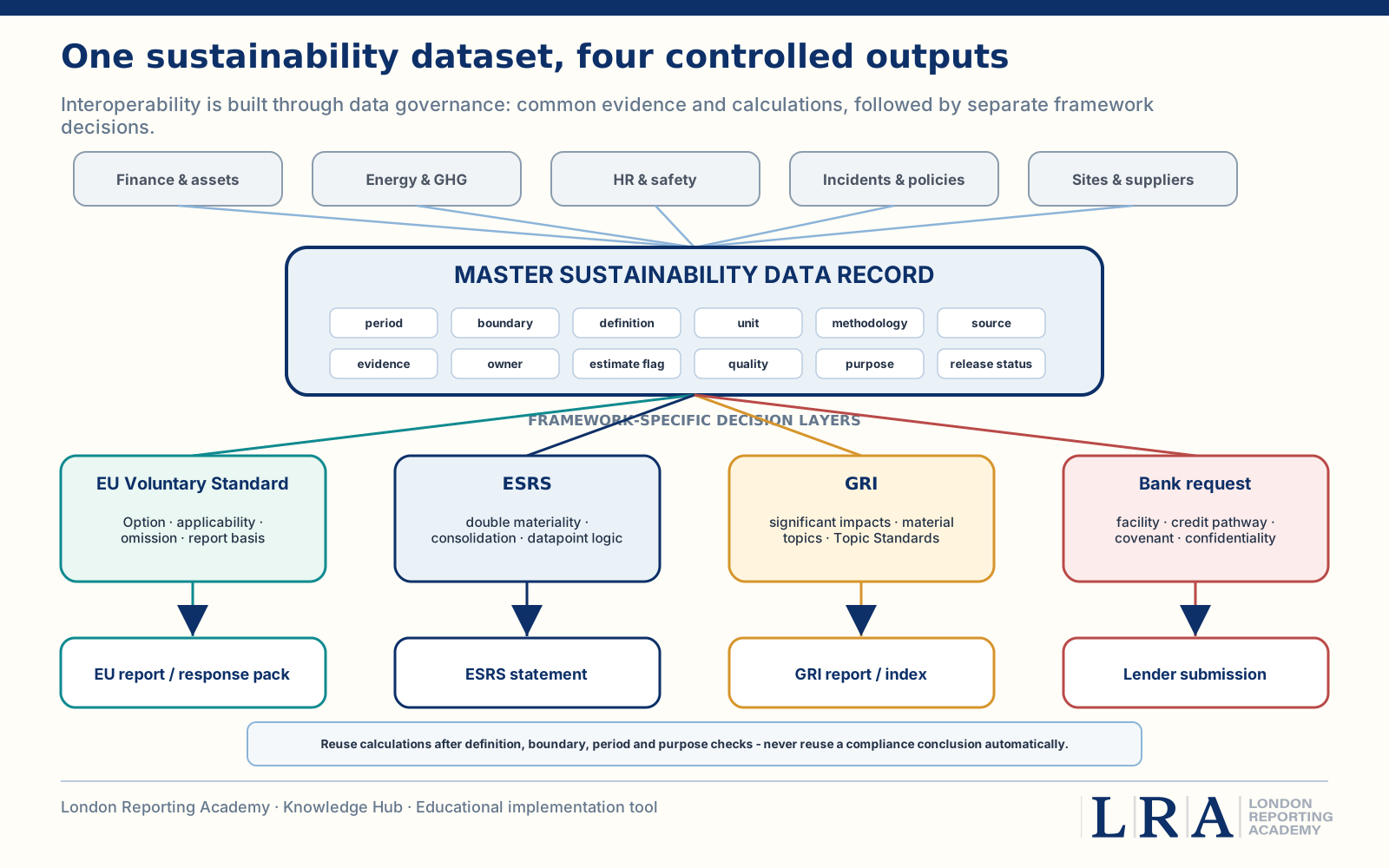
LRA master data architecture: one evidence layer, controlled calculations, separate decision layers and distinct outputs.
Rule
CORE PRINCIPLE
Reuse source evidence and controlled calculations. Re-perform framework decisions. Do not reuse a materiality, applicability or compliance conclusion merely because the underlying figure is the same.
In practice
The four-layer master data model
| Layer | What it contains | Control objective |
|---|---|---|
| 1. Source and evidence | Invoices, meter exports, payroll records, incident logs, policies, certificates, contracts, site data and approved management records. | Prove origin, period, completeness, access rights and retention. |
| 2. Controlled calculation | Validated source inputs, calculation logic, conversion factors, estimates, consolidation, quality score and reviewer sign-off. | Produce a reproducible metric independent of the final report. |
| 3. Reporting decision | Framework version, applicability/materiality result, reporting boundary, required granularity, permitted omission, narrative context and claim status. | Prevent one framework’s decision from silently becoming another framework’s conclusion. |
| 4. Output and release | EU report, ESRS sustainability statement, GRI report/content index, bank response, tender pack or internal dashboard. | Apply purpose, confidentiality, approval, version and publication controls. |
In practice
Minimum fields for every reusable data record
| Field group | Recommended fields | Why it matters |
|---|---|---|
| Identity | Record ID; metric name; source system; legal entity; site; activity; product or value-chain segment. | Makes the record findable and prevents entity or activity mix-ups. |
| Period | Start date; end date; snapshot date; frequency; financial-year mapping; comparative period. | A bank application date, GRI reporting period and ESRS financial year may not be identical. |
| Boundary | Individual/consolidated; included entities; operational/financial control; value-chain reach; exclusions; consolidation method. | A shared label such as “group emissions” can hide materially different perimeters. |
| Definition | Formal metric definition; unit; numerator; denominator; classification; framework version; internal data-dictionary version. | Prevents inconsistent use of terms such as employee, accident, renewable energy or waste diverted. |
| Methodology | Formula; source hierarchy; estimation method; conversion and emission factors; assumptions; allocation; restatement rule. | Allows recalculation and controlled adjustment without reconstructing the method. |
| Evidence | Source file link; evidence type; owner; evidence date; reviewer; review outcome; access level; retention date. | Supports internal review, external assurance and counterparty challenge. |
| Quality and limitations | Primary/secondary data; estimated share; uncertainty; completeness; known gap; improvement action. | A reusable metric needs transparent limitations, not false precision. |
| Purpose and mapping | EU/ESRS/GRI/bank output; disclosure or question ID; use purpose; user; confidentiality; permitted onward sharing. | The same value may be lawful and useful for one purpose but not approved for another. |
| Governance | Preparer; data owner; approver; version; change reason; release status; superseded record. | Stops draft or stale data from entering a live report or tender response. |
In practice
What must remain separate
| Decision | EU Voluntary Standard | ESRS — GRI — Bank request |
|---|---|---|
| Topic selection | Module architecture, “if applicable” conditions, voluntary and sector-specific information. | Double materiality and ESRS disclosure logic under the applicable edition. — Significant impacts and material topics; relevant Sector and Topic Standards. — Information needed for the credit, investment, regulatory or commercial purpose. |
| Boundary | Individual or consolidated basis disclosed; consolidated reporting recommended for a parent. | Reporting undertaking and value-chain information according to ESRS and the Accounting Directive. — Reporting organisation for organisational disclosures; impacts can extend through business relationships. — Borrower, guarantor, facility, collateral, project, group or portfolio — as defined by the bank. |
| Timing | Annual when counterparties require annual updates; period consistent with financial statements when prepared. | Financial-year sustainability statement and applicable comparative/transition requirements. — Chosen reporting period with GRI reporting-practice disclosures. — Application snapshot, covenant date, annual review, drawdown or event-triggered update. |
| Claim | Option A or Option B statement; selected C-disclosures do not equal full Option B. | Compliance follows applicable CSRD/ESRS law and statement architecture. — “In accordance” or “with reference” under GRI 1 conditions. — Usually no framework compliance claim; answer is scoped to the request and evidence. |
Hypothetical scenario
ILLUSTRATIVE MASTER RECORD
Record ENE-2026-014 contains 842 MWh of purchased electricity for 1 January–31 December 2026 for three named legal entities and five sites. The record stores utility invoices, a site completeness check, renewable-contract evidence, the conversion method, approver, estimate share and version. The calculation is approved once; each output then applies its own mapping and adjustment.
Illustrative only. It shows how the decision is made, not wording that can be copied or relied on.
In practice
Example: one energy calculation, four controlled outputs
| Output | Reuse | Residual work before release |
|---|---|---|
| EU Voluntary Standard B3 | Use total MWh and the required breakdown when the information is available. | Confirm Option, undertaking size, consolidated basis, period, whether the breakdown is available and B3 wording. |
| ESRS E1 | Use the same invoices and controlled totals where definitions and boundary align. | Apply the current ESRS energy definitions, materiality decision, required categories/disaggregation, value-chain rules and sustainability-statement controls. |
| GRI Energy disclosure | Use the source evidence and conversion table. | Apply the GRI Energy Standard effective for the period, reporting organisation boundary, topic materiality and required denominator/method disclosures. |
| Bank credit response | Use the approved energy total and site profile. | Add energy cost, price sensitivity, contract expiry, capex, covenant or collateral relevance where needed; specify snapshot date and permitted use. |
Controlled adjustments are a feature, not a failure
A mature system does not insist that every output display one identical number. It requires every difference to be explained. Legitimate adjustments include period alignment, currency or unit conversion, entity inclusion, activity-based allocation, market- versus location-based information, separate numerator/denominator definitions, site disaggregation, estimate updates and restatement of prior-period data. Each adjustment should point back to the controlled master record and create a new output version rather than overwrite the source calculation.
In practice
| Adjustment log field | Example |
|---|---|
| Parent record | GHG-2026-001 — approved group Scope 1 calculation |
| Output record | BANK-2026-CLIMATE-004 |
| Adjustment | Exclude a non-borrowing subsidiary and add collateral-site location |
| Reason | Credit request is for the borrowing subgroup and secured facility |
| Method | Entity filter using legal-entity register; no change to source emission factors |
| Reviewer | Group reporting owner and credit-response approver |
| Claim impact | Scoped bank response only; not used for the EU consolidated report |
Implementation steps
1. Inventory current outputs and questions. Collect report disclosures, questionnaires, covenant fields and recurring customer requests before designing the dataset.
2. Create the data dictionary. Define each metric, unit, period, boundary and owner; include the version of the relevant standard or question set.
3. Separate raw evidence from calculations. Preserve source files and immutable extracts; do not treat a manually edited report table as the source of truth.
4. Build calculation objects. Store inputs, formulas, factors, estimates, quality and approvals in a repeatable file or system.
5. Create framework decision records. Record applicability/materiality, required granularity, omissions, narrative context and claim status for each output.
6. Map, do not equate. Mark relations as direct, supporting, reusable with adjustment, or not reusable; document residual differences.
7. Introduce release controls. Purpose, recipient, confidentiality, version, legal/privacy review and onward-sharing permissions belong at output level.
8. Reconcile annually. Compare report totals, financial statements, prior periods, bank responses and website claims; investigate differences before release.
Hypothetical scenario
ILLUSTRATIVE SCENARIO
A logistics SME maintains one workforce register with employees by contract type, gender, location and FTE/headcount status. The EU report uses the fields required by B8 and B10. ESRS reporting by its parent customer uses a supplier-data extract with a different value-chain purpose. The SME’s GRI report assesses which workforce impacts are significant and may need broader contractor information. A bank asks for headcount trend, turnover, fatalities and industrial-action exposure for a refinancing decision. The shared register reduces duplicate collection, but four mapping records preserve the different population, period, use purpose and disclosure claim.
Illustrative only. It shows how the decision is made, not wording that can be copied or relied on.
Common mistakes
A single “ESG value” column. Without boundary, period and definition, reuse becomes guesswork.
Mapping only disclosure names. Similar titles do not prove identical definitions, units, populations or materiality.
Overwriting the master record for a bank response. Purpose-specific adjustments should create a child record with an audit trail.
One confidentiality flag for all uses. Public reporting, customer due diligence and restricted lender evidence have different release permissions.
Treating the bank questionnaire as a standard. A questionnaire can mix regulatory, credit, marketing and product-compliance purposes.
Allowing the report designer to become the data owner. Publication formatting should never replace source ownership and calculation review.
Claiming cross-framework compliance from a mapping table. Mapping supports efficiency; it does not perform the missing assessments or approvals.
Readiness
Master dataset readiness checklist
- Every metric has a stable ID and current definition.
- Period and snapshot dates are explicit.
- Entity, site, activity and value-chain boundaries are traceable.
- Methodology, factors, estimates and assumptions are versioned.
- Evidence links work and access levels are assigned.
- Data owner, preparer, reviewer and approver are distinct where risk warrants.
- Framework mappings include residual differences and source editions.
- Materiality/applicability decisions are stored separately from calculations.
- Purpose, recipient, confidentiality and onward-sharing conditions are recorded.
- Output claims and release approvals are controlled independently.
Self-check
- Which fields make a metric reusable even when the final reported value changes?
- Why should a materiality conclusion never be stored as an inherent property of the raw datapoint?
- What is the difference between a common data field and a common reporting requirement?
Questions
Questions people ask
Can one spreadsheet satisfy every sustainability framework?
Teams often begin with a spreadsheet that contains values such as electricity consumption, Scope 1 emissions, workforce headcount and accident rate. The values may be correct and still be unusable across reporting outputs because the file does not show which entity, site, period, unit, definition or methodology each value represents.
Should the same number appear in every report?
A mature system does not insist that every output display one identical number. It requires every difference to be explained.
Can materiality be reused across ESRS and GRI?
Reuse source evidence and controlled calculations. Re-perform framework decisions. Do not reuse a materiality, applicability or compliance conclusion merely because the underlying figure is the same.
How should bank-specific data be stored?
Yes — one controlled sustainability dataset can support the EU Voluntary Standard, ESRS, GRI and bank requests, but only when the dataset stores more than a number. Each record should preserve the period, boundary, definition, methodology, evidence, owner, review status and intended purpose.
Does a crosswalk prove compliance?
Mapping supports efficiency; it does not perform the missing assessments or approvals. Similar titles do not prove identical definitions, units, populations or materiality.
Take it with you
The checklists as a working spreadsheet
Every checklist and table on this page, with empty status, owner and evidence columns for your team to fill in and keep.
✓ Knowledge Hub AI Assistant · Human-in-the-loop

Ask about this guide
It answers from this page, and reaches into the linked disclosure cards when your question is about the standard itself.
Go deeper · EU Voluntary Standard 2026
Certified VSME Sustainability Reporting (EU Voluntary Standard for SMEs)
This page settles one datapoint. The VSME course turns the EU voluntary standard into a proportionate reporting process for a non-listed SME, on your own data.
Available as Guided Flex, Live Cohort, 1:1 Expert Mentorship or Corporate Programme.