Short answer
The answer, before the reasoning
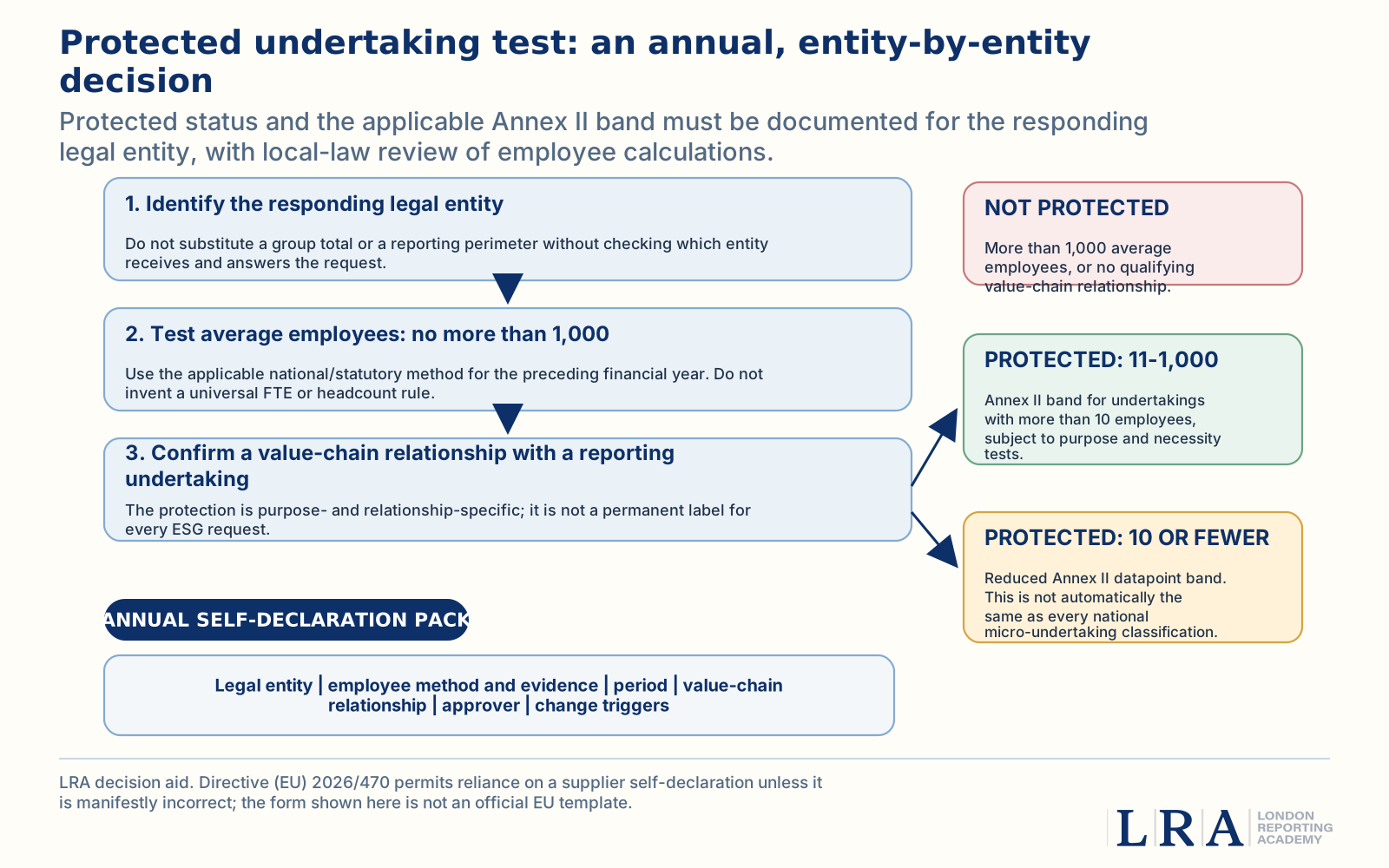
A company is a protected undertaking only if the specific responding undertaking is in the value chain of a CSRD reporting undertaking and does not exceed an average of 1,000 employees during the preceding financial year on its balance sheet date. The status should be documented for the correct legal entity through a dated self-declaration supported by the employee calculation, accounts or payroll evidence, value-chain relationship and reporting period.
An undertaking with 10 employees or fewer receives the smaller Annex II cap. Voluntary use of the Standard, micro-undertaking status and group reporting are separate questions. Reassess the declaration annually and after material restructurings or changes to the legal entity, workforce or request purpose.
Employee threshold, legal entity, value-chain relationship, self-declaration, group questions and annual reassessment
Why this question matters
The right to decline above-cap information depends on protected-undertaking status. An informal statement such as 'we are an SME' is not enough: the EU test uses an employee threshold, a preceding-financial-year period and a value-chain relationship. It does not use turnover as a cap criterion.
The test can become difficult for groups, recently acquired companies, seasonal workforces and entities close to 10 or 1,000 employees. The safest approach is to document the exact legal entity, method, evidence, period and uncertainty rather than applying a group label without analysis.
Quick orientation
Quick orientation
- Applies to
- Any undertaking receiving or expecting a CSRD-related sustainability request from a value-chain partner.
- Primary decision
- Whether the respondent meets both the employee and value-chain criteria, and which Annex II employee band applies.
- Key source
- Directive (EU) 2026/470 - amended Articles 19a(3) and 29a(3).
- Common confusion
- Assuming that every company outside CSRD or every company using the Voluntary Standard is automatically a protected undertaking.
Technical status
CURRENT LEGAL STATUS
Current legal status at 24 September 2026. The European Commission adopted C(2026) 5011 on 3 July 2026. It was published in the Official Journal on 21 September 2026 as Commission Delegated Regulation (EU) 2026/1560 and entered into force on 24 September 2026. Its value-chain-cap article applies for financial years beginning on or after 1 January 2027. Directive (EU) 2026/470 is in force at EU level, but Member States have until 19 March 2027 to transpose the relevant reporting amendments. Confirm the current national-law position before relying on a statutory right, prohibition or formal compliance statement.
In practice
Voluntary reporting eligibility and protected status are different
| Question | What it decides |
|---|---|
| Can the undertaking use the Voluntary Standard? | Whether it can prepare a voluntary report under Annex I. The Standard is principally intended for undertakings outside mandatory CSRD and up to 1,000 employees. |
| Is it a protected undertaking? | Whether it is in the value chain of a reporting undertaking and satisfies the employee threshold, so the statutory cap mechanism can apply to a qualifying request. |
| Which Annex II band applies? | Whether the undertaking has 10 employees or fewer, or more than 10 up to 1,000, for the datapoint ceiling. |
| Must it provide information? | A separate question. The cap itself does not impose a reporting duty; contract and other law must be reviewed. |
Protected undertaking test
Figure 3. Protected-undertaking status is tested for the responding undertaking, its value-chain relationship and its preceding-year average employee count. The 10-employee band is a separate Annex II classification.
In practice
| Step | Test | Evidence and judgement |
|---|---|---|
| 1 | Identify the responding undertaking. | Record legal name, registration number, registered office and the entity that received the request or is party to the contract. |
| 2 | Identify the reporting undertaking. | Confirm the ultimate customer or group entity required to report under Article 19a or 29a; do not rely only on a platform name. |
| 3 | Evidence the value-chain relationship. | Contract, purchase order, supplier record, customer relationship, investment or other documented business relationship. |
| 4 | Fix the balance sheet date and preceding financial year. | Use the respondent's relevant financial year and retain the approved period definition. |
| 5 | Calculate the average number of employees. | Apply the relevant national accounting/company-law methodology, reconcile HR/payroll records and document treatment of part-time, temporary and seasonal workers. |
| 6 | Apply the 1,000 threshold. | 1,000 or fewer meets the employee limb; more than 1,000 does not. Record any estimation or borderline uncertainty. |
| 7 | Apply the 10-employee band. | 10 or fewer receives the smaller Annex II cap; 11-1,000 receives the larger Annex II cap. |
| 8 | Issue a self-declaration and obtain approval. | Signed declaration, preparer/reviewer, calculation file, evidence references and validity period. |
| 9 | Reassess annually and on trigger events. | New declaration or documented confirmation that the status remains current. |
Rule
EMPLOYEE CALCULATION CAUTION
The cap provisions use 'average number of employees during the preceding financial year' but do not set a universal EU calculation formula in the delegated act. National accounting law and the methodology used for statutory accounts may be decisive. Do not substitute a year-end headcount or an FTE number without documenting why it is the legally appropriate measure.
How to handle group questions
The directive defines a protected undertaking as 'an undertaking' and permits a self-declaration from an undertaking in the value chain. It does not state a universal rule in the cap text that automatically aggregates every employee in the respondent's wider group. Group size should therefore not be assumed to answer the test without identifying the legal entity and applicable national implementation.
In practice
| Situation | Controlled approach |
|---|---|
| A subsidiary receives the request and holds the contract. | Test the subsidiary as the responding legal entity, then obtain legal review of any national group-aggregation rule or anti-avoidance provision. |
| The request is addressed to the parent for group-wide data. | Identify whether the parent or consolidated group is the undertaking responding and whether data are required from individual subsidiaries. |
| A consolidated voluntary report already exists. | Do not assume its reporting basis determines protected status. B1 individual/consolidated reporting is a separate voluntary-reporting choice. |
| A restructuring occurred after year-end. | Use the statutory preceding-year test but disclose the change in the self-declaration where it may make reliance misleading. |
Micro-undertaking and 10-employee treatment
Annex II gives extra protection to undertakings with 10 employees or fewer by excluding several environmental and Comprehensive datapoints from their cap. This employee-band rule should not be treated as identical to the Accounting Directive's formal micro-undertaking classification, which can involve other criteria. For the value chain cap, document the employee band directly.
In practice
Self-declaration template fields
| Field | Required content |
|---|---|
| Responding undertaking | Legal name, registration number, legal form, registered office and contact. |
| Request context | Reporting undertaking/customer, platform if any, request reference and stated purpose. |
| Balance sheet date | Date on which the threshold is assessed. |
| Preceding financial year | Start and end dates used for the average. |
| Average employees | Number, methodology, units and evidence references. |
| Size band | 10 or fewer; 11-1,000; or more than 1,000. |
| Value-chain relationship | Nature of the relationship and supporting contract or supplier/customer record. |
| Declaration | Statement that the undertaking meets or does not meet the definition, subject to stated assumptions. |
| Known changes | Acquisition, disposal, merger, major workforce change or other event relevant to reliance. |
| Approval | Name, role, signature/date, reviewer and validity/reassessment date. |
Hypothetical scenario
ILLUSTRATIVE SELF-DECLARATION
[Legal entity] declares that, on its balance sheet date of [date], it did not exceed an average of 1,000 employees during the preceding financial year [period] and is in the value chain of [reporting undertaking] through [relationship]. Its calculated average was [number] using [method]. It therefore considers itself a protected undertaking for the stated request, subject to current national implementation and the assumptions listed in this declaration.
Illustrative only. It shows how the decision is made, not wording that can be copied or relied on.
In practice
Hypothetical examples
| Facts | Conclusion and limitation |
|---|---|
| A standalone supplier averaged 420 employees in the preceding year and supplies a CSRD reporting customer. | It meets the employee and value-chain limbs and can issue a protected-undertaking self-declaration, subject to national implementation. |
| A supplier averaged exactly 1,000 employees. | The wording is 'does not exceed 1,000', so it meets the employee limb. Calculation evidence should be especially robust. |
| A supplier averaged 1,006 employees but has turnover below the CSRD threshold. | It may be outside mandatory CSRD but is not protected by the cap's employee criterion. |
| A 90-employee subsidiary belongs to a 1,600-employee group. | Do not decide solely from group size. Identify the responding undertaking and obtain national-law advice on aggregation before claiming protection. |
| An undertaking averaged 9 employees but had 14 at year-end. | The preceding-year average drives the EU test, not the snapshot alone. The method and current change should be disclosed. |
In practice
Weak versus stronger self-declaration
| Weak | Stronger |
|---|---|
| “We are an SME and therefore protected.” | Identifies the legal entity, value-chain relationship, preceding-year average, method, size band and approval. |
| Uses year-end headcount without explaining the average. | Shows the calculation period, data source, treatment of workforce categories and reconciliation. |
| Relies on group turnover or SME classification. | Uses the employee test prescribed for the cap and documents group uncertainty separately. |
| Declaration has no expiry or update process. | Includes validity period, annual reassessment and event-driven triggers. |
Annual reassessment triggers
New balance sheet date or completed financial year.
Average workforce approaches 10 or 1,000 employees.
Acquisition, disposal, merger, demerger or change in the contracting legal entity.
Significant seasonal, temporary or agency-labour changes that affect the calculation method.
A new reporting undertaking, customer group or procurement platform relies on the declaration.
Change in the stated purpose of the data request.
Member State transposition or official guidance changes the calculation or group approach.
The reporting undertaking knows or can reasonably be expected to know that the declaration may be manifestly incorrect.
Common mistakes
Testing the entire corporate group without first identifying the responding undertaking.
Using turnover, SME classification or CSRD scope as a substitute for the cap's employee test.
Using current headcount instead of the preceding-year average without analysis.
Ignoring the special 10-employee Annex II band.
Issuing a declaration without a value-chain relationship or request context.
Failing to disclose a post-year-end restructuring that could make reliance misleading.
Treating the self-declaration as permanent rather than an annually controlled record.
In practice
| MYTH | Any company outside mandatory CSRD is automatically a protected undertaking. |
|---|---|
| REALITY | Protected status requires both a qualifying employee count and a value-chain relationship with a reporting undertaking. Some companies may be outside CSRD but exceed 1,000 employees; others may use the Voluntary Standard without currently being in the value chain of a CSRD reporter. |
Readiness
Protected-status readiness checklist
- The responding legal entity is identified and matches the request or contract.
- The ultimate CSRD reporting undertaking is identified.
- The value-chain relationship is evidenced.
- The balance sheet date and preceding financial year are fixed.
- The average-employee method is consistent with applicable national rules and documented.
- The calculation is reconciled to payroll, HR and/or statutory accounts.
- The 10/1,000 employee band is correct.
- Group questions and post-year-end changes are disclosed and reviewed.
- The declaration is signed, dated, versioned and stored with evidence.
- An annual and event-driven reassessment process is assigned.
In practice
Related requirements and next steps
| Relation | Reference | Why it matters |
|---|---|---|
| Direct | Directive (EU) 2026/470 protected-undertaking definition | Employee test, value-chain relationship and self-declaration reliance. |
| Direct | C(2026) 5011 Annex II | Determines the separate 10-or-fewer and more-than-10 caps. |
| Comparison | B1 individual or consolidated reporting | A reporting-basis choice, not a substitute for protected-status analysis. |
| Next step | EU Value Chain Cap Explained | Classify requested datapoints after protected status is documented. |
| Next step | Can a Supplier Refuse an ESG Data Request? | Use the declaration in a controlled response. |
Questions
Questions people ask
What is a protected undertaking?
The directive defines a protected undertaking as 'an undertaking' and permits a self-declaration from an undertaking in the value chain. It does not state a universal rule in the cap text that automatically aggregates every employee in the respondent's wider group.
Is the threshold 1,000 employees or turnover?
An informal statement such as 'we are an SME' is not enough: the EU test uses an employee threshold, a preceding-financial-year period and a value-chain relationship. It does not use turnover as a cap criterion.
Does group headcount count?
The directive defines a protected undertaking as 'an undertaking' and permits a self-declaration from an undertaking in the value chain. It does not state a universal rule in the cap text that automatically aggregates every employee in the respondent's wider group.
What evidence supports a self-declaration?
A company is a protected undertaking only if the specific responding undertaking is in the value chain of a CSRD reporting undertaking and does not exceed an average of 1,000 employees during the preceding financial year on its balance sheet date. The status should be documented for the correct legal entity through a dated self-declaration supported by the employee calculation, accounts or payroll evidence, value-chain relationship and reporting period.
How often should it be updated?
Reassess the declaration annually and after material restructurings or changes to the legal entity, workforce or request purpose. The safest approach is to document the exact legal entity, method, evidence, period and uncertainty rather than applying a group label without analysis.
Sources
Primary sources
- Directive (EU) 2026/470 (Omnibus I)
- Commission Delegated Regulation C(2026) 5011 final of 3 July 2026 - main act — published as Delegated Regulation (EU) 2026/1560 (OJ, 21 September 2026)
- Annexes 1 and 2 to Commission Delegated Regulation C(2026) 5011 final — published as Delegated Regulation (EU) 2026/1560 (OJ, 21 September 2026)
- European Commission adoption announcement, 3 July 2026
- Commission Staff Working Document SWD(2026) 500 final
Take it with you
The checklists as a working spreadsheet
Every checklist and table on this page, with empty status, owner and evidence columns for your team to fill in and keep.
✓ Knowledge Hub AI Assistant · Human-in-the-loop

Ask about this guide
It answers from this page, and reaches into the linked disclosure cards when your question is about the standard itself.
Go deeper · EU Voluntary Standard 2026
Certified VSME Sustainability Reporting (EU Voluntary Standard for SMEs)
This page settles one datapoint. The VSME course turns the EU voluntary standard into a proportionate reporting process for a non-listed SME, on your own data.
Available as Guided Flex, Live Cohort, 1:1 Expert Mentorship or Corporate Programme.