Short answer
The answer, before the reasoning
The value chain cap is a purpose-specific upper limit, not a general ban on ESG questions and not a duty for suppliers to report. A request is potentially within the cap only where a CSRD reporting undertaking seeks information for its sustainability reporting, the respondent is a protected undertaking in its value chain, the datapoint is listed in Annex II for the respondent's employee band, and the information is necessary.
A CSRD-related request beyond Annex II may still be made, but the protected undertaking must be told which items exceed the cap and that it has a statutory right to decline them. Requests for lending, due diligence, product compliance or other purposes sit outside this cap and must be assessed under their own legal or contractual basis.
Protected undertakings, Annex II, necessity, within-cap and above-cap requests, supplier rights and practical examples
Why this question matters
Supplier questionnaires often mix several purposes in one spreadsheet: customer CSRD reporting, supplier due diligence, tender scoring, product traceability and financing. The legal treatment cannot be determined from the datapoint alone. The same emissions figure may be within the cap for one request, above the cap for a very small supplier, or outside the cap because the bank needs it for credit assessment.
The cap also does not mean that a reporting undertaking should ask for the maximum Annex II set. The EU text requires reporting undertakings to request information only insofar as necessary and to request less than the maximum where they do not need all of it.
Quick orientation
Quick orientation
- Applies to
- Requests from undertakings reporting under Accounting Directive Articles 19a or 29a to protected undertakings in their value chains.
- Primary decision
- Whether each request line is within the Annex II ceiling, above it, or outside the cap because the purpose or parties differ.
- Key sources
- Directive (EU) 2026/470, C(2026) 5011 Articles 1-4, Annex II, and the Commission's May 2026 Q&A.
- Common confusion
- Treating the complete Voluntary Standard as the cap. The cap is the specific list in Annex II, with a smaller list for undertakings with 10 employees or fewer.
Technical status
CURRENT LEGAL STATUS
Current legal status at 24 September 2026. The European Commission adopted C(2026) 5011 on 3 July 2026. It was published in the Official Journal on 21 September 2026 as Commission Delegated Regulation (EU) 2026/1560 and entered into force on 24 September 2026. Its value-chain-cap article applies for financial years beginning on or after 1 January 2027. Directive (EU) 2026/470 is in force at EU level, but Member States have until 19 March 2027 to transpose the relevant reporting amendments. Confirm the current national-law position before relying on a statutory right, prohibition or formal compliance statement.
In practice
Key concepts
| Term | Working meaning |
|---|---|
| Reporting undertaking | An undertaking required to report sustainability information under Article 19a or 29a. |
| Protected undertaking | An undertaking in the reporting undertaking's value chain that does not exceed an average of 1,000 employees during the preceding financial year. |
| Annex II | The exhaustive datapoint list that sets the cap, with separate columns for undertakings with 10 employees or fewer and those with more than 10 employees. |
| Within-cap request | A necessary CSRD-reporting request for an Annex II datapoint applicable to the protected undertaking's employee band. |
| Above-cap request | A CSRD-reporting request for information not listed in the relevant Annex II column, or for greater detail than the listed datapoint. |
| Outside-cap request | A request that is not for CSRD reporting, is not from/for a reporting undertaking, concerns a respondent that is not protected, or relies on another legal purpose. |
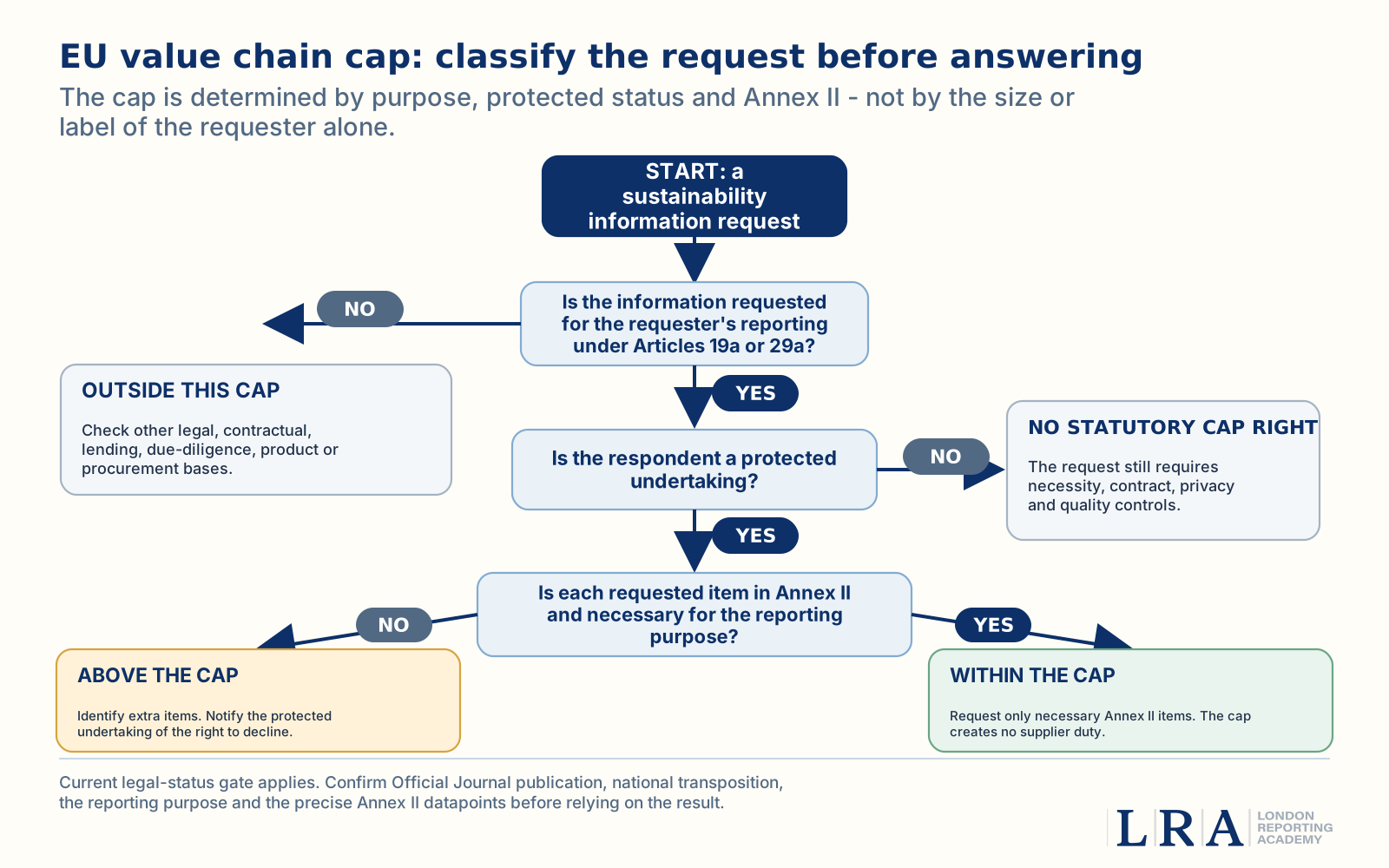
Line-by-line decision tree
Figure 2. The value chain cap is triggered by the requester, purpose, protected status, employee band, Annex II and necessity. Failure at an earlier gate usually means the request is outside this cap, not automatically prohibited.
In practice
| Step | Question | Classification and evidence |
|---|---|---|
| 1 | Who is the ultimate requester? | Confirm whether the information is sought by or for an undertaking required to report under Article 19a or 29a. Record legal name and role. |
| 2 | What is the exact purpose? | The statutory cap applies only to information gathering for sustainability reporting under the Accounting Directive. Obtain a written purpose statement. |
| 3 | Is the respondent in the reporting undertaking's value chain? | Document the supplier, customer, investee or other business relationship. If not, protected-undertaking status is not established under this mechanism. |
| 4 | Does the respondent exceed 1,000 average employees in the preceding financial year? | If no, it can be a protected undertaking. If yes, the cap protection does not apply. Retain a self-declaration and supporting calculation. |
| 5 | Which Annex II employee band applies? | Use the smaller column for 10 employees or fewer; use the more-than-10 column for 11-1,000 employees. |
| 6 | Is the requested datapoint listed in that column? | If yes, it is potentially within the cap. If no, it is above the cap for a CSRD-reporting request. |
| 7 | Is the information genuinely necessary for the reporting undertaking's CSRD reporting? | The cap is a ceiling, not an entitlement to the whole list. Record the ESRS/reporting use and required granularity. |
| 8 | Does another law, contract or purpose apply? | A separate legal or contractual basis may operate. Classify it outside this cap and review it independently. |
Annex II locator: what is inside the cap
The table below paraphrases the Commission-adopted Annex II. An X means the datapoint is in the cap for that employee band. Absence of an X means the datapoint is above the cap for a CSRD-reporting request to that protected undertaking; it does not mean that the information can never be requested for another purpose.
In practice
| Reference and datapoint | 10 employees or fewer | More than 10 employees |
|---|---|---|
| B1 27(a): selected module option | X | X |
| B1 27(c): individual or consolidated reporting basis | X | X |
| B1 27(e)(i)-(vii): general undertaking information | X | X |
| B3 32: total energy consumption in MWh | - | X |
| B3 33: estimated absolute gross Scope 1 and location-based Scope 2 GHG emissions | - | X |
| B6 36: total water withdrawal | - | X |
| B7 38: whether and how circular-economy principles are applied | - | X |
| B7 39(a): waste generated, hazardous/non-hazardous breakdown | - | X |
| B7 39(b): proportion of waste diverted to recycling or reuse | - | X |
| B8 40(a): employee numbers by contract type | X | X |
| B8 40(b): employee numbers by gender | X | X |
| B9 41(a): number and rate of recordable work-related accidents | X | X |
| B10 42(a): pay at or above applicable minimum wage | X | X |
| B10 42(c): percentage covered by collective bargaining | X | X |
| B10 42(d): average annual training hours per employee | X | X |
| C1 46(a): significant product/service groups | - | X |
| C1 46(b): significant markets | - | X |
| C1 46(c): main business relationships | - | X |
| C5 58: employee turnover rate | - | X |
| C6 61(a): code of conduct or human-rights policy | - | X |
| C6 61(c): workforce complaints-handling mechanism | - | X |
| C7 62(a): confirmed incidents in own workforce | - | X |
| C7 62(c), first sentence: confirmed incidents involving value-chain workers, communities, consumers or end-users | - | X |
Necessity is an additional filter
Annex II is the maximum permitted requirement for the relevant band. It is not a standard supplier questionnaire that every CSRD reporter should circulate. A reporting undertaking should connect each request to a reporting need, ask for less than the cap where less is sufficient, and use estimates where appropriate under its reporting framework rather than transferring unnecessary work to the supplier.
In practice
| Request design question | Evidence of a proportionate request |
|---|---|
| Which ESRS or disclosure use requires this information? | A documented reporting use, material matter or value-chain calculation. |
| Why is supplier-specific information needed? | Explanation of why internal information, estimates or sector data are insufficient. |
| What granularity is necessary? | Requested unit, period, boundary and calculation method limited to the reporting need. |
| Can fewer datapoints or a phased request work? | A reduced request, sampling strategy or alternative evidence route. |
In practice
Rights and obligations around the cap
| Rule | Practical consequence |
|---|---|
| Self-declaration | A reporting undertaking may rely on a supplier's protected-undertaking self-declaration unless it knows, or can reasonably be expected to know, that it is manifestly incorrect. |
| Right to decline above-cap information | A protected undertaking may decline information exceeding Annex II when the request is made for CSRD sustainability reporting. |
| Notification duty | If a reporting undertaking asks for above-cap information directly or indirectly, it must identify the extra information and inform the protected undertaking of its statutory right to decline. |
| Contract protection | In arrangements established for CSRD reporting, a clause requiring above-cap information is not binding; the rest of the contract remains binding. |
| No supplier duty created by the cap | The cap itself does not impose or imply an obligation on a value-chain undertaking to provide sustainability information. |
| Other purposes unaffected | Requests for due diligence or other Union/national-law purposes remain subject to their own rules. |
In practice
Practical examples
| Scenario | Classification | Reason |
|---|---|---|
| A CSRD-reporting manufacturer asks its 120-employee supplier for total energy and Scope 1/2 emissions needed for its value-chain reporting. | Potentially within cap | B3 energy and GHG datapoints are listed for undertakings with more than 10 employees; necessity must still be documented. |
| The same customer asks the 120-employee supplier for a full Scope 3 inventory and detailed transition plan for CSRD reporting. | Above cap | Scope 3 is a sector consideration and the transition-plan detail is not listed in Annex II. |
| A CSRD-reporting customer asks an 8-employee supplier for water withdrawal and GHG emissions. | Above cap | Those environmental datapoints are not in the Annex II column for undertakings with 10 employees or fewer. |
| A buyer asks for traceability data required by separate product-compliance law. | Outside this cap | The purpose is not CSRD sustainability reporting; the separate legal regime must be reviewed. |
| A bank asks a borrower for emissions for credit-risk assessment. | Outside this cap | The purpose is lending, although the delegated-act recital encourages financial institutions to limit requests as far as possible to Annex I. |
In practice
Weak versus stronger request wording
| Weak request | Stronger request |
|---|---|
| “Complete our ESG questionnaire. All fields are mandatory.” | States the ultimate requester, CSRD-reporting purpose, protected-undertaking assessment and whether each line is within or above Annex II. |
| A platform bundles CSRD, due-diligence and tender questions with no purpose labels. | Each datapoint has a purpose code, legal basis, required/voluntary status and contact for clarification. |
| The whole Annex II list is sent to every supplier. | Only the datapoints necessary for the reporting use are requested, with proportional granularity. |
| Above-cap items are hidden among required fields. | Above-cap items are clearly marked and the supplier is informed of its right to decline. |
Common mistakes
Using the entire Basic and Comprehensive Modules as the cap instead of Annex II.
Ignoring the special Annex II column for undertakings with 10 employees or fewer.
Classifying a request by datapoint without documenting the purpose.
Assuming an indirect platform request avoids the notification duty.
Treating within-cap as automatically mandatory for the supplier.
Using the cap to reject a request based on another Union or national-law obligation.
Failing to record why supplier-specific information is necessary rather than estimated.
In practice
| MYTH | The cap means a large company can require every datapoint in Annex II from every |
|---|---|
| REALITY | Annex II is an upper limit for a qualifying CSRD-reporting request. The reporting undertaking should request only information it needs, and the cap does not itself create a duty for the supplier to provide even within-cap information. Existing contracts or other legal obligations must be reviewed separately. |
Readiness
Requester pre-issue checklist
- Identify the ultimate CSRD reporting undertaking and its reporting obligation.
- State the purpose for every request line.
- Obtain or refresh the supplier's protected-undertaking self-declaration.
- Apply the correct Annex II employee band.
- Map each requested field to the exact Annex II reference or mark it above/outside the cap.
- Document why the field and requested granularity are necessary.
- Mark above-cap items and provide the statutory right-to-decline notice.
- Separate due-diligence, lending, product and procurement purposes from CSRD reporting.
- Review contractual wording and platform settings for hidden mandatory fields.
- Retain the classification, notice and response record.
In practice
Related requirements and next steps
| Relation | Reference | Why it matters |
|---|---|---|
| Direct | Directive (EU) 2026/470 - amended Articles 19a(3) and 29a(3) | Protected status, self-declaration, right to decline, contracts, notice and other-purpose carve-out. |
| Direct | C(2026) 5011 Article 3 and Annex II | Defines the datapoint ceiling and employee bands. |
| Next step | Protected Undertaking Test | Document whether the respondent meets the employee and value-chain conditions. |
| Next step | Can a Supplier Refuse an ESG Data Request? | Translate classification into a legally and commercially controlled response. |
| Comparison | Banks, Customers and Procurement Platforms | Classify mixed-purpose requests and indirect collection channels. |
Annex II has one column for undertakings with 10 employees or fewer and another for protected undertakings with more than 10 and no more than 1,000 employees. The first covers selected B1 profile, B8 employee, B9 accident and B10 workforce datapoints. The second also covers selected B3 energy and emissions, B6 water, B7 circularity and waste, C1 business-model, C5 turnover, C6 policy and complaints and C7 confirmed-incident datapoints; consult the exact Annex II row because it is not the full Standard.
Questions
Questions people ask
What is the EU value chain cap?
The value chain cap is triggered by the requester, purpose, protected status, employee band, Annex II and necessity. Failure at an earlier gate usually means the request is outside this cap, not automatically prohibited.
Which datapoints are in Annex II?
Annex II has one column for undertakings with 10 employees or fewer and another for protected undertakings with more than 10 and no more than 1,000 employees. The first covers selected B1 profile, B8 employee, B9 accident and B10 workforce datapoints. The second also covers selected B3 energy and emissions, B6 water, B7 circularity and waste, C1 business-model, C5 turnover, C6 policy and complaints and C7 confirmed-incident datapoints; consult the exact Annex II row because it is not the full Standard.
Does the cap make supplier reporting mandatory?
The cap itself does not impose or imply an obligation on a value-chain undertaking to provide sustainability information. Requests for due diligence or other Union/national-law purposes remain subject to their own rules.
Does it apply to due diligence?
The value chain cap is a purpose-specific upper limit, not a general ban on ESG questions and not a duty for suppliers to report. Requests for lending, due diligence, product compliance or other purposes sit outside this cap and must be assessed under their own legal or contractual basis.
Sources
Primary sources
- Directive (EU) 2026/470 (Omnibus I)
- Commission Delegated Regulation C(2026) 5011 final of 3 July 2026 - main act — published as Delegated Regulation (EU) 2026/1560 (OJ, 21 September 2026)
- Annexes 1 and 2 to Commission Delegated Regulation C(2026) 5011 final — published as Delegated Regulation (EU) 2026/1560 (OJ, 21 September 2026)
- European Commission Q&A on the value chain cap, 6 May 2026
- European Commission adoption announcement, 3 July 2026
- Commission Staff Working Document SWD(2026) 500 final
Take it with you
The checklists as a working spreadsheet
Every checklist and table on this page, with empty status, owner and evidence columns for your team to fill in and keep.
✓ Knowledge Hub AI Assistant · Human-in-the-loop

Ask about this guide
It answers from this page, and reaches into the linked disclosure cards when your question is about the standard itself.
Go deeper · EU Voluntary Standard 2026
Certified VSME Sustainability Reporting (EU Voluntary Standard for SMEs)
This page settles one datapoint. The VSME course turns the EU voluntary standard into a proportionate reporting process for a non-listed SME, on your own data.
Available as Guided Flex, Live Cohort, 1:1 Expert Mentorship or Corporate Programme.