Short answer
The answer, before the reasoning
The most decision-useful information for a bank is not the longest list of ESG datapoints. It is information that helps the lender understand the borrower’s cash-flow resilience, operating-cost exposure, asset and collateral vulnerability, legal or incident risk, management capability and financing needs.
The EU Voluntary Standard provides a strong proportionate core through B1–B11 and selected or full Comprehensive disclosures, especially B3, B8–B11, C1, C3, C4 and C5–C9. Appendix C explains how selected datapoints connect to EU sustainable-finance and prudential information needs; it is not a universal credit score or a rule that every bank must request every field. A lending request is also not the same as a supplier request subject to the value chain cap.
Rule
EU-FIN-001
EU Voluntary Standard for Bank and Lender Requests: What Information Is Most Decision-Useful? How credit risk, energy and emissions, workforce, incidents, climate risks and governance information can support a lender — and what Appendix C does not do
In practice
Type
| Type | Tier | Audience — Current context |
|---|---|---|
| Finance user guide and response framework | Tier 3 — Deep guide | SME CFOs, relationship managers, credit teams, sustainability teams and advisers — EU Voluntary Standard as a proportionate information core for financing discussions |
Start from the credit decision, not the ESG questionnaire
A lender is usually trying to assess repayment capacity, uncertainty, collateral value, management quality and the conditions under which credit can be extended. Sustainability information becomes decision-useful when it is connected to one of those questions. A standalone emissions number can be relevant, but its value increases when the bank can see the energy-cost pathway, exposure to carbon-intensive activities, capex response, target credibility and effect on cash flows.
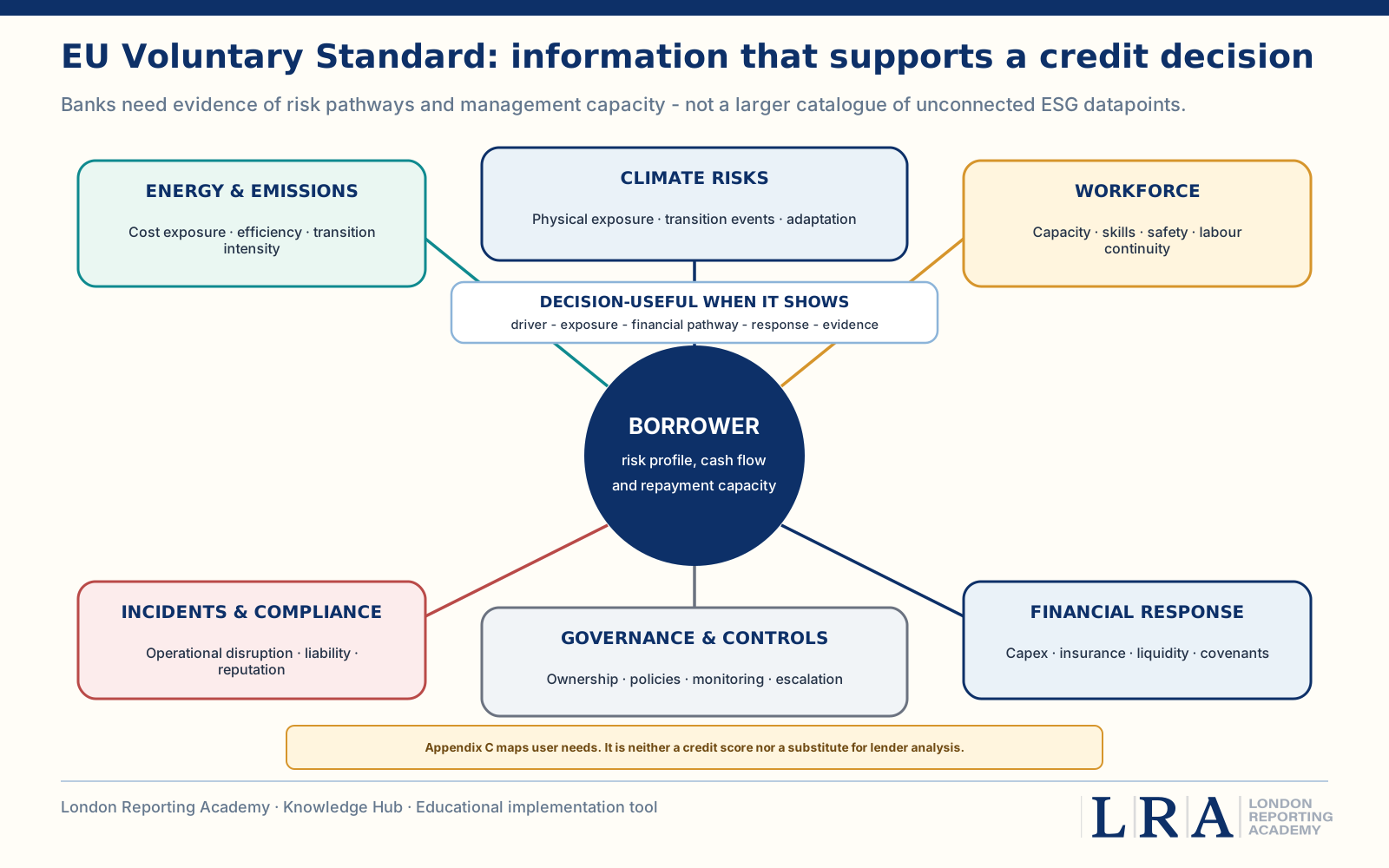
LRA credit-decision map: information is useful when it connects a sustainability driver to a borrower risk pathway and an evidence-backed management response.
Rule
PURPOSE BOUNDARY
The statutory EU value chain cap applies to information requests made for mandatory sustainability reporting under the Accounting Directive. A bank request for loan origination, credit monitoring or investment analysis is a different purpose. C(2026) 5011 nevertheless encourages financial institutions to limit such other-purpose requests, as far as possible, to Annex I information for undertakings with 1,000 employees or fewer.
In practice
Seven information blocks that usually matter most
| Information block | Relevant Voluntary Standard disclosures | Why a lender may find it decision-useful |
|---|---|---|
| Borrower identity and boundary | B1 | Legal form, NACE, turnover, assets, employee count, countries, sites and reporting basis help the bank match sustainability data to the borrower, group, facility and collateral. |
| Business model and relationships | C1 | Products, markets and key business relationships show concentration, customer dependency, supply-chain exposure and sensitivity to transition or disruption. |
| Energy and emissions | B3; C3 | Energy volume and mix, Scope 1 and 2, relevant Scope 3, targets and actions can inform operating-cost, carbon-price, technology, capex and market-access analysis. |
| Climate risks and adaptation | C4 | Hazards, transition events, exposed assets and activities, time horizons and adaptation actions support physical-risk, business-continuity, insurance and collateral review. |
| Workforce and safety | B8–B10; C5 | Headcount, contract type, turnover, accident rate, fatalities, pay, collective bargaining and training can signal capacity, productivity, disruption and operating-control risk. |
| Human-rights and conduct incidents | C6–C7; B11 | Policies, grievance mechanisms, confirmed incidents, corruption convictions and fines can affect legal exposure, licence to operate, counterparties and reputation. |
| Governance and implementation capacity | B2; C2; C8; C9 | Practices, policies, future initiatives, exposed revenue and governance diversity help the lender assess whether commitments are owned, funded and monitored. |
What Appendix C does
Appendix C is written for users of the sustainability report. It identifies selected Basic and Comprehensive datapoints that correspond to information needs under the Sustainable Finance Disclosure Regulation, EBA Pillar 3 rules and the Benchmark Regulation. For example, it connects site geolocation to physical-risk information, energy and GHG metrics to sustainable-finance indicators, climate targets and risks to transition and physical-risk templates, and workforce or human-rights datapoints to social indicators.
In practice
| Appendix C helps a user… | Appendix C does not… |
|---|---|
| Understand why a datapoint may recur in bank, investor or large-company requests. | Require every bank to collect every mapped datapoint from every borrower. |
| Relate selected disclosures to SFDR, EBA Pillar 3 and benchmark information needs. | Convert the Voluntary Standard into a credit-rating methodology or prudential reporting template. |
| See that a proportionate SME report can feed regulated users. | Establish that a datapoint is material to a particular facility or borrower. |
| Reduce unnecessary reinvention of definitions and evidence. | Remove the need for borrower, facility, collateral, geography, tenor or cash-flow analysis. |
| Support a common information baseline. | Create a legal obligation for the SME to answer a lending request. |
The lender usefulness test
1. Exposure: What activity, asset, location, workforce population or relationship is exposed?
2. Risk driver: Is the driver physical climate, transition, energy price, workforce capacity, safety, legal conduct or another sustainability factor?
3. Financial pathway: Could it affect revenue, cost, capex, working capital, asset value, insurance, access to markets or continuity?
4. Time horizon: Does the risk arise within the facility tenor, refinancing cycle or useful life of the collateral?
5. Management response: Is there an approved action, target, budget, control owner or adaptation measure?
6. Evidence and trend: Is the information current, comparable, methodologically clear and supported by records?
7. Decision use: Will the bank use it for approval, pricing, limit, covenant, monitoring, collateral, sustainability-linked terms or portfolio classification?
In practice
A practical bank response pack
| Pack component | Contents | Release control |
|---|---|---|
| 1. Basis and borrower profile | B1, reporting period, individual/consolidated basis, included entities, option, contact and version. | Finance owner confirms match to borrower and facility. |
| 2. Core sustainability report | Option A or Option B report with any permitted omissions and cross-references. | Reporting owner and data owners approve current version. |
| 3. Credit-risk supplement | Facility-specific energy cost, capex, cash-flow sensitivity, collateral location, insurance, customer concentration and covenant data. | Treasury/finance and legal approve purpose and confidentiality. |
| 4. Evidence index | Calculation files, invoices, HR reports, incident records, policies, certificates and board approvals. | Access is restricted; provide documents only where necessary. |
| 5. Limitations and improvement plan | Estimate shares, missing sites, unresolved Scope 3, scenario limitations and remediation dates. | Transparent wording; no unsupported assurance or completeness claim. |
| 6. Release record | Recipient, purpose, version, date, approved fields, onward-sharing condition and expiry. | Commercial owner and final approver sign off. |
In practice
Information by credit-risk pathway
| Credit-risk question | Decision-useful evidence | Weak response |
|---|---|---|
| Could energy transition pressure margins? | B3 energy and emissions; energy spend and contract profile; C3 actions and capex; product/customer exposure. | Only a total emissions number with no cost or business-model connection. |
| Could physical hazards disrupt operations or collateral? | B1 site geolocation; C4 hazard, exposure, sensitivity, horizon and adaptation; insurance and continuity plans. | A generic statement that climate change is a risk. |
| Is workforce capacity stable? | B8 headcount and contracts; C5 turnover; B9 safety; B10 training and bargaining; critical-skill data. | A diversity statement unrelated to operational capacity. |
| Could incidents create legal or reputation loss? | C6 policies and mechanisms; C7 confirmed incidents and response; B11 convictions/fines; legal status. | “No material incidents” without definition, period or evidence. |
| Can management execute the transition? | B2/C2 practices, policies and future initiatives; targets, owners, budgets, milestones and governance approvals. | A future ambition with no owner, funding or implementation record. |
Hypothetical scenario
ILLUSTRATIVE SCENARIO
A 320-employee food manufacturer seeks a five-year refinancing. Its Option B report shows energy use, Scope 1 and 2, accident rates, turnover, climate hazards and a reduction target. The lender does not request the entire Appendix C list. It focuses on gas-price exposure, flood risk at the collateral site, refrigeration capex, customer concentration, accident trend and the status of a prior environmental fine. The SME supplies the approved report plus a facility-specific addendum with energy spend, insurance, adaptation works and cash-flow sensitivity. The addendum is labelled for credit assessment only and is not published as part of the sustainability report.
Illustrative only. It shows how the decision is made, not wording that can be copied or relied on.
Common mistakes
Sending every datapoint because Appendix C mentions banks. The lender should request information linked to a decision, regulation or documented monitoring use.
Assuming the value chain cap applies to the loan. Lending and mandatory sustainability reporting are distinct purposes.
Confusing regulatory mapping with credit materiality. A datapoint can be relevant to Pillar 3 while immaterial to one small facility — or vice versa.
Providing a public report without a borrower/facility bridge. The bank may not know which entities or assets the data covers.
Hiding gaps to look creditworthy. Transparent estimates and remediation plans are usually more useful than unsupported precision.
Giving unrestricted access to evidence. Personal data, incidents, contracts and commercial information need necessity and release controls.
Using assurance language loosely. Assurance of selected emissions does not assure the whole bank response or credit addendum.
Readiness
Bank-request readiness checklist
- The bank, facility, borrower and purpose are identified.
- The reporting period and snapshot date are explicit.
- The EU report boundary is reconciled to the borrowing group and collateral.
- Each requested field has a credit, regulatory or monitoring use.
- Energy/emissions are linked to cost, capex, transition or market exposure where relevant.
- Climate risks identify assets, locations, time horizons and response actions.
- Workforce, safety and incident data use controlled populations and definitions.
- Policies and targets show owners, approval, implementation and limitations.
- Confidential evidence is shared only on a need-to-know basis.
- Public, lender-only and restricted information are clearly separated.
- The response does not make an unsupported Option B, assurance or IFRS claim.
Self-check
- Why is Appendix C not a standardised credit questionnaire?
- Which extra fields might a lender need beyond the EU report for a secured facility?
- How does request purpose change the relevance of the value chain cap?
Questions
Questions people ask
Which EU Voluntary Standard disclosures are most useful to banks?
The most decision-useful information for a bank is not the longest list of ESG datapoints. It is information that helps the lender understand the borrower’s cash-flow resilience, operating-cost exposure, asset and collateral vulnerability, legal or incident risk, management capability and financing needs. The EU Voluntary Standard provides a strong proportionate core through B1–B11 and selected or full Comprehensive disclosures, especially B3, B8–B11, C1, C3, C4 and C5–C9.
Does Appendix C require banks to request every datapoint?
The EU Voluntary Standard provides a strong proportionate core through B1–B11 and selected or full Comprehensive disclosures, especially B3, B8–B11, C1, C3, C4 and C5–C9. Appendix C explains how selected datapoints connect to EU sustainable-finance and prudential information needs; it is not a universal credit score or a rule that every bank must request every field.
Is a bank loan request covered by the value chain cap?
The statutory EU value chain cap applies to information requests made for mandatory sustainability reporting under the Accounting Directive. A bank request for loan origination, credit monitoring or investment analysis is a different purpose.
Should an SME give the bank its whole evidence pack?
Access is restricted; provide documents only where necessary. Confidential evidence is shared only on a need-to-know basis.
What should sit outside the public report?
Confidential evidence is shared only on a need-to-know basis. Public, lender-only and restricted information are clearly separated.
Take it with you
The checklists as a working spreadsheet
Every checklist and table on this page, with empty status, owner and evidence columns for your team to fill in and keep.
✓ Knowledge Hub AI Assistant · Human-in-the-loop

Ask about this guide
It answers from this page, and reaches into the linked disclosure cards when your question is about the standard itself.
Go deeper · EU Voluntary Standard 2026
Certified VSME Sustainability Reporting (EU Voluntary Standard for SMEs)
This page settles one datapoint. The VSME course turns the EU voluntary standard into a proportionate reporting process for a non-listed SME, on your own data.
Available as Guided Flex, Live Cohort, 1:1 Expert Mentorship or Corporate Programme.