Short answer
The answer, before the reasoning
A protected supplier has a statutory right to decline information that exceeds the relevant Annex II cap when the request is made for a CSRD reporting purpose. That right does not automatically apply to requests for lending, due diligence, product compliance or other purposes.
Equally, information being within the cap does not by itself create a duty to provide it: the directive states that the cap does not impose or imply a supplier reporting obligation. The supplier should therefore classify each request line by requester, purpose, protected status, Annex II reference and other legal or contractual basis, then choose a controlled response: provide, clarify, negotiate scope, offer alternative evidence, defer, or decline with precise wording.
Within-cap and above-cap requests, contracts, other legal bases, commercial response options and wording templates
Why this question matters
A reflexive 'yes' can create unnecessary cost, disclosure risk and a continuing contractual expectation. A reflexive 'no' can damage a customer relationship or ignore a valid obligation under another law or contract. The practical task is to separate the statutory cap from commercial choice and other legal bases.
Quick orientation
Quick orientation
- Applies to
- Protected undertakings receiving sustainability information requests directly from customers or indirectly through procurement platforms and advisers.
- Primary decision
- Whether the supplier has a statutory right to decline, another obligation to respond, or a commercial choice to negotiate.
- Key source
- Directive (EU) 2026/470 - amended Articles 19a(3) and 29a(3).
- Common confusion
- Assuming that within-cap means mandatory, or that above-cap/outside-cap means the request is unlawful.
Technical status
CURRENT LEGAL STATUS
Current legal status at 24 September 2026. The European Commission adopted C(2026) 5011 on 3 July 2026. It was published in the Official Journal on 21 September 2026 as Commission Delegated Regulation (EU) 2026/1560 and entered into force on 24 September 2026. Its value-chain-cap article applies for financial years beginning on or after 1 January 2027. Directive (EU) 2026/470 is in force at EU level, but Member States have until 19 March 2027 to transpose the relevant reporting amendments. Confirm the current national-law position before relying on a statutory right, prohibition or formal compliance statement.
In practice
The three classifications
| Classification | Supplier position | Next legal/commercial question |
|---|---|---|
| Within cap | The datapoint is in the correct Annex II column and is requested for CSRD reporting. The cap itself still does not impose a duty to provide it. | Is there a valid contract, other legal obligation or agreed commercial commitment? |
| Above cap | For a qualifying CSRD request, a protected undertaking has the statutory right to decline. The requester must identify the extra information and notify that right. | Would voluntary provision, aggregation, an alternative metric or a phased response be commercially preferable? |
| Outside cap | The statutory cap does not decide the request because the purpose or parties differ. | What law, contract, tender rule, financing requirement or voluntary choice governs the response? |
Controlled response workflow
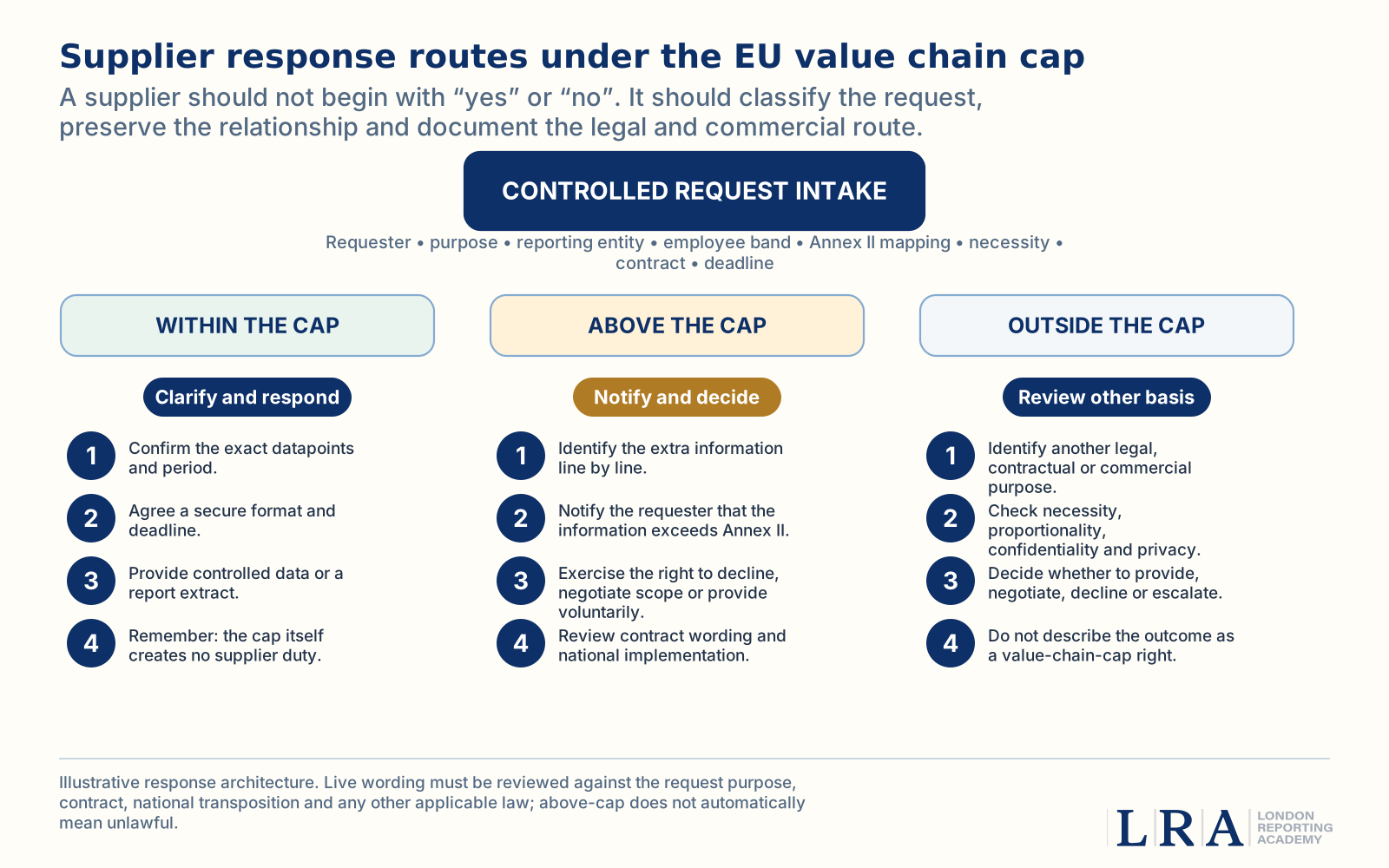
Figure 4. A supplier should route each request line through within-cap, above-cap or outside-cap logic, then test contracts and other law before deciding whether to provide, negotiate or decline.
In practice
| Step | Action | Record to retain |
|---|---|---|
| 1 | Acknowledge the request without accepting that every field is mandatory. | Request receipt, deadline and contact. |
| 2 | Ask the requester to state the ultimate requester, purpose and legal/contractual basis for each request category. | Written purpose clarification. |
| 3 | Confirm protected-undertaking status and the applicable employee band. | Current self-declaration and calculation evidence. |
| 4 | Map each line to Annex II or classify it as above/outside the cap. | Line-by-line classification matrix. |
| 5 | Review existing contracts, procurement terms and other applicable laws. | Legal review note and contract references. |
| 6 | Choose response option: provide, narrow, aggregate, substitute, defer or decline. | Approved response decision and owner. |
| 7 | Issue clear wording and avoid accidental continuing commitments. | Final correspondence and attachments. |
| 8 | Update the request register and reusable data pack. | Decision history and future-response controls. |
In practice
Response options beyond a binary yes or no
| Option | When it can be appropriate | Control |
|---|---|---|
| Provide | The information is available, proportionate and legally/commercially appropriate. | State period, boundary, method and permitted use. |
| Provide within-cap only | A mixed CSRD request includes both Annex II and above-cap fields. | Return the classified subset and identify excluded lines. |
| Clarify or narrow | Purpose, granularity, period or legal basis is unclear. | Ask precise questions and pause the response deadline by agreement. |
| Alternative evidence | The requested format is burdensome but an existing report, certificate, policy or aggregate metric meets the need. | Confirm acceptance in writing. |
| Phased response | Data exist but controls or calculations need remediation. | Agree dates, interim limitations and no automatic future obligation. |
| Decline | The protected undertaking exercises its right for above-cap CSRD information, or no other duty exists and commercial approval supports refusal. | Use specific, respectful wording and preserve the relationship. |
Polite clarification and refusal wording
All wording above is illustrative. It must be adapted to the facts, current national law, contract and approved customer-relationship strategy.
Rule
1. PURPOSE CLARIFICATION
Thank you for the request. To classify the information correctly, please confirm for each section whether it is requested for your sustainability reporting under Articles 19a or 29a of Directive 2013/34/EU, for due diligence, lending/credit assessment, product compliance, procurement evaluation or another purpose. Please also identify the ultimate reporting undertaking where the request is made through a platform or service provider.
Rule
2. PARTIAL RESPONSE
Based on the stated CSRD-reporting purpose and our current protected-undertaking assessment, we have completed the request lines that correspond to the applicable Annex II cap. The attached matrix identifies the remaining lines as above the cap. We would be pleased to discuss whether a narrower request or alternative evidence would meet your need.
Rule
3. ABOVE-CAP DECLINE
We understand that items [list] are requested for your CSRD sustainability reporting and exceed the information specified in the applicable Annex II column. As a protected undertaking, we exercise our statutory right to decline those items. This response is limited to the stated request and does not affect information we may be required or choose to provide under another legal or contractual basis.
Rule
4. COMMERCIAL REFUSAL WHERE NO DUTY IS IDENTIFIED
Following our review, we have not identified a current legal or contractual obligation requiring the requested information in the stated form. We are therefore unable to complete the request at this time. We can provide [existing report/aggregate metric/policy/certificate] as an alternative and would welcome confirmation that this meets the intended use.
Hypothetical example: a mixed customer questionnaire
A hypothetical 65-employee supplier receives a platform questionnaire containing energy, Scope 1/2, Scope 3, transition-plan, grievance, product-traceability and tender-scoring fields. The customer initially marks all fields mandatory. The supplier asks for purpose labels. The customer confirms that energy, Scope 1/2 and workforce data support its CSRD report; product traceability supports separate product law; the transition plan and Scope 3 are desirable for supplier engagement; and tender scoring is voluntary procurement.
The supplier provides the necessary Annex II fields, reviews product-law requirements separately, offers a high-level climate action note voluntarily and declines the detailed Scope 3 and transition-plan fields. The platform record is updated so that the voluntary fields are no longer shown as legally mandatory.
In practice
Weak versus stronger response
| Weak | Stronger |
|---|---|
| “The EU cap means we refuse your entire questionnaire.” | Classifies request lines, states protected status and purpose, and declines only the relevant above-cap items unless another decision is approved. |
| The supplier uploads unreviewed data to preserve the customer relationship. | Data are released only with approved boundary, period, method, limitation and permitted-use wording. |
| A response says the requester is acting illegally. | The response calmly identifies the legal classification and invites clarification or a proportionate alternative. |
| A one-off voluntary response silently becomes an annual commitment. | The correspondence states scope, period, permitted use and whether future updates require separate agreement. |
In practice
Legal and commercial review matrix
| Question | Legal review | Commercial review |
|---|---|---|
| Is the supplier protected? | Employee method, legal entity, value-chain relationship and national law. | Whether the declaration is acceptable to the customer. |
| Is the request above the cap? | Annex II mapping, purpose and notification. | Whether voluntary provision creates value or precedent. |
| Is there another duty? | Contract, sector law, product law, due diligence or financing terms. | Risk of refusal, alternatives and negotiation position. |
| Can the information be disclosed safely? | Confidentiality, privacy, competition and data-protection constraints. | Customer expectations, aggregation and permitted use. |
| Who approves the response? | Authorised signatory and legal position. | Sales/account owner and management escalation. |
Common mistakes
Refusing before confirming the request purpose and ultimate requester.
Treating within-cap fields as automatically mandatory without checking contract or law.
Using the right to decline for due-diligence or product-compliance requests that are outside this cap.
Responding through a platform without retaining the exact question version and purpose labels.
Providing data without period, boundary, method or permitted-use controls.
Accusing the requester of a breach before national transposition and legal status are confirmed.
Allowing a voluntary response to become a continuing obligation through ambiguous wording.
In practice
| MYTH | If information is within the value chain cap, the supplier must provide it. |
|---|---|
| REALITY | The directive expressly states that the cap does not impose or imply an obligation on a value-chain undertaking to provide sustainability information. Within-cap status limits what a reporting undertaking may require for CSRD reporting, but an actual duty must come from a valid contract, another law or an accepted commercial commitment. |
Readiness
Supplier response checklist
- The ultimate requester and stated purpose are confirmed in writing.
- Protected-undertaking status and employee band are current.
- Each request line is classified within, above or outside the cap.
- Existing contracts and other legal bases are reviewed.
- Data confidentiality, privacy and competition concerns are assessed.
- The response option is approved by legal and the commercial owner.
- Any above-cap decline is precise and limited to the relevant items.
- Alternative evidence or narrower scope has been considered.
- Released data include period, boundary, method and limitations.
- The correspondence avoids creating an unintended recurring obligation.
- The request, classification and final response are retained in the evidence register.
In practice
Related requirements and next steps
| Relation | Reference | Why it matters |
|---|---|---|
| Direct | Directive (EU) 2026/470 | Right to decline, notice, contract effect and no automatic supplier duty. |
| Prerequisite | Protected Undertaking Test | A supplier should establish status before relying on the cap. |
| Prerequisite | EU Value Chain Cap Explained | Annex II and purpose classification. |
| Comparison | Banks, Customers and Procurement Platforms | Mixed-purpose and indirect request analysis. |
| Tool | Line-by-line request and response register | Creates a repeatable evidence and approval trail. |
Questions
Questions people ask
Can a supplier refuse an ESG questionnaire?
A protected supplier has a statutory right to decline information that exceeds the relevant Annex II cap when the request is made for a CSRD reporting purpose. That right does not automatically apply to requests for lending, due diligence, product compliance or other purposes.
Is within-cap information mandatory?
A protected supplier has a statutory right to decline information that exceeds the relevant Annex II cap when the request is made for a CSRD reporting purpose. That right does not automatically apply to requests for lending, due diligence, product compliance or other purposes. Equally, information being within the cap does not by itself create a duty to provide it: the directive states that the cap does not impose or imply a supplier reporting obligation.
Does the cap override contracts?
A reflexive 'no' can damage a customer relationship or ignore a valid obligation under another law or contract. The practical task is to separate the statutory cap from commercial choice and other legal bases.
Does it apply to due diligence?
A protected supplier has a statutory right to decline information that exceeds the relevant Annex II cap when the request is made for a CSRD reporting purpose. That right does not automatically apply to requests for lending, due diligence, product compliance or other purposes.
Sources
Primary sources
- Directive (EU) 2026/470 (Omnibus I)
- Commission Delegated Regulation C(2026) 5011 final of 3 July 2026 - main act — published as Delegated Regulation (EU) 2026/1560 (OJ, 21 September 2026)
- Annexes 1 and 2 to Commission Delegated Regulation C(2026) 5011 final — published as Delegated Regulation (EU) 2026/1560 (OJ, 21 September 2026)
- European Commission Q&A on the value chain cap, 6 May 2026
- European Commission adoption announcement, 3 July 2026
Take it with you
The checklists as a working spreadsheet
Every checklist and table on this page, with empty status, owner and evidence columns for your team to fill in and keep.
✓ Knowledge Hub AI Assistant · Human-in-the-loop

Ask about this guide
It answers from this page, and reaches into the linked disclosure cards when your question is about the standard itself.
Go deeper · EU Voluntary Standard 2026
Certified VSME Sustainability Reporting (EU Voluntary Standard for SMEs)
This page settles one datapoint. The VSME course turns the EU voluntary standard into a proportionate reporting process for a non-listed SME, on your own data.
Available as Guided Flex, Live Cohort, 1:1 Expert Mentorship or Corporate Programme.