Short answer
The answer, before the reasoning
ESRS are the reporting standards used to prepare the sustainability statement required by the EU Accounting Directive, as amended by the CSRD and Omnibus I. They do not decide legal scope on their own.
A company first determines whether national law requires individual or consolidated sustainability reporting; it then identifies the ESRS version in force for the period, performs a double materiality assessment, applies ESRS 1 and ESRS 2, and uses the topical standards and entity-specific disclosures for material impacts, risks and opportunities. The resulting statement sits in a dedicated section of the management report and is subject to assurance and digital-reporting controls.
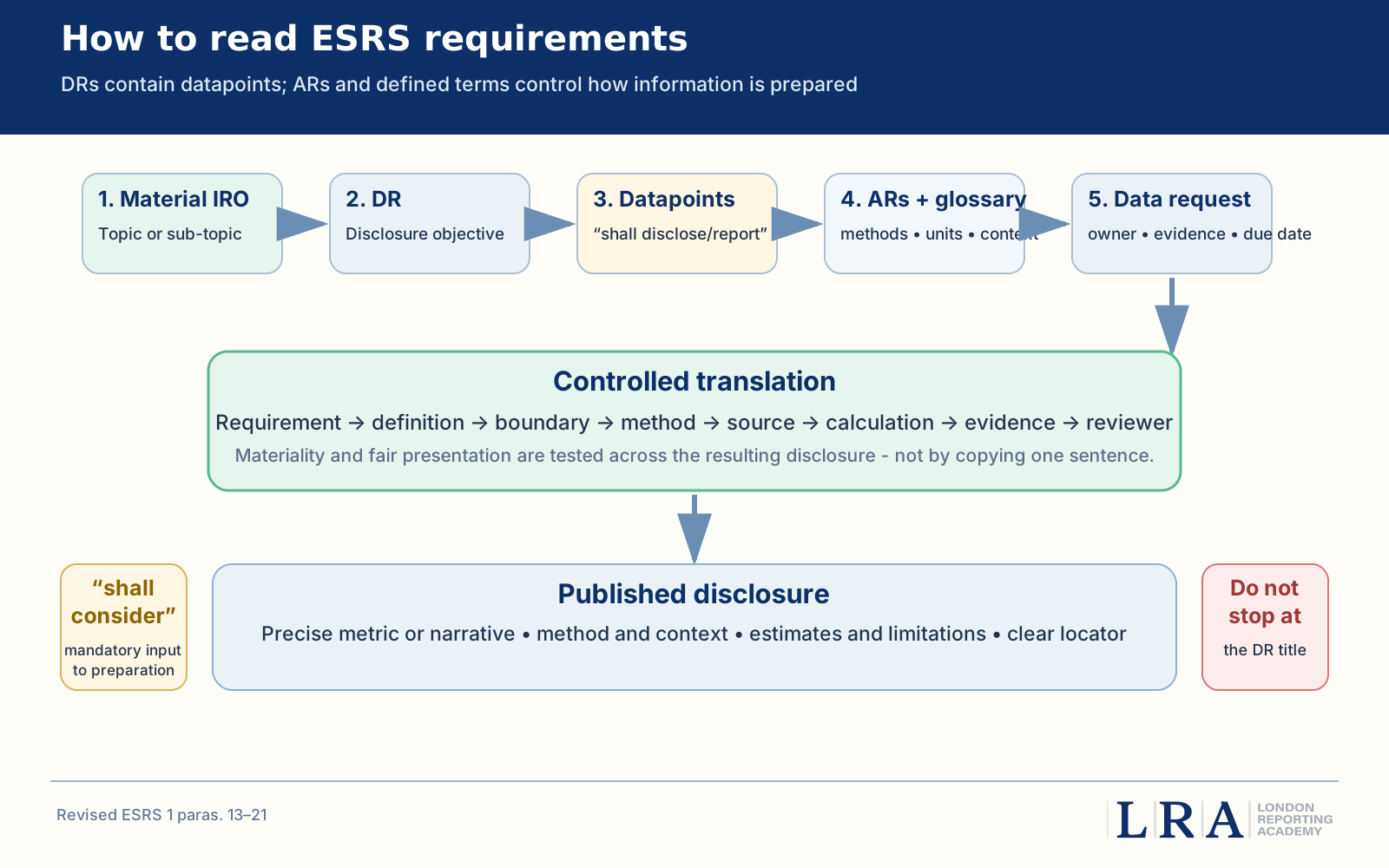
The most common starting error is to open a datapoint list before resolving four gateway questions: who is legally in scope, which reporting entity is covered, which standard version applies and which matters are material. ESRS implementation works in the opposite order. Legal scope establishes the reporting obligation; ESRS 1 establishes the preparation logic; ESRS 2 provides cross-cutting disclosures; and the topical standards supply disclosures for material environmental, social and governance matters.
Technical status
LEGAL STATUS
Publication and legal-status control. The revised ESRS were adopted by the Commission on 3 July 2026 as Delegated Regulation (EU) 2026/1563, published in the Official Journal on 21 September 2026. The Regulation replaces Annex I (the ESRS) and Annex II of Delegated Regulation (EU) 2023/2772, enters into force on 10 November 2026 and applies to financial years beginning on or after 1 January 2027. For financial years beginning in 2026, undertakings may apply the 2023 ESRS (Delegated Regulation (EU) 2023/2772 as last amended by Delegated Regulation (EU) 2025/1416, the 2025 Quick Fix) or the revised ESRS, or the 2023 ESRS together with specified reliefs from revised ESRS 1, and must state which version they apply (Article 2). Scope and timing also depend on national transposition of Omnibus I and the entity’s reporting period.
Quick orientation
Quick orientation
- Applies to
- EU undertakings and groups assessing mandatory sustainability reporting, plus advisers and assurance teams designing an ESRS-ready process.
- Primary decision
- Determine the legal gateway, applicable ESRS edition, reporting boundary, material matters and first implementation sequence.
- Key source
- Accounting Directive Articles 19a, 29a and 29b, as amended; Delegated Regulation (EU) 2023/2772 as amended by Delegated Regulation (EU) 2026/1563.
- Common confusion
- Treating ESRS as the law that determines scope, or treating all topical datapoints as automatically mandatory.
1. The legal gateway: CSRD creates the duty; ESRS describe the reporting content
The Corporate Sustainability Reporting Directive (CSRD) amended the Accounting Directive. Omnibus I amended that legal architecture again in 2026, including the main scope thresholds and the timetable. Member States must transpose the relevant Omnibus I provisions by 19 March 2027. This means that a group cannot determine its enforceable obligation from an ESRS document alone: it must read the applicable national law, any transitional or exemption measures and, for issuers, the relevant transparency-law route.
At EU Directive level, the main individual and consolidated scope for financial years beginning on or after 1 January 2027 is targeted at undertakings or groups that exceed both EUR 450 million net turnover and an average of 1,000 employees during the financial year. The phrase “on the balance sheet date” is the legal measurement point; it does not add a balance-sheet-total threshold. Special rules continue for issuers, credit institutions, insurers, subsidiaries, financial holding undertakings and third-country groups. The Knowledge Hub guide on CSRD scope after Omnibus I addresses those tests in detail.
2. The complete ESRS map
The revised 2026 architecture retains two cross-cutting standards and ten topical standards. The standards work as a connected system rather than twelve independent checklists. ESRS 1 and ESRS 2 apply across the statement. Topical standards are used when the related topic is material, subject to the materiality of the information within the applicable disclosures. Entity-specific disclosures close gaps where a material impact, risk or opportunity is not covered, or not covered with sufficient granularity, by ESRS.
In practice
| Standard | Primary role | Typical implementation question |
|---|---|---|
| ESRS 1 · General Requirements | Defines fair presentation, double materiality, boundaries, value chain, preparation reliefs and statement structure. | How will the company decide what to report and document judgements? |
| ESRS 2 · General Disclosures | Provides general disclosures across governance, strategy, impact/risk/opportunity management, and metrics and targets. | What cross-cutting information is required across all material topics? |
| ESRS E1 · Climate Change | Climate transition, policies/actions, energy, GHG emissions, targets and financial effects. | Are climate impacts or risks material, and are GHG boundaries controlled? |
| ESRS E2 · Pollution | Pollutants, substances of concern, microplastics, policies, actions and targets. | Which pollutants are material following an entity-specific managerial assessment? |
| ESRS E3 · Water | Water withdrawal, consumption, discharge and water stored; marine resources now sit in E5 and marine ecosystems in E4. | Which sites, basins and value-chain dependencies require information? |
| ESRS E4 · Biodiversity and Ecosystems | Biodiversity impacts, dependencies, transition considerations, sites and metrics. | Where are material interactions with sensitive locations, species and ecosystems? |
| ESRS E5 · Resource Use and Circular Economy | Resource inflows, outflows, waste and circularity. | Which material flows and product-system characteristics need measurement? |
| ESRS S1 · Own Workforce | Working conditions, equal treatment, other work-related rights and workforce metrics. | Which employee and non-employee populations are within the disclosure boundary? |
| ESRS S2 · Workers in the Value Chain | Material impacts, engagement, remediation, policies and actions for value-chain workers. | Which parts of the value chain create or are linked to material impacts? |
| ESRS S3 · Affected Communities | Material impacts on communities, engagement, channels and remediation. | Which communities and locations require focused evidence and disclosure? |
| ESRS S4 · Consumers and End-users | Product-related information, safety, inclusion, privacy and other consumer impacts. | Which user groups and product or service risks are material? |
| ESRS G1 · Business Conduct | Corporate culture, corruption, political influence, supplier relationships and payment practices. | Which conduct risks and controls are material to the undertaking? |
3. What ESRS 1 and ESRS 2 do
ESRS 1 is the operating manual for the statement. It explains how to identify material impacts, risks and opportunities; assess the materiality of information; determine the reporting undertaking and value-chain boundary; handle estimates, uncertainty, acquisitions, disposals and omissions; and structure the final statement. Under the revised text, fair presentation applies to the sustainability statement as a whole. The company is not expected to satisfy every information need of every individual user; it must provide decision-useful material information for the defined user groups.
ESRS 2 is the cross-cutting disclosure standard. It organises information around governance, strategy, the management of impacts, risks and opportunities, and metrics and targets. In practice, a reporting team should not draft ESRS 2 in isolation. Governance statements must be consistent with board minutes and delegated authorities; strategy disclosures must connect to the business model and financial planning; and topic-management disclosures must tie to the decisions made in the double materiality assessment.
Rule
What the standards do not require
ESRS do not require the company to report every topical datapoint, use one prescribed software platform, copy the standard’s paragraph order into the report, or invent a policy, target or action that does not exist. Nor does an attractive standalone sustainability report replace the legally required sustainability statement in the management report.
4. Double materiality controls the reporting universe
Double materiality combines two perspectives. Impact materiality considers the undertaking’s actual and potential positive and negative impacts on people and the environment, including through business relationships. Financial materiality considers sustainability-related risks and opportunities that affect, or could reasonably be expected to affect, financial performance, financial position, cash flows, access to finance or cost of capital over the short, medium or long term. A matter is material when it is material from either perspective; it does not need to satisfy both.
The revised ESRS explicitly supports a top-down approach. A team may begin with the business model, sectors, geographies, products, activities, relationships and known sustainability issues, and use that picture to focus detailed assessment work. It is generally unnecessary to score every theoretically possible impact, risk or opportunity. However, a top-down process still needs evidence, coverage checks and documented reasons for excluding plausible matters.
In practice
| Decision layer | Question | Evidence to retain |
|---|---|---|
| Context | Which activities, products, geographies and relationships could create material impacts, risks or opportunities? | Business model, legal-entity map, sites, products, procurement and sales data, due-diligence records. |
| Impact lens | Which actual or potential impacts are significant, considering severity and, for potential impacts, likelihood? | Impact inventory, incident data, stakeholder and expert evidence, sector and location information. |
| Financial lens | Which sustainability risks or opportunities could affect financial prospects? | Risk register, strategic plan, budgets, scenarios, financing and insurance information. |
| Information materiality | Which information within the applicable requirements is material and decision-useful? | Datapoint assessment, user needs, omission rationale and reviewer challenge. |
| Approval | Who approves the material matters, key judgements and changes? | Management and governance-body minutes, methodology sign-off and change log. |
5. Reporting boundaries: financial perimeter, own operations and value chain
The sustainability statement is prepared for the reporting undertaking: the same undertaking or group covered by the related management report and financial reporting perimeter. That starting point does not mean every ESRS metric uses an identical operational boundary. Some information concerns own operations; other requirements extend to upstream or downstream value-chain actors where material impacts, risks or opportunities arise. Metric-specific instructions may define additional inclusions, exclusions or calculation treatments.
A practical boundary register should reconcile the consolidation perimeter to subsidiaries, joint operations, associates, joint ventures, leased assets and relevant business relationships. It should then identify the boundary used for each material disclosure, data source and estimate. Revised ESRS include reliefs and proportionate approaches for value-chain information, acquisitions, disposals, partial value-chain scope and joint operations. These are controlled reliefs, not permission to omit the value chain wholesale.
6. How the sustainability statement is structured
The statement is included in a dedicated section of the individual or consolidated management report. Under revised ESRS 1, it is organised into four parts: general information, environmental information, social information and governance information; a different structure can be used only with a reasoned explanation (paragraph 105). The company may include a clearly identified executive summary and may present EU Taxonomy disclosures in a separate appendix within the management report (paragraph 106). Incorporation by reference is conditional and must preserve accessibility, timing, assurance scope and traceability.
In practice
| Part | Typical content | Control point |
|---|---|---|
| General information | Basis of preparation, governance, strategy, materiality process and cross-cutting disclosures. | Consistent reporting entity, period, version statement and materiality conclusions. |
| Environmental | Material E1-E5 information and entity-specific environmental disclosures. | Methods, units, site/value-chain boundaries, estimates and financial connectivity. |
| Social | Material S1-S4 information and entity-specific social disclosures. | Population definitions, privacy, incident substantiation and remediation evidence. |
| Governance | Material G1 information and entity-specific governance disclosures. | Board oversight, policy approval, conduct evidence and balanced reporting. |
7. Assurance and digital reporting are part of the design
The Accounting Directive requires an assurance opinion on sustainability reporting based on a limited assurance engagement; following Omnibus I, the earlier plan to move to reasonable assurance has been removed. Assurance readiness therefore starts before drafting: definitions, data owners, systems, calculations, estimates, controls, evidence retention, management review and governance approvals should be designed into the annual cycle. A late “assurance clean-up” is usually more expensive and creates greater disclosure risk.
The management report must also be prepared in the required electronic reporting format, with sustainability information marked up once the relevant digital-tagging rules apply. Even before mandatory tagging, a stable data dictionary and disclosure index help keep the narrative, quantitative tables, taxonomy disclosures and source evidence synchronised.
In practice
8. A practical implementation roadmap
| Step | Action | Primary owner — Output / control |
|---|---|---|
| 1 | Confirm scope, reporting level, period, national law and standard version. | Legal, finance, company secretariat — Approved scope and version memorandum. |
| 2 | Map the reporting entity, operations and value chain. | Finance, sustainability, procurement, sales — Boundary and relationship register. |
| 3 | Design and approve the double materiality method. | Sustainability, risk, finance, internal audit — Methodology, evidence sources and approval route. |
| 4 | Identify material impacts, risks and opportunities using a top-down process with coverage checks. | Cross-functional working group — Materiality register and decision records. |
| 5 | Map material matters to ESRS 2, topical requirements and entity-specific gaps. | Reporting team and technical adviser — Disclosure applicability matrix. |
| 6 | Build the data dictionary, calculation methods, evidence register and controls. | Data owners, finance, IT, HR, operations — Controlled dataset and evidence trail. |
| 7 | Draft the four-part statement, including limitations and connections to financial reporting. | Reporting team — Review-ready sustainability statement. |
| 8 | Complete management, governance, legal and assurance review; prepare release and tagging. | CFO, board committee, assurance provider — Approved, version-controlled publication package. |
Hypothetical scenario
Illustrative scenario - diversified manufacturer
A group with factories in three Member States, an Asian supply chain and a European service business confirms consolidated reporting. It uses a top-down materiality assessment to identify climate transition risk, water impacts at two sites, workforce safety, value-chain labour risks and business conduct as plausible priorities. Detailed evidence shows that biodiversity is material at one site but not across every operation. The group maps each conclusion to ESRS 2 and the applicable topical standards, adds entity-specific product-safety information, and records where supplier data are estimated. The first-year output is not “all ESRS datapoints”; it is a controlled statement covering material matters and material information, with transparent limitations and a data-improvement plan.
Illustrative only. It shows how the decision is made, not wording that can be copied or relied on.
Illustrative basis-of-preparation wording
Why this works: it identifies the reporting entity, period, version, double-materiality basis and value-chain coverage. What must be adapted: the exact legal basis, version, boundary differences, estimates, omissions, assurance status and any transition reliefs actually used.
Hypothetical scenario
Illustrative wording - adapt to facts and applicable law
“The consolidated sustainability statement has been prepared for the same group as the consolidated financial statements for the year ended 31 December 20X7. The group applied [identify the ESRS version applied, for example the ESRS set out in Annex I to Delegated Regulation (EU) 2023/2772 as amended by Delegated Regulation (EU) 2026/1563] and assessed material impacts, risks and opportunities using both impact and financial materiality perspectives. The assessment covered own operations and relevant upstream and downstream value-chain relationships. Boundary differences, estimation methods, value-chain limitations and changes from the prior period are explained in the related disclosures.”
Illustrative only. It shows how the decision is made, not wording that can be copied or relied on.
In practice
Common mistakes and fixes
| Mistake | Why it fails | Practical fix |
|---|---|---|
| Starting with a 1,000-line datapoint spreadsheet | It reverses the required logic and encourages non-material disclosure. | Lock scope, material matters and information materiality before detailed data requests. |
| Treating every topical standard as mandatory | Topical content is driven by material matters and material information. | Use an applicability matrix tied to the approved materiality register. |
| Using the financial consolidation perimeter as the only boundary | Material impacts and risks may arise through the upstream and downstream value chain. | Maintain a boundary register by disclosure and metric. |
| Inventing policies, actions or targets to fill gaps | The statement must reflect the undertaking’s actual state, including absence or immaturity. | Report the gap accurately and assign a controlled improvement action. |
| Separating sustainability data from finance controls | This weakens connectivity, consistency and assurance readiness. | Use finance-style ownership, reconciliations, change control and sign-off. |
| Publishing a glossy report outside the management report only | It may not satisfy the legal location and structure of the sustainability statement. | Prepare the legal statement first; repurpose it into other channels with controlled cross-references. |
Applicability and readiness questions
Which national law applies to the undertaking, parent and issuer, and has Omnibus I been transposed?
Does the entity or group exceed both the relevant turnover and employee thresholds for the period?
Is reporting required at individual, consolidated or third-country level, and are exemptions available?
Which ESRS version applies for the period, and for a financial year beginning in 2026, which option under Article 2 of Delegated Regulation (EU) 2026/1563 has been chosen and stated?
Is the sustainability statement boundary reconciled to the financial reporting entity?
Does the double materiality method cover own operations and relevant business relationships?
Have material matters been mapped to ESRS 2, topical standards and entity-specific gaps?
Are data definitions, estimates, controls, evidence and approvals ready for limited assurance?
Is the statement structured for the management report and future digital tagging?
Has the board or appropriate governance body approved the key judgements and release?
In practice
Source register
| ID | Official source | Role in article — Status |
|---|---|---|
| S1 | Directive 2013/34/EU (Accounting Directive), consolidated and as amended | Legal location, scope framework, statement, assurance and digital-format duties — Current law; national transposition required |
| S2 | Directive (EU) 2022/2464 (CSRD) | Introduced the sustainability-reporting architecture and original application timetable — Amended |
| S3 | Directive (EU) 2026/470 (Omnibus I) | Revised scope, protected undertakings, timetable and simplification mandate — In force 18 March 2026; transpose by 19 March 2027 |
| S4 | Commission Delegated Regulation (EU) 2023/2772 | Current first set of ESRS — In force |
| S5 | Commission Delegated Regulation (EU) 2025/1416 | Quick Fix for wave-one phase-ins — In force |
| S6 | Commission Delegated Regulation (EU) 2026/1563 and Annexes (OJ L, 2026/1563, 21.9.2026) | Revised ESRS architecture, transition options and 2027 application — Published; in force from 10 November 2026; applies from FY2027 |
| S7 | European Commission adoption notice, 3 July 2026 | Adoption announcement and reduction summary — Background to the published Regulation |
Questions
Questions people ask
Are ESRS and CSRD the same thing?
ESRS are the reporting standards used to prepare the sustainability statement required by the EU Accounting Directive, as amended by the CSRD and Omnibus I. They do not decide legal scope on their own.
Does a company have to report every ESRS datapoint?
ESRS do not require the company to report every topical datapoint, use one prescribed software platform, copy the standard’s paragraph order into the report, or invent a policy, target or action that does not exist. Nor does an attractive standalone sustainability report replace the legally required sustainability statement in the management report.
Are ESRS reports subject to assurance?
The Accounting Directive requires an assurance opinion on sustainability reporting based on a limited assurance engagement; following Omnibus I, the earlier plan to move to reasonable assurance has been removed. Assurance readiness therefore starts before drafting: definitions, data owners, systems, calculations, estimates, controls, evidence retention, management review and governance approvals should be designed into the annual cycle. A late “assurance clean-up” is usually more expensive and creates greater disclosure risk.
Can the sustainability statement be a separate PDF?
The statement is included in a dedicated section of the individual or consolidated management report. Nor does an attractive standalone sustainability report replace the legally required sustainability statement in the management report.
Take it with you
The checklists as a working spreadsheet
Every checklist and table on this page, with empty status, owner and evidence columns for your team to fill in and keep.
✓ Knowledge Hub AI Assistant · Human-in-the-loop

Ask about this guide
It answers from this page, and reaches into the linked disclosure cards when your question is about the standard itself.
Go deeper · ESRS
Certified ESRS (CSRD) Applied Sustainability Reporting
This page settles one Disclosure Requirement. The ESRS / CSRD course walks the whole European cycle — double materiality, datapoints, evidence and assurance — with drafting exercises on your own data.