Short answer
The answer, before the reasoning
Preparing an ESRS sustainability statement is a controlled reporting programme, not a late-stage writing exercise. The undertaking first locks the legal scope, reporting entity, reporting period and applicable ESRS version.
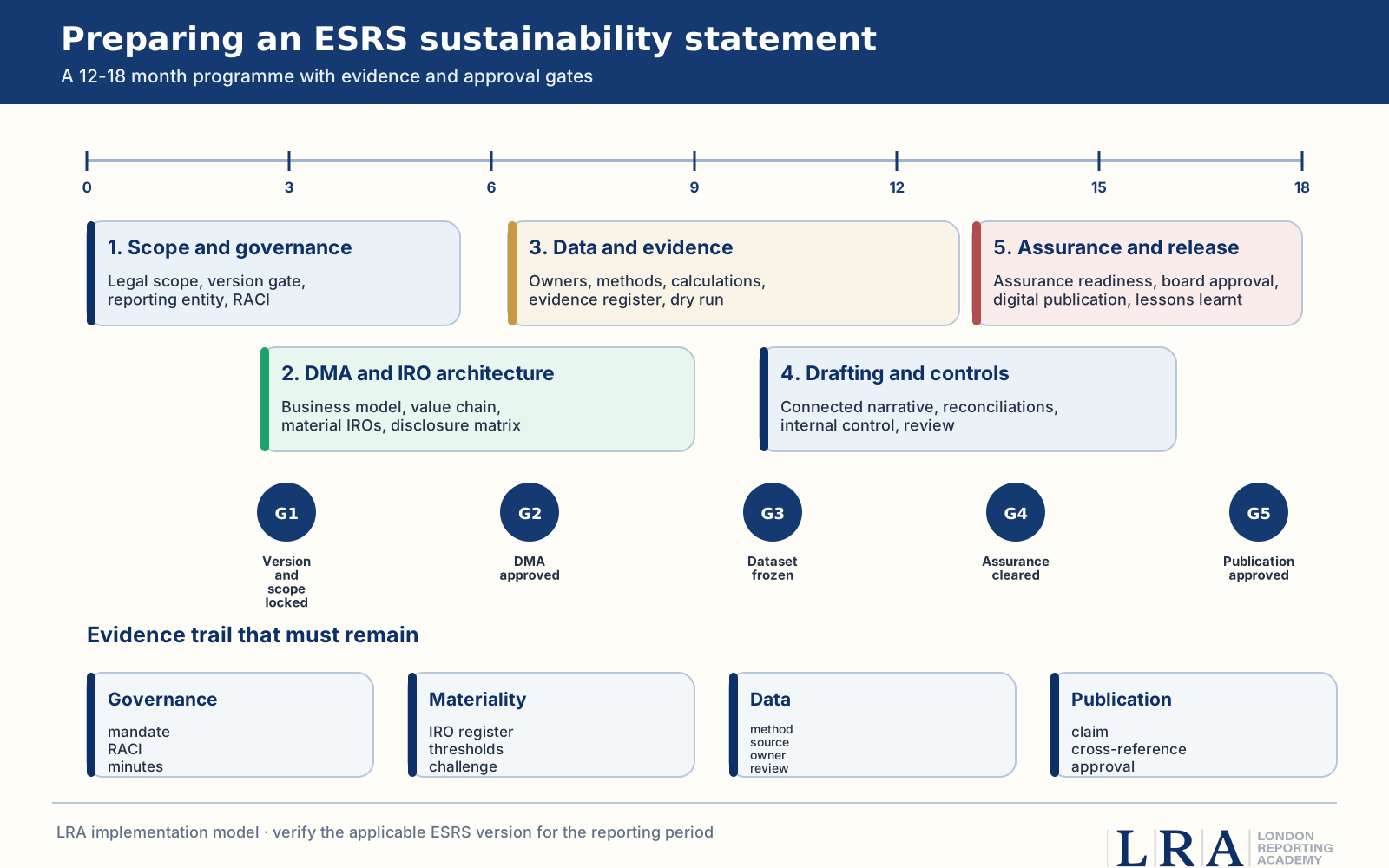
It then establishes governance; maps the business model, geographies and value chain; performs the double materiality assessment; maintains an impact, risk and opportunity (IRO) register; converts material IROs into a disclosure matrix; collects controlled data and evidence; drafts connected narrative and metrics; runs internal controls and assurance-readiness procedures; obtains governance approval; and publishes a clearly identifiable sustainability statement in the management report. A realistic first implementation commonly needs 12-18 months, although timing depends on reporting maturity and data readiness.
Rule
ESRS-IMP-001
How to Prepare an ESRS Sustainability Statement: Complete Step-by-Step Guide. Scope, governance, double materiality, the IRO register, disclosure architecture, data, controls, assurance and publication.
In practice
Type
| Type | Tier | Audience — Current context |
|---|---|---|
| End-to-end ESRS reporting implementation guide | Tier 4 · Deep How-to Guide | Cross-functional ESRS programme teams, executives and assurance functions — Revised ESRS (Delegated Regulation (EU) 2026/1563, OJ 21.9.2026); version and legal-status gate checked to 25 September 2026 |
Rule
2026 VERSION GATE
The revised ESRS were adopted by the European Commission on 3 July 2026 as Commission Delegated Regulation (EU) 2026/1563 and published in the Official Journal on 21 September 2026 (OJ L, 2026/1563). The Regulation enters into force on 10 November 2026 and applies to financial years beginning on or after 1 January 2027. For financial years beginning between 1 January and 31 December 2026, Article 2 gives undertakings two routes: (a) apply either the 2023 ESRS (Delegated Regulation (EU) 2023/2772 as last amended by Delegated Regulation (EU) 2025/1416) or the revised ESRS; or (b) apply the 2023 ESRS together with specified reliefs from revised ESRS 1: the top-down DMA (paragraph 27), undue cost or effort and the value-chain limitation in the DMA (paragraphs 32-33), acquisitions and disposals (paragraphs 74-75), metrics for non-significant activities (paragraph 90), partial reporting scope of the value chain (paragraph 91), joint operations (paragraph 92), Taxonomy disclosures in a separate appendix (paragraph 106) and the executive summary (paragraph 110). The sustainability statement must clearly state which version is applied (Article 2(2)). Every project should record its version decision for financial year 2026, together with any reliefs used, and control it through the reporting cycle. The article below explains the revised text.
Why this question matters
A sustainability statement can fail even when individual numbers are correct. The more common first-year weaknesses are unresolved scope, a materiality process that does not connect to the disclosure matrix, unsupported narrative claims, data collected without definitions, inconsistent boundaries between metrics, late governance involvement and assurance evidence assembled after drafting. These weaknesses create rework because the statement is the final output of a reporting system, not the system itself.
The revised ESRS place double materiality, fair presentation and information materiality at the centre of reporting. They also require the statement to be clearly identifiable within the management report, to use the same reporting undertaking as the financial statements subject to specified boundary rules, and to explain the basis of preparation, value-chain coverage, reliefs and significant judgements. A strong project therefore starts with legal and reporting architecture before it starts collecting datapoints.
Quick orientation
Quick orientation
- Applies to
- First-time reporters, entities redesigning a 2023 ESRS process and groups preparing for assurance or a new reporting perimeter.
- Primary decision
- How to organise the programme so that materiality, data, narrative, controls and publication form one traceable process.
- Key sources
- Revised ESRS 1 Chapters 2-3, 5-9; revised ESRS 2 BP, GOV, SBM and IRO disclosures.
- Common confusion
- Treating the sustainability statement as a writing project that can be completed after the annual data close.
The ten-stage preparation process
In practice
| Stage | Core actions | Controlled output — Main approval or control |
|---|---|---|
| 1. Scope and version gate | Confirm CSRD/national scope, reporting period, reporting entity, consolidation basis, value-chain coverage, ESRS version and assurance context. For financial year 2026, record the version chosen under Article 2 of Delegated Regulation (EU) 2026/1563 and any reliefs used, because the statement must state it (Article 2(2)). | Scope memorandum and standards-version register. — Legal, finance and reporting owner sign-off. |
| 2. Project governance | Set sponsor, programme lead, workstreams, decision rights, escalation, reporting calendar and RACI. | Approved project charter and governance calendar. — Executive sponsor and audit committee or equivalent. |
| 3. Business model and value chain | Map activities, significant sectors, products/services, geographies, key resources, business relationships and affected stakeholders. | Business-model and value-chain evidence map. — Strategy, risk, procurement and operations challenge. |
| 4. Double materiality assessment | Identify and assess impact and financial IROs; set qualitative considerations or thresholds; validate and approve conclusions. | Methodology, IRO register, evidence register and approved material topics. — Cross-functional challenge and governance approval. |
| 5. Disclosure architecture | Translate material IROs into ESRS 2, topical DRs/ARs, general disclosures, entity-specific information and supplementary information. | Disclosure matrix, content architecture and gap list. — Technical reviewer checks completeness and information materiality. |
| 6. Data and evidence design | Define each metric, period, boundary, unit, method, source, estimate, owner, reviewer, retention and linkage to financial information. | Data dictionary, calculation files and evidence index. — Data-owner certification, reconciliation and change control. |
| 7. Dry run and remediation | Perform a prior-period or interim collection, test value-chain estimates, identify unavailable data and resolve methodology choices. | Dry-run dataset, issue log and remediation plan. — Programme steering committee closes critical gaps. |
| 8. Drafting and internal control | Draft connected information across governance, strategy, management, metrics and targets; control cross-references and consistency with other public statements. | Controlled draft, claim ledger, review comments and disclosure locator. — Prepare/review separation, legal review and internal controls. |
| 9. Assurance readiness | Agree subject matter and criteria, prepare evidence requests, test management judgements, remediate findings and lock the final data set. | Assurance pack, findings log, representations and final evidence archive. — Assurance provider and responsible governance body. |
| 10. Approval and publication | Approve material conclusions, statement architecture, reliefs, claims, digital output and management-report release; archive the released version. | Approved sustainability statement, publication record and lessons-learned log. — Administrative, management or supervisory body and statutory sign-off route. |
In practice
A practical 12-18 month timetable
| Timing | Programme focus | What should be visibly complete |
|---|---|---|
| Months 0-2 | Scope, version gate, mobilisation and governance. | Scope memorandum, sponsor, RACI, source register, reporting calendar and assurance strategy. |
| Months 2-5 | Business-model, value-chain and stakeholder evidence mapping. | Activity/geography map, relationship inventory, risk and due-diligence evidence, stakeholder map. |
| Months 4-8 | DMA, thresholds, focused deep dives and approval. | Approved IRO register, evidence register, material topic conclusions and IRO-1 process record. |
| Months 6-10 | Disclosure matrix, data dictionary and dry run. | DR/datapoint decisions, owners, methods, first calculations, gap log and entity-specific needs. |
| Months 9-13 | Narrative drafting, controls and financial connectivity. | First complete statement, reconciliations, review trail, claim ledger and financial-effects links. |
| Months 12-16 | Year-end collection, consolidation and assurance fieldwork. | Final dataset, evidence files, management judgements, assurance findings and remediation. |
| Months 15-18 | Governance approval, publication and next-cycle reset. | Approved final statement, release controls, archived submission, restatement triggers and lessons learnt. |
A workable RACI
R = Responsible; A = Accountable; C = Consulted; I = Informed. The precise allocation depends on national governance and statutory-reporting arrangements. The control principle is more important than the labels: preparers of key information should not be the only reviewers of that information.
In practice
| Activity | Board / committee | Executive sponsor / CFO — Reporting lead — Functional and data owners — Risk, le |
|---|---|---|
| Scope and reporting basis | I | A — R — C — C — I |
| DMA methodology and material conclusions | A | C — R — C — C — I |
| Disclosure matrix and entity-specific information | I | A — R — C — C — C |
| Metric definitions and calculations | I | A — C — R — C — C |
| Internal controls and evidence | I | A — R — R — C / R — C |
| Final claims, reliefs and statement approval | A | R — C — C — C — I |
| Assurance conclusion and publication | I | A — R — C — C — R |
How the sustainability statement should be structured
Revised ESRS 1 requires all ESRS disclosures to be presented in a dedicated section of the management report identified as the sustainability statement. The statement should be clearly identifiable and both human- and machine-readable. The default structure is general information, environmental information, social information and governance information, although an alternative order may be used with a reasoned explanation. EU Taxonomy (Article 8) disclosures must be included in the sustainability statement and may be presented in a separate appendix within the management report (ESRS 1 paragraph 106); they are not subject to other ESRS provisions. For financial year 2026 this option is also available under the 2023 ESRS (Article 2(1)(b)(vii)).
The structure should follow the reporting logic rather than reproduce the internal project plan. Material IROs should connect to strategy, policies, actions, metrics, targets and financial effects without forcing readers to reconstruct the links across unrelated sections. Cross-references and incorporation by reference can reduce duplication, but they must remain precise, accessible and controlled.
In practice
Requirement and implementation practice
| Source-grounded ESRS requirement | LRA implementation practice |
|---|---|
| The undertaking determines reported information through double materiality and information materiality and applies ESRS 2 plus relevant topical and entity-specific information. | Maintain one controlled IRO-to-disclosure matrix that links each material conclusion to DRs, datapoints, owners, evidence and publication locations. |
| The statement is a dedicated management-report section and must state the ESRS applicable at the end of the reporting period. | Freeze the version of the applicable standards, data dictionary and calculation methods before year-end collection, with controlled late changes. |
| The undertaking discloses the reporting basis, value-chain coverage, reliefs, significant judgements and limitations prescribed by ESRS. | Run an interim dry close and a mock assurance evidence request rather than waiting for the statutory reporting timetable. |
Hypothetical worked example
Why the example works: the company does not treat every data gap as a materiality conclusion, does not wait for the final annual close to define methods, and preserves separate evidence for scope, materiality, data and publication claims. The numbers are illustrative and do not establish a benchmark for project duration or number of IROs.
Hypothetical scenario
ILLUSTRATIVE SCENARIO
Northstar Components is a diversified manufacturer with three reporting segments, production sites in six countries and a large outsourced logistics network. The group has finance-grade Scope 1 and 2 data but inconsistent workforce and value-chain evidence. It starts 15 months before publication. The project first confirms the consolidated reporting undertaking and identifies two value-chain areas needing estimates. It then approves a hybrid DMA, creates 74 IRO records, identifies seven material topics and builds a disclosure matrix. A dry run reveals that safety contractor data and water-stress disaggregation are not consistently controlled. These gaps are remediated before year-end. The audit committee approves the material conclusions and the final statement only after the data owners certify their boundaries and the assurance findings are closed.
Illustrative only. It shows how the decision is made, not wording that can be copied or relied on.
In practice
Weak versus stronger implementation
| Area | Weak approach | Stronger controlled approach |
|---|---|---|
| Scope | Assume the financial consolidation perimeter answers every sustainability boundary question. | Document reporting entity, own-operations boundary, value-chain coverage, metric-specific differences and group disaggregation needs. |
| DMA | Run one management workshop and convert votes into material topics. | Use business-model evidence, impact and financial criteria, stakeholder/due-diligence inputs, challenge and approval records. |
| Data | Request every listed datapoint from every entity. | Filter by material IROs and information materiality, then define owner, method, boundary and evidence before collection. |
| Narrative | Draft generic policy descriptions and add metrics later. | Draft from the IRO-to-disclosure matrix and connect strategy, actions, metrics, targets, financial effects and limitations. |
| Assurance | Send the final report and spreadsheets to the assurer. | Agree scope early, build evidence throughout, run dry requests and manage findings before publication. |
Common mistakes
Starting with the ESRS datapoint list instead of scope, business model and material IROs. This creates unnecessary collection and obscures the reporting rationale.
Treating the DMA, data workstream and drafting workstream as separate projects. The disclosure matrix must connect them.
Allowing each subsidiary to define metrics independently. Group reporting needs controlled definitions, boundary rules and consolidation instructions.
Inviting the board only at final approval. Governance bodies need earlier decisions on methodology, severe impacts, material topics, reliefs and significant claims.
Confusing the assurance provider with management. Management remains responsible for the statement, evidence and judgements.
Publishing before checking consistency with the financial statements, website, investor materials, policies, targets and prior public commitments.
Myth
'Once the DMA is complete, the sustainability statement is mostly a drafting exercise.'
Reality
The DMA determines the reporting scope, but the statement still depends on information materiality, controlled definitions, evidence, estimates, financial connectivity, fair presentation, governance review and publication controls. Materiality is the beginning of the disclosure architecture, not the end of the reporting programme.
Readiness
Pre-publication readiness checklist
- The applicable ESRS version, reporting period, reporting entity and national requirements are documented.
- The DMA methodology, IRO register, evidence register and approval record are current and traceable.
- Every material IRO has a defined disclosure route, or a documented reason why no separate information is material.
- Metric definitions, boundaries, methods, estimates, source data, reviewers and comparative treatment are controlled.
- Narrative statements and effectiveness claims are supported by evidence and are consistent with public commitments.
- Reliefs, omissions, incorporation by reference and supplementary information are identified and clearly presented.
- Assurance scope and wording cannot be mistaken for assurance of information outside the engagement.
- The final statement, digital output, management report and website version are identical or reconciled.
- The responsible governance body has approved the material conclusions and publication claim.
- A complete archive, change log and next-cycle improvement plan have been retained.
Self-check
- Can the team trace a published claim back through the disclosure matrix to the material IRO, source evidence, owner and approval?
- Which decisions must be taken before year-end rather than during final drafting?
- Where does the programme separate preparation, review and governance approval?
Sources
Primary sources
- Commission Delegated Regulation (EU) 2026/1563 of 3 July 2026 amending Delegated Regulation (EU) 2023/2772 (OJ L, 2026/1563, 21.9.2026)
- EFRAG Knowledge Hub, Revised ESRS 1 General Requirements (Delegated Act version)
- EFRAG Knowledge Hub, Revised ESRS 2 General Disclosures (Delegated Act version)
- European Commission, adoption announcement, 3 July 2026
- EFRAG Knowledge Hub home page
Framework references
Disclosures this page affects
Take it with you
The checklists as a working spreadsheet
Every checklist and table on this page, with empty status, owner and evidence columns for your team to fill in and keep.
✓ Knowledge Hub AI Assistant · Human-in-the-loop

Ask about this guide
It answers from this page, and reaches into the linked disclosure cards when your question is about the standard itself.
Go deeper · ESRS
Certified ESRS (CSRD) Applied Sustainability Reporting
This page settles one Disclosure Requirement. The ESRS / CSRD course walks the whole European cycle — double materiality, datapoints, evidence and assurance — with drafting exercises on your own data.