Short answer
The answer, before the reasoning
No. Under the revised ESRS, a material topic or sub-topic establishes the reporting area, but it does not automatically make every Disclosure Requirement or datapoint reportable. The undertaking first identifies topics linked to material impacts, risks or opportunities and then determines the material information to report for each topic.
It applies ESRS 2, the general disclosures on policies, actions, metrics and targets, relevant topical Disclosure Requirements and Application Requirements, and entity-specific information needed for fair presentation. Information that is not material must not be presented as ESRS information, except where clearly identified as supplementary. The internal file should therefore document decisions from IRO to topic, requirement and datapoint, even when the public statement does not explain every excluded datapoint line by line.
Rule
ESRS-MAT-004
ESRS Information Materiality: Why a Material Topic Does Not Make Every Datapoint Mandatory. How to distinguish a material IRO, topic or sub-topic, Disclosure Requirement, Application Requirement and individual datapoint.
In practice
Type
| Type | Tier | Audience — Current context |
|---|---|---|
| Information-materiality and disclosure-filtering guide | Tier 4 · Expert Disclosure Guide | Teams building an ESRS disclosure matrix and reviewing completeness — Revised ESRS 1 paragraphs 23-31 and ESRS 2 IRO-2 (Delegated Regulation (EU) 2026/1563) checked to 25 September 2026 |
Rule
2026 VERSION GATE
The revised ESRS were adopted by the European Commission on 3 July 2026 as Commission Delegated Regulation (EU) 2026/1563 and published in the Official Journal on 21 September 2026 (OJ L, 2026/1563). The Regulation enters into force on 10 November 2026 and applies to financial years beginning on or after 1 January 2027. For financial years beginning between 1 January and 31 December 2026, Article 2 gives undertakings two routes: (a) apply either the 2023 ESRS (Delegated Regulation (EU) 2023/2772 as last amended by Delegated Regulation (EU) 2025/1416) or the revised ESRS; or (b) apply the 2023 ESRS together with specified reliefs from revised ESRS 1: the top-down DMA (paragraph 27), undue cost or effort and the value-chain limitation in the DMA (paragraphs 32-33), acquisitions and disposals (paragraphs 74-75), metrics for non-significant activities (paragraph 90), partial reporting scope of the value chain (paragraph 91), joint operations (paragraph 92), Taxonomy disclosures in a separate appendix (paragraph 106) and the executive summary (paragraph 110). The sustainability statement must clearly state which version is applied (Article 2(2)). Every project should record its version decision for financial year 2026, together with any reliefs used, and control it through the reporting cycle. The article below explains the revised text.
Why this distinction changes the whole reporting project
A common first-year approach is to select a material topic and then request every datapoint in the related topical standard. This creates excessive data collection and long, low-value statements. The opposite error is to disclose only the information management already has, leaving material IROs without a complete and faithful explanation. Information materiality is the control that prevents both outcomes.
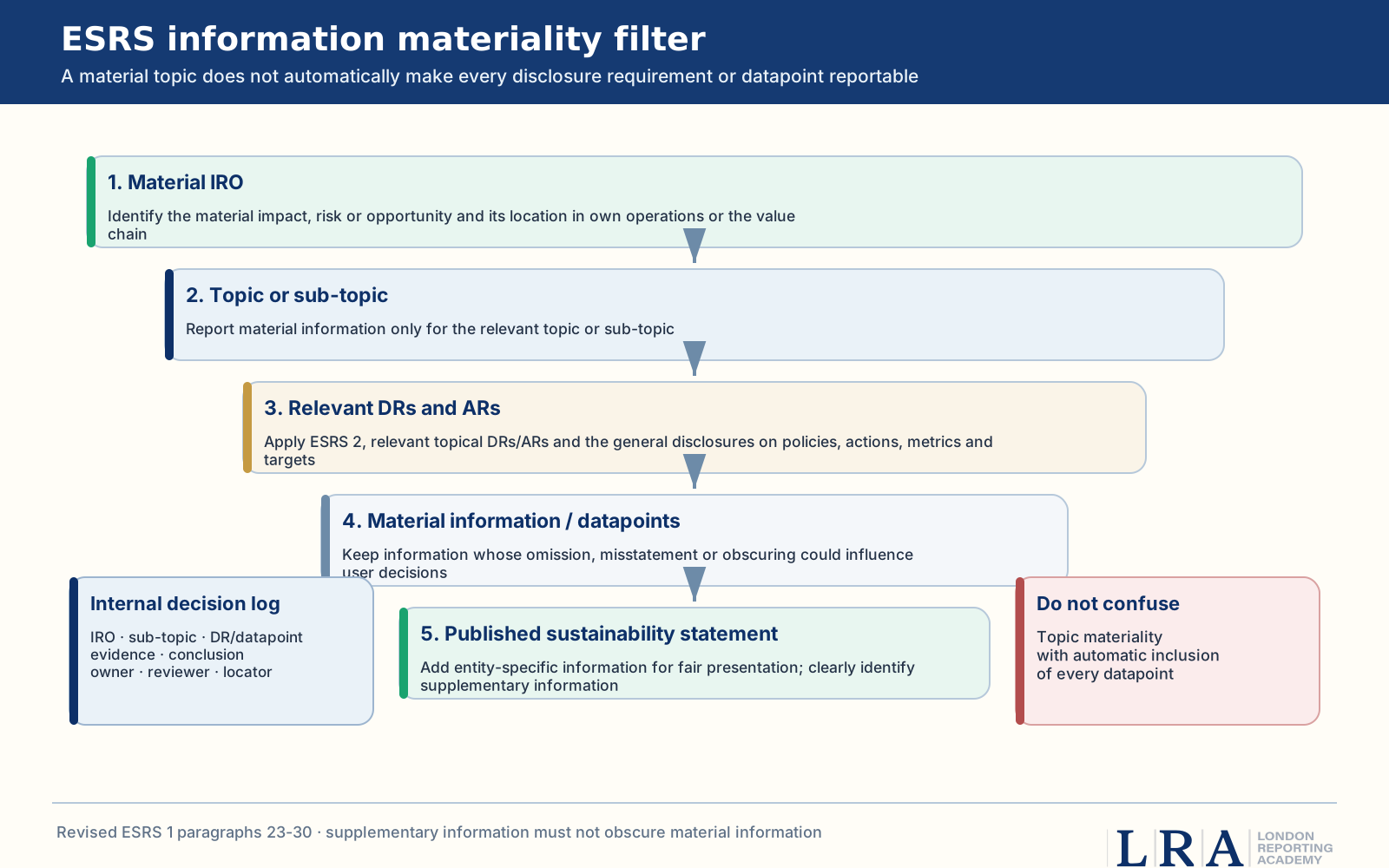
The revised ESRS make the filter explicit. The undertaking first identifies topics or sub-topics linked to material IROs. It then determines the material information to report, applying ESRS 2, relevant topical DRs and ARs, general disclosures for policies, actions, metrics and targets, and entity-specific information where necessary for fair presentation. ESRS 1 paragraph 24 prohibits disclosing non-material information prescribed by an ESRS DR or datapoint, and non-material entity-specific information. The only exception is supplementary information under paragraphs 107-109, clearly identified as not resulting from the materiality assessment.
Quick orientation
Figure 5. The ESRS information-materiality filter from material IRO to published statement.
Quick orientation
- Applies to
- Teams building a disclosure matrix, preparing data requests, drafting topical sections or challenging completeness.
- Primary decision
- Which DRs, ARs, datapoints and entity-specific information are material for each material IRO and sub-topic.
- Key sources
- Revised ESRS 1 paragraphs 23-31, AR 8-12; ESRS 2 IRO-2 and general disclosures.
- Common confusion
- Assuming that materiality of ESRS E1, S1 or another topic automatically activates every datapoint in that standard.
In practice
Five concepts that must not be collapsed
| Concept | What it means in the reporting architecture | Decision made |
|---|---|---|
| Material IRO | An actual or potential impact, risk or opportunity that meets the applicable impact or financial criteria. | Does the IRO enter the reporting scope and under which lens? |
| Topic or sub-topic | The ESRS subject area to which the material IRO relates. | At what level should the statement organise material information? |
| Disclosure Requirement (DR) | A required disclosure objective and set of information elements in ESRS 2 or a topical standard. | Is the DR relevant to the material sub-topic, and what material information is needed? |
| Application Requirement (AR) | Mandatory application provisions with the same authority as the related requirements. | How must the DR or materiality rule be applied? |
| Datapoint / material information | An individual qualitative or quantitative information element. | Could omission, misstatement or obscuring reasonably influence user decisions? |
The two-step ESRS reporting test
1. Identify topics related to material IROs. The undertaking reports material information for a topic or sub-topic when it relates to one or more material IROs.
2. Determine the material information for each topic. Apply ESRS 2; the general disclosures for policies, actions, metrics and targets; relevant topical DRs and ARs; and entity-specific information needed for fair presentation.
Where a material IRO concerns only a sub-topic, the undertaking reports only material information for that sub-topic. This is important for broad standards such as own workforce, climate or biodiversity: a material issue does not automatically activate unrelated sub-topics.
In practice
A practical DR and datapoint filter
| Gate | Question | Evidence retained — Possible conclusion |
|---|---|---|
| 1. IRO gate | Which material IRO does the information explain, and under which lens? | Approved IRO register and rationale. — No linked material IRO: do not treat it as required ESRS information; assess supplementary purpose separately. |
| 2. Sub-topic gate | What is the precise topic/sub-topic and context? | Topic mapping, geography, activity, stakeholder and value-chain location. — Limit reporting to the material sub-topic and appropriate disaggregation. |
| 3. DR / AR gate | Which ESRS 2 or topical DRs/ARs are relevant to that sub-topic? | Standards mapping and disclosure objective. — Apply relevant requirements; do not assume every DR in the topical standard is relevant. |
| 4. Information gate | Would omitting, misstating or obscuring the information influence relevant user decisions? | User need, evidence, significance, aggregation and uncertainty analysis. — Include, exclude, aggregate, disaggregate or add entity-specific information. |
| 5. Fair-presentation gate | Does the statement as a whole give a complete, neutral and accurate depiction? | Overall review, connected information and claim ledger. — Add entity-specific information, adjust balance or remove obscuring immaterial detail. |
| 6. Publication gate | Is any non-material information included for another purpose? | Supplementary-information register and clear label. — Present separately and clearly so it does not obscure ESRS material information. |
What must be visible publicly, and what belongs in the internal file
The revised ESRS do not generally require a public line-by-line reason for every datapoint judged non-material. A defensible internal record is nevertheless essential because the undertaking must demonstrate how the statement was determined and why it is complete, neutral, accurate and not obscured by irrelevant information.
In practice
| Public sustainability statement | Internal decision evidence |
|---|---|
| Concise descriptions of material IROs, topics and where they arise in own operations or the value chain. | IRO-to-topic and IRO-to-DR mapping, including rejected alternatives. |
| The list of DRs complied with and precise locations, including incorporation by reference. | Datapoint-level decisions, evidence, owners, reviewers and information-materiality rationale. |
| A list of supplementary information and the prescribed table of EU-law datapoints, marking those assessed as not material. | Supplementary-purpose and release approval, so voluntary information is not mistaken for mandatory ESRS disclosure. |
| The basis for concluding that climate change is not material when ESRS E1 is omitted. | The full E1 assessment, evidence, challenge and governance approval. |
| Reliefs, options, limitations and significant judgements where ESRS requires them. | The underlying calculation, legal analysis, data-gap log and approval record. |
In practice
Recommended information-materiality decision log
| Field | Example purpose |
|---|---|
| Standard version and reporting period | Prevent a decision under one edition from being reused without review. |
| Material IRO and lens | Anchor the information to the approved materiality conclusion. |
| Topic / sub-topic | Avoid activation of unrelated subject areas. |
| DR, AR and datapoint identifier | Show the exact requirement considered. |
| User decision and significance | Explain why the information could or could not influence decisions. |
| Evidence and uncertainty | Record source, estimate, limitation, aggregation and contrary evidence. |
| Conclusion | Include, exclude, aggregate, disaggregate, incorporate by reference, entity-specific or supplementary. |
| Owner, reviewer and approval | Separate preparation and challenge. |
| Publication locator and version | Confirm that the final statement reflects the approved decision. |
In practice
Worked examples
| Scenario | Materiality conclusion | Reporting consequence |
|---|---|---|
| Own-workforce skills and retention are material; other S1 sub-topics are not linked to material IROs. | The undertaking reports material information on the relevant workforce sub-topic, including connected policies, actions, metrics and targets. | It does not automatically publish every S1 datapoint; it retains the decision log and adds entity-specific retention information if needed for fair presentation. |
| Water is material at two sites in stressed basins but not across all group locations. | The water sub-topic is material, with significant geographic variation. | Information is disaggregated for the material sites or contexts so group averages do not obscure impacts; unrelated water datapoints are filtered. |
| Climate change is assessed as non-material and ESRS E1 is omitted. | A special ESRS 2 IRO-2 disclosure applies. | The basis for the non-material conclusion is disclosed, and the underlying assessment and governance approval are retained. |
| A lender requests an additional metric that is not material under ESRS. | The metric may serve a separate user or contractual purpose but is not automatically ESRS material information. | If included in the sustainability statement, it is clearly identified as supplementary and must not obscure material ESRS information. |
In practice
Over-reporting and under-reporting risks
| Risk | Typical symptom | Control |
|---|---|---|
| Over-reporting | Every datapoint in a material topical standard is included, producing long generic sections and immaterial detail. | Use the IRO-sub-topic-DR-datapoint filter and remove information that does not meet information materiality. |
| Under-reporting | Only existing KPIs are disclosed, while material IROs lack strategy, action, financial-effect or entity-specific information. | Review the disclosure objective and fair presentation; add relevant narrative or entity-specific information. |
| Obscuring | Material information is hidden in aggregated figures, boilerplate or large voluntary appendices. | Disaggregate where significant variation exists and clearly identify supplementary information. |
| Mechanical compliance | The matrix is marked complete because a cell contains any text. | Test whether the information is relevant, faithful, specific, connected and supported by evidence. |
| Uncontrolled omissions | Datapoints disappear from the draft without a decision owner or record. | Maintain a version-controlled decision log and change approval. |
Common mistakes
Calling a broad topic material and treating the entire topical standard as automatically mandatory.
Filtering at datapoint level before identifying the material IRO and relevant sub-topic.
Assuming ESRS 2 can be ignored for a topic because the topical standard contains similar narrative.
Using lack of data as the reason a datapoint is not material. Data availability and information materiality are different decisions.
Failing to add entity-specific information when the prescribed ESRS information does not provide fair presentation.
Including large volumes of voluntary information without labelling it supplementary or checking that it does not obscure material information.
Publishing a disclosure matrix that lists requirements but not precise locations or incorporated references.
Myth
'If ESRS E1 is material, every E1 datapoint is mandatory.'
Reality
Materiality of a topic or sub-topic determines the reporting area. The undertaking then applies information materiality to relevant DRs, ARs and datapoints, while ensuring ESRS 2 and entity-specific information provide fair presentation. The decision must be controlled; it is not permission to select only convenient information.
Readiness
Disclosure-matrix review checklist
- Each material IRO links to a specific topic or sub-topic and disclosure objective.
- Relevant ESRS 2 requirements and general disclosures on policies, actions, metrics and targets are included.
- Topical DRs and ARs are assessed for the material sub-topic rather than activated by standard title alone.
- Every inclusion or exclusion has an owner, evidence and reviewer in the internal decision log.
- Data availability has not been confused with materiality; estimates, limitations and reliefs are addressed separately.
- Entity-specific information is added where prescribed ESRS information is insufficient for fair presentation.
- Aggregation and disaggregation do not obscure site, geography, subsidiary, product or stakeholder differences.
- Supplementary information is clearly identified and does not change the ESRS compliance claim.
- IRO-2 lists the DRs complied with and points users to precise locations.
Sources
Primary sources
- Commission Delegated Regulation (EU) 2026/1563 of 3 July 2026 amending Delegated Regulation (EU) 2023/2772 (OJ L, 2026/1563, 21.9.2026)
- EFRAG Knowledge Hub, Revised ESRS 1 General Requirements (Delegated Act version)
- EFRAG Knowledge Hub, Revised ESRS 2 General Disclosures (Delegated Act version)
- European Commission, adoption announcement, 3 July 2026
- EFRAG Knowledge Hub home page
Framework references
Disclosures this page affects
Take it with you
The checklists as a working spreadsheet
Every checklist and table on this page, with empty status, owner and evidence columns for your team to fill in and keep.
✓ Knowledge Hub AI Assistant · Human-in-the-loop

Ask about this guide
It answers from this page, and reaches into the linked disclosure cards when your question is about the standard itself.
Go deeper · ESRS
Certified ESRS (CSRD) Applied Sustainability Reporting
This page settles one Disclosure Requirement. The ESRS / CSRD course walks the whole European cycle — double materiality, datapoints, evidence and assurance — with drafting exercises on your own data.