Short answer
The answer, before the reasoning
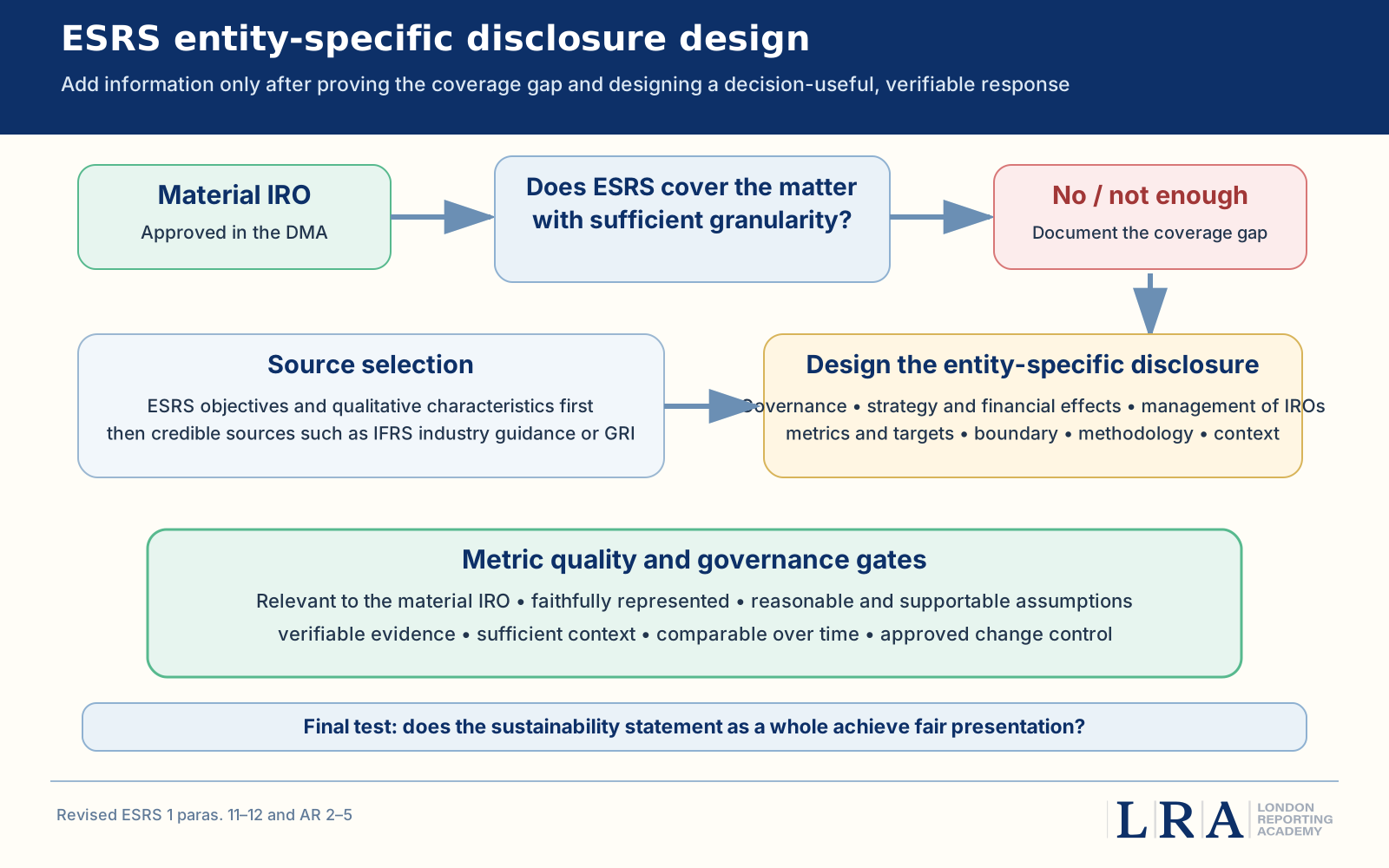
An undertaking needs entity-specific disclosures when a material impact, risk or opportunity is not covered by ESRS, or is not covered with enough granularity for users to understand the matter and how it is managed. The solution is not to invent an attractive KPI.
The organisation should identify the information gap, define the user need, select credible sources, design relevant and faithfully represented information, document methods and assumptions, support comparability and subject the disclosure to the same governance, evidence and assurance controls as an ESRS-prescribed datapoint.
Why entity-specific information is a core ESRS requirement
Sector-agnostic standards cannot anticipate every business model, technology, geography, product or emerging sustainability issue. A cloud provider may have material impacts from local power constraints and water use. A digital marketplace may have material consumer-safety impacts arising from third-party sellers. A bank may face material social impacts from automated credit decisions. A manufacturer may have a critical process-safety risk with sector-specific consequences not captured adequately by a broad topical disclosure.
If the materiality assessment identifies such an IRO, the absence of a perfect ESRS metric is not a reason to omit it. The revised ESRS require entity-specific disclosures when the topic is not covered, or not covered with sufficient granularity. They also make entity-specific information part of fair presentation where applying ESRS alone is insufficient for users to understand material IROs and their management.
In practice
| Quick orientation | Practical meaning |
|---|---|
| Trigger | A material IRO exists and the ESRS coverage is absent or insufficiently granular |
| Objective | Fill the information gap needed for a fair presentation, not create a second voluntary report inside ESRS |
| Source options | ESRS principles, applicable regulation, recognised methods, IFRS industry-based guidance, GRI Standards, sector practice and well-governed internal measures |
| Core quality test | Relevance, faithful representation, completeness, neutrality, accuracy, comparability, verifiability and understandability |
| Main risk | Arbitrary metrics, cherry-picked positive indicators, inconsistent boundaries or unsupported claims |
| Governance outcome | A documented design decision, approved methodology, evidence trail, owner, review and update trigger |
The decision rule
The revised ESRS provide two related tests.
1. Coverage test: Is the topic related to the material IRO covered by an ESRS?
2. Granularity test: If covered, does the ESRS provide enough information for users to understand the specific IRO and how the undertaking manages it?
A “no” answer to either test can require entity-specific information. The test should be applied to the matter as a whole and to the information needed for the relevant reporting areas: governance, strategy, impact/risk/opportunity management, and metrics and targets.
Entity-specific does not mean entity-promotional
The term refers to information designed for the undertaking's facts. It does not authorise the organisation to select only favourable KPIs, use unverified marketing measures or avoid a difficult ESRS metric. The entity-specific layer must be balanced and material. It should explain adverse outcomes, data limitations and methodological changes where these are necessary for understanding.
Entity-specific does not mean “additional information” without limit
The revised ESRS distinguish entity-specific disclosures needed for fair presentation from supplementary non-material information that may be included under controlled conditions. Entity-specific disclosures are driven by material IROs and information materiality. Supplementary information must be clearly identified and must not obscure material information.
When additional entity-specific information is likely to be needed
Common triggers include:
• an emerging issue that is not represented in the ESRS topic list;
• a sector-specific impact with a distinctive pathway, affected population or outcome;
• a material IRO covered only at a high level, where the prescribed information does not explain the undertaking's exposure or management response;
• a material social topic for which the topical ESRS prescribes narrative disclosures but no sufficiently useful metric for the undertaking's facts;
• a business-model feature that creates a material impact through a product, platform, franchise or service arrangement;
• a localised environmental impact where group-level information would obscure significant variation;
• a material risk or opportunity tracked by management through an internal metric that is relevant to users but not prescribed by ESRS;
• a significant change in business model or technology that makes prior disclosures incomplete.
The reporting team should not assume that every internal ESG KPI belongs in the sustainability statement. The question is whether the information is needed to understand a material IRO, meets information materiality and contributes to fair presentation.
A six-stage design process
Stage 1 - define the material IRO precisely
Start with the impact, risk or opportunity, not the metric. The record should identify:
• the affected people, environmental resource or financial exposure;
• whether the impact is actual or potential, positive or negative;
• the activity, product, service or business relationship creating the connection;
• geography and value-chain position;
• time horizon;
• severity, likelihood and financial-effect considerations;
• the evidence supporting materiality.
A vague label such as “digital responsibility” is not a sufficient design basis. “Potential discriminatory outcomes for low-income applicants arising from automated credit models in three markets” is specific enough to test information needs.
Stage 2 - perform a structured ESRS coverage gap analysis
Map the IRO to:
1. ESRS 2 general disclosures;
2. the most relevant topical standard and sub-topic;
3. applicable policies/actions/metrics/targets requirements;
4. any metric-specific boundary or methodology;
5. existing entity-specific disclosures in prior periods.
Classify each information need as:
• fully covered by an ESRS DR;
• partly covered but needing more granularity;
• not covered;
• covered by another mandatory legal disclosure that may be incorporated or cross-referenced;
• non-material and excluded;
• unresolved and requiring technical review.
The gap analysis should be retained as evidence. It explains why the organisation added information and helps reviewers distinguish a necessary entity-specific disclosure from voluntary narrative.
Stage 3 - identify the user need and disclosure objective
Write a one-sentence objective before choosing a KPI. For example:
This objective guides the selection of narrative and metrics. It also prevents the team from reporting an activity metric, such as the number of seller training sessions, when users need outcome information about unsafe products and response effectiveness.
Stage 4 - select sources without claiming equivalence
The revised ESRS allow undertakings to use available best practices, frameworks or reporting standards, including IFRS industry-based guidance and GRI Standards, when developing entity-specific disclosures. This is a source-selection permission, not a statement that the external framework is legally equivalent to ESRS.
A practical source hierarchy is:
For every external source, record the version, purpose, differences from ESRS, modifications made and why the resulting measure is useful for the material IRO.
In practice
| Priority | Source | Use |
|---|---|---|
| 1 | Applicable EU or national law, regulatory definitions and sector rules | Mandatory definitions, thresholds, incident classifications and measurement methods |
| 2 | ESRS principles and the nearest cross-cutting/topical disclosures | Reporting objective, materiality, boundary, qualitative characteristics and presentation |
| 3 | Recognised international or sector standards | Candidate metrics, definitions and comparability, subject to ESRS adaptation |
| 4 | Peer-reviewed science or authoritative technical methodology | Environmental thresholds, health/safety outcomes, modelling and assumptions |
| 5 | Established industry practice and peer disclosures | Benchmarking and terminology, not proof of a universal requirement |
| 6 | Internal management metrics | Entity relevance, provided definitions, controls and comparability are robust |
Designing an entity-specific metric
A metric specification should contain enough information for a different preparer to reproduce the result and for an assurance provider to test it.
The revised ESRS specify that an entity-specific metric should provide relevant information, be measured in a way that faithfully represents the matter using reasonable, supportable and verifiable information and assumptions, and include sufficient context.
Figure 2. Entity-specific metric design and assurance loop. Branded educational visual by London Reporting Academy.
In practice
| Design field | Required decision | Review question |
|---|---|---|
| Metric objective | What material IRO and user need does the metric address? | Does the metric measure the matter or merely an activity around it? |
| Definition | Exact numerator, denominator, categories and inclusion/exclusion rules | Could two owners calculate different results from the definition? |
| Unit and direction | Number, rate, percentage, days, currency or qualitative scale | Is a higher value better, worse or ambiguous? |
| Boundary | Entities, sites, products, workers, customers, value-chain stages and geography | Does the boundary match the material IRO and report boundary? |
| Period and cut-off | Reporting period, event date, case closure date and late adjustments | Are events counted consistently and comparably? |
| Data sources | Systems, external data, surveys, grievances, models or estimates | Are sources complete, authorised and retrievable? |
| Method and assumptions | Formula, classification, model, proxy and estimation rules | Are significant assumptions reasonable, supportable and verifiable? |
| Disaggregation | Geography, affected group, product, severity or channel | Could aggregation obscure a material variation? |
| Comparatives | Baseline, prior periods, restatement and change policy | Is the trend meaningful after scope or method changes? |
| Context | Explanation of performance, actions, limitations and uncertainty | Could a user misinterpret the number without context? |
| Controls | Preparation, review, reconciliation, access and change controls | Is there evidence of operation, not only a written procedure? |
| Governance | Owner, approver and review frequency | Who is accountable for continued relevance and accuracy? |
Methodology, comparability and changes
Methodology note
The public disclosure should normally explain:
• what is measured and why;
• boundary and exclusions;
• data sources and collection frequency;
• calculation or classification method;
• significant assumptions and estimates;
• quality limitations;
• changes from the prior period;
• whether the measure is externally assured and to what scope.
The internal methodology should be more detailed and contain worked examples, decision rules, system fields, control steps and issue escalation.
Comparability over time
The revised ESRS require consideration of comparability over time and with other undertakings in the same sector. Comparability does not prohibit improvement. It requires transparency when definitions, boundaries, systems or estimates change.
Use a change policy that distinguishes:
• method improvement - same underlying phenomenon, better measurement;
• scope change - acquisitions, disposals, new products or boundary decisions;
• error correction - prior information was incorrect;
• classification change - revised categories or severity criteria;
• new metric - information was not previously reported;
• retired metric - no longer relevant, replaced or immaterial.
Where practicable, restate comparatives. Where restatement is not practicable or would not be meaningful, explain the effect and present a bridge.
Sector comparability
External metrics may improve comparability only if definitions and boundaries are genuinely aligned. Copying a SASB or GRI metric title while changing the formula can reduce comparability. Name the source, identify adaptations and avoid unqualified “aligned with” claims.
Hypothetical example: product safety on a digital marketplace
Organisation. A European online marketplace connects third-party sellers with consumers. Its materiality assessment identifies material potential and actual impacts on consumers from unsafe electrical products and delayed removal of repeat offenders.
Coverage assessment. ESRS S4 provides relevant disclosures on consumer impacts, policies, engagement, actions and incidents. The reporting team concludes that the prescribed information does not provide enough granularity for users to understand the scale and effectiveness of the marketplace's specific detection and response model.
Entity-specific objective. Explain the exposure to unsafe listings, the speed and effectiveness of response, recurrence and limitations in seller identification.
Selected metrics.
1. substantiated unsafe-product cases per 100,000 active listings;
2. median time from validated alert to listing restriction;
3. percentage of substantiated cases involving a seller previously subject to a safety action;
4. percentage of high-risk listings covered by pre-listing conformity-document checks;
5. number of consumers notified after confirmed exposure, with a narrative explanation of coverage limitations.
Method decisions. “Substantiated” is linked to a defined internal case status supported by regulator notice, verified testing or completed investigation. The denominator uses average monthly active listings. The response-time clock starts when an alert is validated, not when it is first received. Repeat-seller logic uses a controlled seller-identity matching method and discloses limitations where sellers create new accounts.
Evidence. Case-management extracts, product-testing records, regulator notices, seller master data, system timestamps, reconciliation to customer notifications, methodology approval and access-control logs.
Illustrative disclosure - adapt to facts.
Why it works
The disclosure connects the metric to a material impact, defines the unit and period, provides a comparative, reports an adverse trend, explains an estimate and links performance to actions. It does not claim that faster removal proves that all consumer harm was prevented.
Narrative information may be more useful than a metric
Not every information gap should be filled with a number. For an emerging risk, a decision-useful entity-specific disclosure may explain:
• the nature and pathway of the IRO;
• exposure and affected groups;
• governance and decision rights;
• scenario or sensitivity analysis;
• response options and dependencies;
• uncertainty and data-development plan.
A weak metric can create false precision. The design team should use qualitative information where measurement is immature, while explaining the limitation and improvement plan.
Governance and internal controls
Entity-specific disclosures deserve heightened governance because the standard does not provide a complete ready-made method.
Minimum controls include:
1. gap assessment approval - technical reviewer approves why prescribed ESRS information is insufficient;
2. source review - methodology sources, versions and adaptations are documented;
3. metric specification approval - owner, subject-matter expert, reporting and assurance-readiness reviewer sign off;
4. data lineage - each value traces to systems, transformations and evidence;
5. model governance - estimates, algorithms and proxies have validation and change control;
6. comparative control - changes and restatements are assessed consistently;
7. balanced disclosure review - adverse results and limitations are not suppressed;
8. board or delegated committee review - material new metrics and public claims receive appropriate oversight;
9. annual relevance review - confirm whether the metric remains material, useful and aligned with evolving ESRS or sector standards.
Assurance questions to anticipate
An assurance provider is likely to ask:
• Why was entity-specific information necessary?
• What user need does the disclosure address?
• How was the source or methodology selected?
• Are definitions complete and consistently applied?
• Is the boundary consistent with the material IRO?
• How were estimates validated?
• How are incidents classified and prevented from double counting?
• Why are comparatives meaningful?
• What controls operated and what evidence remains?
• Does the narrative fairly explain limitations and negative performance?
The reporting team should answer these questions in the design file before drafting the public wording.
In practice
Weak versus stronger design
| Weak design | Risk | Stronger design |
|---|---|---|
| “Number of sustainability initiatives” | No clear link to a material IRO or outcome | Metric tied to a defined impact, affected group and decision-useful outcome |
| Metric copied from a peer report | Unknown method and boundary; false comparability | Source reviewed, definition adapted transparently and differences documented |
| Positive KPI only | Cherry-picking and unbalanced presentation | Outcome, adverse incidents, coverage, limitations and corrective action shown together |
| No comparative because the metric is new | Users cannot assess direction | Explain that it is new, provide baseline if supportable and define future comparative policy |
| Internal dashboard screenshot | Uncontrolled fields and unclear evidence | Approved metric specification, controlled data lineage and report-ready narrative |
Common mistakes and corrections
1. Treating “no ESRS metric” as “no disclosure”. Perform the coverage and granularity test and design the needed information.
2. Starting with an available internal KPI. Start with the material IRO and user need, then test whether the KPI is relevant.
3. Using external standards without documenting differences. Record source, version, adaptations and residual ESRS requirements.
4. Reporting activity instead of outcome. Pair training, audits or checks with impact, coverage or effectiveness information.
5. Changing definitions annually without a change policy. Maintain version control, comparatives and restatement decisions.
6. Hiding uncertainty behind a precise percentage. Explain assumptions, proxies, ranges and data-quality limitations.
7. Using group averages that obscure a severe local impact. Disaggregate where significant variations arise.
8. Assuming assurance will be lighter because the metric is company-designed. Expect more challenge on relevance, method and controls.
Readiness
Implementation checklist
- A material IRO is documented with evidence and a clear level of granularity.
- ESRS coverage is mapped and the information gap is approved.
- The entity-specific disclosure has a written user-oriented objective.
- Sources and external frameworks are versioned and adaptations are recorded.
- Metrics have complete specifications, boundaries, methods and owners.
- Narrative information is used where a metric would create false precision.
- Comparability and restatement rules are defined.
- Data lineage, access, calculation, review and change controls operate.
- Limitations and adverse outcomes are reflected in public wording.
- The disclosure is tested for fair presentation and information materiality.
- Update triggers include EFRAG or Commission guidance, non-mandatory sector guidance, regulation, methodology changes and evidence issues. Mandatory sector-specific ESRS are no longer expected: Omnibus I (Directive (EU) 2026/470) removed the empowerment to adopt them.
Self-check
- Can the team explain exactly what users would not understand if the entity-specific disclosure were removed?
- Can an independent reviewer reproduce the metric from the specification and evidence?
- Does the disclosure remain balanced when performance deteriorates?
Related standards and guidance
• Revised ESRS 1 paragraphs 11-12 and AR 2-5: trigger, reporting areas, metric quality and source options for entity-specific disclosures.
• Revised ESRS 1 paragraphs 19-21 and AR 6-7: fair presentation and statement-level assessment.
• Revised ESRS 2 GDR-M and GDR-T: metric and target context for entity-specific information.
• EFRAG IG 1: non-authoritative guidance for identifying entity-specific matters under the 2023 ESRS.
• IFRS industry-based guidance and GRI Standards: possible sources, subject to adaptation and no automatic equivalence.
Frequently asked questions
Must every material IRO have an entity-specific metric?
No. The undertaking needs material information sufficient for fair presentation. Depending on the IRO and data maturity, that may be narrative, a metric, a target, a scenario analysis or a combination.
Can we copy a SASB or GRI metric directly?
It may be a useful source, but the organisation should confirm relevance, boundary, method and comparability, document adaptations and meet ESRS materiality and fair-presentation requirements.
Are entity-specific disclosures outside the assurance scope?
No. If they form part of the ESRS sustainability statement, they are part of the reported sustainability information and should be prepared for the applicable assurance scope.
Can an entity-specific metric replace a prescribed ESRS metric?
Not merely because the internal measure is easier or more favourable. Prescribed applicable material information must still be addressed unless a specific relief or other rule applies. Entity-specific information fills gaps; it is not a general substitution right.
Framework references
Disclosures this page affects
Take it with you
The checklists as a working spreadsheet
Every checklist and table on this page, with empty status, owner and evidence columns for your team to fill in and keep.
✓ Knowledge Hub AI Assistant · Human-in-the-loop

Ask about this guide
It answers from this page, and reaches into the linked disclosure cards when your question is about the standard itself.
Go deeper · ESRS
Certified ESRS (CSRD) Applied Sustainability Reporting
This page settles one Disclosure Requirement. The ESRS / CSRD course walks the whole European cycle — double materiality, datapoints, evidence and assurance — with drafting exercises on your own data.