Short answer
The answer, before the reasoning
A top-down ESRS materiality assessment begins with the undertaking rather than with an exhaustive list of datapoints. It uses strategy and business model, sectors, geographies, activities, business relationships, upstream and downstream value-chain features, due-diligence evidence, incidents and known risk signals to identify topics or sub-topics whose materiality or non-materiality is evident.
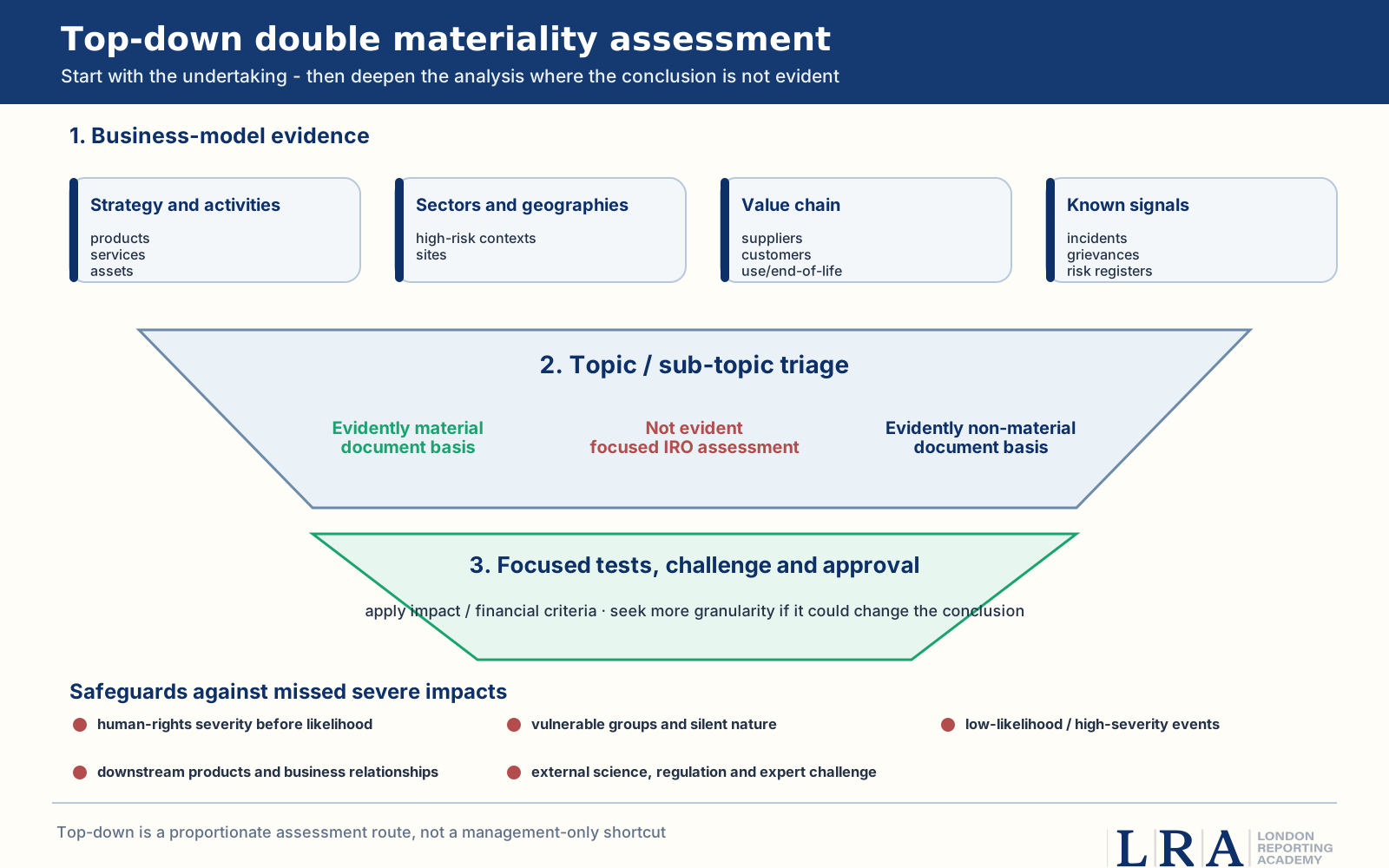
Where the conclusion is not evident - or where greater granularity could change it - the undertaking performs a focused assessment of the relevant impacts, risks or opportunities. The approach may be combined with bottom-up analysis for selected topics. Proportionality does not remove the need for the ESRS impact and financial criteria, evidence, challenge, severe-impact safeguards and governance approval.
Rule
ESRS-MAT-003
Top-Down Double Materiality Assessment Under Revised ESRS: Practical Methodology. A proportionate route from business model, sectors, geographies and known signals to focused IRO assessment and approval.
In practice
Type
| Type | Tier | Audience — Current context |
|---|---|---|
| Top-down DMA methodology and workshop guide | Tier 4 · Expert Methodology Guide | Experienced reporters redesigning DMA under the revised ESRS — Revised ESRS 1 paragraphs 27-28 and 32-33, AR 9-11 and AR 13-16; legal status checked to 25 September 2026 (Delegated Regulation (EU) 2026/1563) |
Rule
2026 VERSION GATE
The revised ESRS were adopted by the European Commission on 3 July 2026 as Commission Delegated Regulation (EU) 2026/1563 and published in the Official Journal on 21 September 2026 (OJ L, 2026/1563). The Regulation enters into force on 10 November 2026 and applies to financial years beginning on or after 1 January 2027. For financial years beginning between 1 January and 31 December 2026, Article 2 gives undertakings two routes: (a) apply either the 2023 ESRS (Delegated Regulation (EU) 2023/2772 as last amended by Delegated Regulation (EU) 2025/1416) or the revised ESRS; or (b) apply the 2023 ESRS together with specified reliefs from revised ESRS 1: the top-down DMA (paragraph 27), undue cost or effort and the value-chain limitation in the DMA (paragraphs 32-33), acquisitions and disposals (paragraphs 74-75), metrics for non-significant activities (paragraph 90), partial reporting scope of the value chain (paragraph 91), joint operations (paragraph 92), Taxonomy disclosures in a separate appendix (paragraph 106) and the executive summary (paragraph 110). The sustainability statement must clearly state which version is applied (Article 2(2)). Every project should record its version decision for financial year 2026, together with any reliefs used, and control it through the reporting cycle. For a double materiality assessment, this means the top-down approach (paragraph 27) and paragraphs 32-33 are available for financial year 2026 under either version of the ESRS (Article 2(1)(b)(i)-(ii)). The undertaking must state the version it applies (Article 2(2)) and disclose the reliefs it uses. The article below explains the revised text.
Why top-down does not mean superficial
The revised ESRS introduce an explicit top-down route to avoid unnecessary work. The purpose is to begin with evidence about the undertaking and focus detailed assessment where it can change the conclusion. It is not permission to replace the ESRS criteria with a management brainstorm, a peer list or a sector template.
A robust top-down process can reach conclusions at topic or sub-topic level when materiality or non-materiality is evident. If the conclusion is not evident, or if a more granular assessment could reasonably lead to a different result, the undertaking performs a focused IRO assessment. It can combine this route with bottom-up analysis for specific topics.
Quick orientation
Figure 4. Top-down DMA funnel with focused assessment and severe-impact safeguards.
Quick orientation
- Applies to
- Undertakings redesigning an exhaustive DMA, experienced reporters refreshing prior conclusions and groups with complex value chains.
- Primary decision
- Which topics can be concluded from business-model evidence and which require focused IRO-level assessment.
- Key sources
- Revised ESRS 1 paragraphs 27-28 and 32-33, AR 9-11 and AR 13-16, and the impact/financial criteria.
- Common confusion
- Equating top-down with using only senior-management views or declaring entire standards non-material without challenge.
In practice
A six-phase top-down methodology
| Phase | Method | Evidence / output — Review question |
|---|---|---|
| 1. Build the undertaking profile | Map strategy, activities, products/services, assets, sectors, geographies, resources, customers, suppliers, financing and business relationships. | Business-model map, significant sector/activity list, geography and value-chain map. — Where are material IROs likely or unlikely to arise, and why? |
| 2. Create topic hypotheses | Use the ESRS topic architecture as a completeness prompt, not a list of automatically reportable matters. Add entity-specific topics and known signals. | Topic/sub-topic heat map with likely drivers and evidence sources. — Would excluding a topic conflict with the business model, due-diligence or risk evidence? |
| 3. Triage evident conclusions | Classify topics as evidently material, evidently non-material or not evident under the impact and financial lenses. | Initial conclusion and written rationale at topic/sub-topic level. — Is the evidence sufficient, or could greater granularity change the conclusion? |
| 4. Perform focused deep dives | For uncertain or heightened-risk matters, identify and assess relevant IROs using severity, likelihood, magnitude, dependencies and context. | Focused IRO records, expert/stakeholder input and decision analysis. — Have severe impacts, vulnerable groups, site differences and value-chain tiers been tested? |
| 5. Challenge completeness | Run cross-functional, external-evidence and independent-review challenge against incidents, grievances, science, regulation, risk registers and sector experience. | Challenge log, overrides, residual uncertainties and evidence gaps. — What credible contrary evidence could overturn the conclusion? |
| 6. Approve and translate | Approve topics and IROs, then map them to DRs, datapoints, entity-specific information and the public IRO-1/IRO-2 disclosures. | Approved register, disclosure matrix, content architecture and update triggers. — Can the published scope be traced to evidence and a governance decision? |
How to design the workshops
Workshop voting can help surface disagreement, but it does not determine materiality. The facilitator should record the evidence, reasoning and unresolved challenge. Seniority should not replace the criteria, and affected-stakeholder evidence should not be converted into a popularity score.
In practice
| Workshop | Participants | Pre-read — Decisions |
|---|---|---|
| 1. Business model and hotspot workshop | Strategy, finance, risk, sustainability, operations, procurement, HR and geographic leads. | Business-model/value-chain map, prior DMA, incidents, risk register, regulatory/scientific scan. — Likely material and likely non-material topics; uncertainties requiring deep dives. |
| 2. Impact challenge workshop | Due diligence, human rights, environment, safety, HR, procurement, community and external experts or stakeholder proxies as relevant. | Impact evidence cards, affected-stakeholder information, severity analysis and high-risk geography notes. — Impact-material IROs, severe-impact overrides and evidence gaps. |
| 3. Financial challenge and approval workshop | Finance, risk, strategy, treasury, business units, investor relations and legal. | Risk/opportunity pathways, scenarios, budgets, asset exposure, financial-effect estimates and dependencies. — Financial-material IROs, connections, final topic set and matters escalated to governance. |
In practice
Safeguards against missing severe impacts
| Safeguard | Practical test |
|---|---|
| Human-rights severity | Could scale, scope or irremediability make the impact severe even when likelihood is low or evidence is incomplete? |
| Vulnerable stakeholders | Are children, migrant workers, indigenous peoples, low-income communities or other vulnerable groups visible in the evidence? |
| Nature as a silent stakeholder | Has the assessment used ecological, basin, ecosystem or scientific evidence where direct stakeholder voice is impossible? |
| Geographic granularity | Could country, region, basin, ecosystem or site context change a group-level conclusion? |
| Downstream products and services | Have use, misuse, disposal, access and customer relationships been considered rather than only procurement? |
| Business relationships and indirect tiers | Do high-risk impacts arise beyond direct suppliers or through finance, franchise, logistics or joint arrangements? |
| Low-likelihood/high-severity events | Could a catastrophic event remain material even if modelled probability is low? |
| External contrary evidence | Do regulator findings, litigation, scientific data, investigative reports or peers reveal a credible gap in internal evidence? |
| Entity-specific topics | Does the business model create a material matter not sufficiently covered by the ESRS topic list? |
| Independent challenge | Has someone outside the preparer group attempted to disprove the non-material conclusions? (Recommended practice, not an ESRS requirement.) |
Hypothetical scenario
ILLUSTRATIVE SCENARIO
An electronics group begins with its business model: semiconductor assembly, branded consumer devices, cloud services and a multi-tier mineral supply chain. Climate energy use, mineral sourcing, product privacy, electronic waste and skilled-labour dependence are evidently relevant. Office water use is provisionally non-material at group level, but a focused review is triggered for one assembly site in a water-stressed basin. The review establishes a material water impact and production dependency at that site, changing the group-level conclusion for the water sub-topic and requiring disaggregated information. The process avoids scoring every hypothetical water IRO across every office while preserving a safeguard for context-specific severity.
Illustrative only. It shows how the decision is made, not wording that can be copied or relied on.
In practice
What top-down is not
| Shortcut | Why it is not a defensible top-down method | Correction |
|---|---|---|
| Copy the peer topic list | Peers are contextual evidence, not proof of the undertaking’s IROs. | Start with the undertaking’s activities and relationships; use peers only as a completeness challenge. |
| Ask executives for their top five ESG issues | Management views can omit affected stakeholders, severe impacts and value-chain evidence. | Use structured evidence and separate impact and financial criteria. |
| Declare a whole topical standard non-material | A topic-level conclusion may hide a material sub-topic or site-specific impact. | Increase granularity whenever it could change the conclusion. |
| Treat no data as no issue | Data absence may signal an evidence gap rather than non-materiality. | Use reasonable and supportable external, sector or regional evidence and document limitations. |
| Score datapoints before identifying IROs | Datapoints are disclosure elements, not the object of materiality assessment. | Identify material IROs and topics first, then apply information materiality. |
Common mistakes
Using top-down only for negative conclusions while requiring exhaustive evidence for material topics, creating an asymmetric methodology. Paragraph 27 allows a conclusion to be derived “without further assessment” where materiality or non-materiality is evident, and AR 13(b) confirms that no exhaustive search for information is required.
Failing to distinguish evident non-materiality from an uncertain conclusion that needs focused assessment.
Applying one group-wide geography level when basin, ecosystem, region or site context can change impact severity.
Ignoring existing due-diligence, grievance and risk-management evidence because it was not created for the DMA.
Letting workshop consensus override severe-impact evidence or external expert findings.
Documenting only final topics and losing the trace from business-model evidence to the conclusion.
Assuming that a proportionate process requires no annual change review. Significant changes must still be considered at each reporting date.
Myth
'Top-down DMA means management can decide material topics from a high-level workshop.'
Reality
Top-down is an evidence-led route that starts with the undertaking’s strategy, business model, sectors, geographies and value chain. It still applies impact and financial criteria, deepens analysis where needed, uses stakeholder and external evidence, and retains challenge and approval.
Readiness
Top-down DMA checklist
- The business-model profile covers own operations and upstream/downstream relationships.
- The topic map includes entity-specific matters and known incidents, dependencies and regulatory/scientific signals.
- Each high-level conclusion is labelled evident, not evident or requiring focused work under each lens.
- Granularity increases where site, product, stakeholder or value-chain context could change the outcome.
- Severe human-rights impacts and low-likelihood/high-severity events receive explicit override tests.
- Non-material conclusions have evidence, not only absence of management concern; a named reviewer and independent challenge are recommended practice rather than ESRS requirements.
- Workshops record reasons and dissent rather than only votes.
- The final IRO register, disclosure matrix and IRO-1 process description are consistent.
Sources
Primary sources
- Commission Delegated Regulation (EU) 2026/1563 of 3 July 2026 amending Delegated Regulation (EU) 2023/2772 (OJ L, 2026/1563, 21.9.2026)
- EFRAG Knowledge Hub, Revised ESRS 1 General Requirements (Delegated Act version)
- EFRAG Knowledge Hub, Revised ESRS 2 General Disclosures (Delegated Act version)
- European Commission, adoption announcement, 3 July 2026
- EFRAG Knowledge Hub home page
- EFRAG State of Play 2026
Framework references
Disclosures this page affects
Take it with you
The checklists as a working spreadsheet
Every checklist and table on this page, with empty status, owner and evidence columns for your team to fill in and keep.
✓ Knowledge Hub AI Assistant · Human-in-the-loop

Ask about this guide
It answers from this page, and reaches into the linked disclosure cards when your question is about the standard itself.
Go deeper · ESRS
Certified ESRS (CSRD) Applied Sustainability Reporting
This page settles one Disclosure Requirement. The ESRS / CSRD course walks the whole European cycle — double materiality, datapoints, evidence and assurance — with drafting exercises on your own data.