Short answer
The answer, before the reasoning
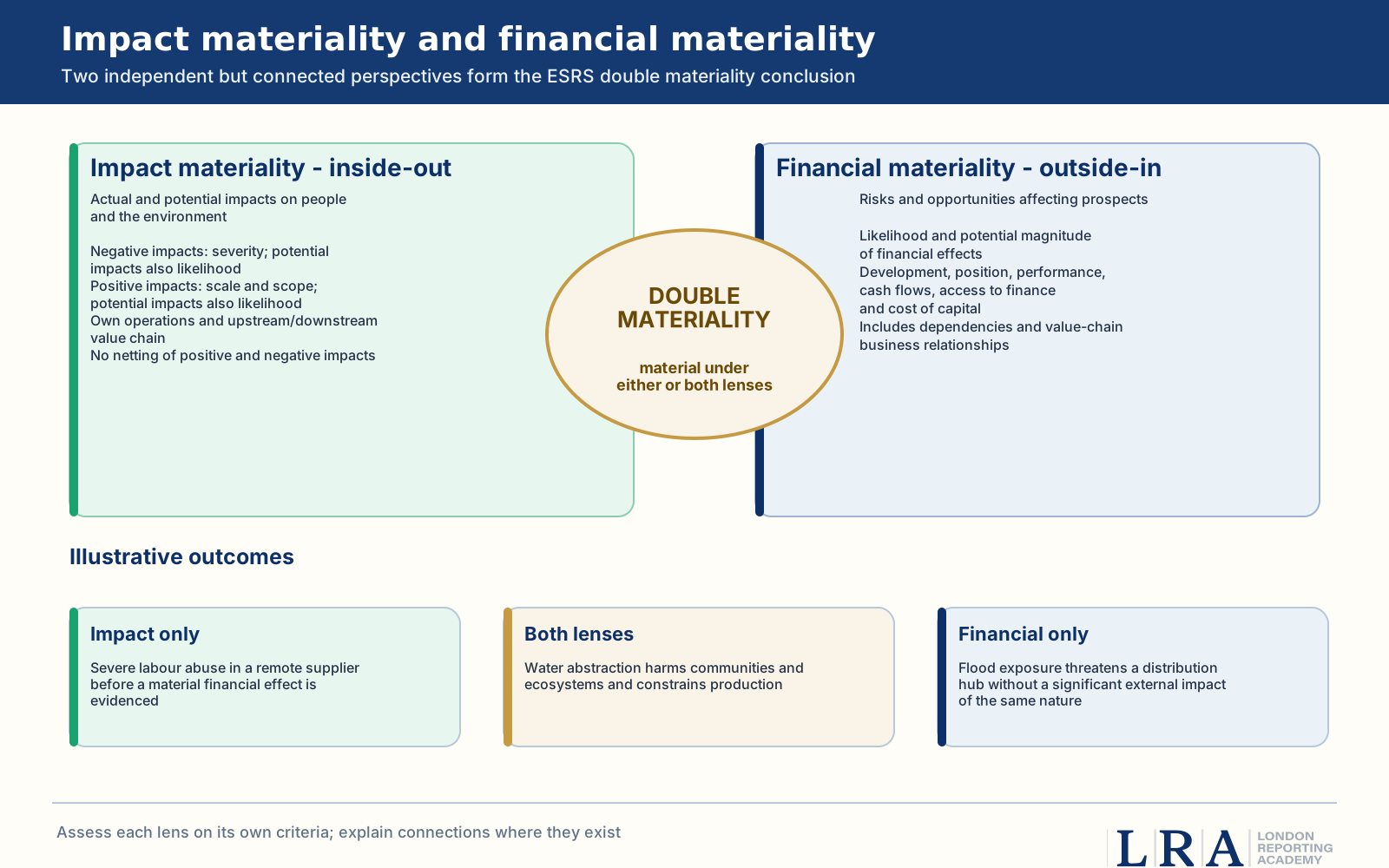
Impact materiality and financial materiality answer different questions. Impact materiality considers actual and potential positive and negative impacts on people and the environment connected with the undertaking, including through its upstream and downstream value chain.
Financial materiality considers sustainability-related risks and opportunities that have or could reasonably be expected to have material financial effects on the undertaking over the short, medium or long term. A topic is material under ESRS if it is material from either perspective or both. The lenses must be assessed on their own criteria, while connections - including impacts that create financial risks and dependencies that affect access to resources - should be explained rather than collapsed into one score.
Rule
ESRS-MAT-002
Impact Materiality vs Financial Materiality: How ESRS Double Materiality Works. Inside-out and outside-in perspectives, actual and potential impacts, severity, likelihood, dependencies and financial effects.
In practice
Type
| Type | Tier | Audience — Current context |
|---|---|---|
| Two-lens materiality comparison and application guide | Tier 3 · Deep Comparison Guide | Practitioners who need to distinguish and connect the two materiality lenses — Revised ESRS 1 Chapters 3.2.1 and 3.2.2 (Delegated Regulation (EU) 2026/1563) checked to 25 September 2026 |
Rule
2026 VERSION GATE
The revised ESRS were adopted by the European Commission on 3 July 2026 as Commission Delegated Regulation (EU) 2026/1563 and published in the Official Journal on 21 September 2026 (OJ L, 2026/1563). The Regulation enters into force on 10 November 2026 and applies to financial years beginning on or after 1 January 2027. For financial years beginning between 1 January and 31 December 2026, Article 2 gives undertakings two routes: (a) apply either the 2023 ESRS (Delegated Regulation (EU) 2023/2772 as last amended by Delegated Regulation (EU) 2025/1416) or the revised ESRS; or (b) apply the 2023 ESRS together with specified reliefs from revised ESRS 1: the top-down DMA (paragraph 27), undue cost or effort and the value-chain limitation in the DMA (paragraphs 32-33), acquisitions and disposals (paragraphs 74-75), metrics for non-significant activities (paragraph 90), partial reporting scope of the value chain (paragraph 91), joint operations (paragraph 92), Taxonomy disclosures in a separate appendix (paragraph 106) and the executive summary (paragraph 110). The sustainability statement must clearly state which version is applied (Article 2(2)). Every project should record its version decision for financial year 2026, together with any reliefs used, and control it through the reporting cycle. The article below explains the revised text.
Why the distinction matters
Many reporting teams use “inside-out” and “outside-in” as shorthand. The shorthand is useful, but it can hide the real decision criteria. Impact materiality is not a reputation score, and financial materiality is not limited to amounts already recognised in the financial statements. A topic may be material under one lens before it becomes material under the other, and the connection can change over time.
The double materiality principle therefore does not mean that both lenses must be met. It means that the undertaking reports material impacts and material risks and opportunities, using the relevant perspective and explaining connections where decision-useful.
Quick orientation
Figure 3. The two ESRS materiality lenses and illustrative impact-only, dual and financial-only outcomes.
Quick orientation
- Applies to
- DMA teams, governance bodies and reviewers deciding which lens applies and how conclusions interact.
- Primary decision
- Whether a topic is material from the impact perspective, financial perspective or both.
- Key sources
- Revised ESRS 1 paragraphs 35-50 and related Application Requirements.
- Common confusion
- Using one blended score that allows a strong result under one lens to cancel a weak result under the other.
In practice
The two perspectives compared
| Dimension | Impact materiality | Financial materiality |
|---|---|---|
| Core question | Does the undertaking have material actual or potential positive or negative impacts on people or the environment? | Does a sustainability-related risk or opportunity have or could it reasonably be expected to have material financial effects on the undertaking? |
| Primary orientation | Effects of the undertaking through own operations, products/services and business relationships. | Effects on the undertaking’s development, financial position, performance, cash flows, access to finance or cost of capital. |
| Negative / positive | Actual and potential, negative and positive impacts are assessed; positive impacts are assessed separately and not netted. | Risks and opportunities are assessed; their origin may include impacts, dependencies or other external factors. |
| Actual / potential | Actual negative: severity. Potential negative: severity and likelihood. Actual positive: scale and scope. Potential positive: scale, scope and likelihood. | Past or future events can create risks/opportunities; materiality is based on likelihood and potential magnitude of financial effects. |
| Value-chain reach | Includes impacts connected through upstream and downstream business relationships, not only controlled entities. | Includes risks and opportunities attributable to upstream and downstream business relationships. |
| Dependencies | Relevant where use of natural, human or social resources creates or contributes to impacts. | Explicit source of financial effects, even when the dependency does not create a material impact of the same nature. |
| Time horizon | Current and potential impacts across appropriate horizons and contexts. | Short, medium and long term, including anticipated effects not yet recognised in financial statements. |
| Main evidence | Due diligence, incidents, stakeholder evidence, scientific/context data, severity and likelihood analysis. | Risk management, budgets, forecasts, scenarios, asset/value-chain exposure, financing and strategic plans. |
Impact materiality in more detail
For actual negative impacts, severity drives the materiality assessment. For potential negative impacts, severity is combined with likelihood. Severity is assessed through scale, scope and irremediable character; any one characteristic can make an impact severe. For a potential negative human-rights impact, severity takes precedence over likelihood. This prevents a low estimated probability from automatically excluding a catastrophic or irremediable human-rights outcome.
Actual positive impacts are assessed using scale and scope; potential positive impacts also include likelihood. Positive impacts are assessed on their own and cannot be netted against negative impacts. Preventing, mitigating or remediating negative impacts to which the undertaking is connected, or merely complying with law, is not itself a positive impact under the revised ESRS logic.
Financial materiality in more detail
A sustainability topic is financially material when related risks or opportunities have or could reasonably be expected to have material financial effects over the short, medium or long term. The scope is broader than information recognised in the financial statements. It includes anticipated effects, resources not recognised as assets, and risks or opportunities arising through business relationships.
Financial risks and opportunities can arise from material impacts, dependencies on natural, human or social resources, and other factors such as climate hazards or regulatory change. A dependency can affect the ability to obtain a resource, its quality and price, or the terms of business relationships even if no material impact of the same nature has been established.
In practice
Five examples across the lenses
| Illustrative topic | Impact conclusion | Financial conclusion — Why the conclusions can differ |
|---|---|---|
| Child labour in an upstream mineral supply chain | Potential or actual severe human-rights impact may be material based on severity and likelihood, with severity prioritised. | Financial effects may be material if disruption, litigation, market access or financing consequences are expected; they may not yet be material. — The harm to people does not depend on proving a material cash-flow effect. |
| Flood exposure at a distribution hub | There may be no significant external impact of the same nature merely because the asset is exposed. | Physical-risk exposure may be material because of downtime, repair cost, inventory loss or insurance/finance effects. — A financial risk can exist without a corresponding material impact. |
| Water abstraction in a stressed basin | Community and ecosystem harm may be material through severity, scope and irremediability. | Permitting, production capacity, input cost and asset value may create material financial risk. — The same underlying dependency and activity can make both lenses material. |
| Low-carbon equipment sold to customers | A genuine positive impact may exist if evidence shows the product reduces another party’s negative impacts and the undertaking is not merely mitigating harm to which it is connected. | Demand, margin, market access or capital allocation may create a material opportunity. — Positive impact and opportunity require separate evidence; revenue alone does not prove impact. |
| Workforce upskilling programme | Training activity is not automatically a positive impact; outcomes for workers must be evidenced. | Skills shortages, productivity, retention or growth capacity may create a material risk or opportunity. — An activity can be financially relevant while its positive impact claim remains unsupported. |
How the lenses interact
1. Start by identifying impacts. ESRS 1 states that the process generally begins with impacts, while risks and opportunities unrelated to impacts must also be evaluated.
2. Test each lens independently. A topic enters the reporting scope when it is material under impact materiality, financial materiality or both.
3. Trace pathways. A negative impact can lead to regulation, litigation, disruption or financing effects; a dependency can constrain resources or affect cost and quality.
4. Avoid automatic causality. The existence of an impact does not prove a material financial effect, and the existence of a financial risk does not prove a significant impact.
5. Present connected information. Where an action taken on one topic creates a material impact or risk on another, the statement should explain the connection and trade-off.
Hypothetical scenario
ILLUSTRATIVE SCENARIO
A steel producer plans to close two high-emission facilities and invest in electric-arc capacity. The climate transition reduces future emissions and may improve market access. It also creates potential negative impacts on workers and communities through redundancies, local supplier loss and regional economic effects. Climate transition risk and opportunity are financially material. Workforce and community impacts are impact-material, and some may also become financially material through restructuring cost, labour relations and project delay. The statement should not present the climate opportunity without the connected social impacts and the actions designed to address them.
Illustrative only. It shows how the decision is made, not wording that can be copied or relied on.
In practice
Weak versus stronger reasoning
| Weak reasoning | Why it fails | Stronger reasoning |
|---|---|---|
| “The topic scored 3.2 overall, below the 3.5 cut-off.” | One blended score may hide a severe impact or a material financial exposure. | State the impact and financial criteria separately, document any threshold and preserve qualitative overrides. |
| “The issue has no current P&L effect, so it is not financially material.” | Financial materiality includes anticipated effects and access-to-finance or cost-of-capital effects over time. | Assess likelihood, potential magnitude, time horizon, dependencies and effects not yet recognised in the financial statements. |
| “The programme generated £5 million of revenue, proving positive impact.” | Commercial output does not prove beneficial change for people or the environment. | Evidence the outcome and counterfactual cautiously, and assess the financial opportunity separately. |
| “Positive impacts offset the negative impacts.” | ESRS does not permit netting positive and negative impacts in the materiality assessment. | Assess and report each material impact and explain trade-offs without cancellation. |
Common mistakes
Using “inside-out” and “outside-in” without applying the actual ESRS criteria.
Treating reputation as a complete financial-materiality test rather than tracing the financial pathway and magnitude.
Using current financial statement recognition as the boundary of financial materiality.
Ignoring value-chain impacts or financial exposures because the entities are not controlled.
Reducing potential impacts to likelihood and overlooking severity, especially for human rights.
Calling a mitigation activity or legal compliance a positive impact without evidence of a distinct beneficial effect.
Netting impacts or combining both lenses into a single average that obscures materiality under one perspective.
Myth
'A topic is material under double materiality only when it is material under both lenses.'
Reality
A sustainability topic meets double materiality when it is material from the impact perspective, the financial perspective, or both. The two conclusions can differ, and each must be supported by its own criteria and evidence.
Readiness
Review checklist
- Where the assessment is performed at IRO level (bottom-up or focused assessment), every IRO is classified clearly as an impact, risk or opportunity and as actual/potential and positive/negative where relevant. Under a top-down approach, conclusions may be reached at topic or sub-topic level for combined IROs (ESRS 1 paragraph 27, AR 9).
- Impact conclusions show scale, scope, irremediability and likelihood as applicable.
- Financial conclusions show likelihood, potential magnitude, time horizon and the financial pathway.
- Dependencies and upstream/downstream business relationships are considered.
- Human-rights severity and vulnerable groups are not diluted by low probability or aggregation.
- Positive and negative impacts are assessed separately without netting.
- Materiality under one lens is not rejected because the other lens is non-material.
- Connections and trade-offs are described without unsupported causal claims.
Sources
Primary sources
- Commission Delegated Regulation (EU) 2026/1563 of 3 July 2026 amending Delegated Regulation (EU) 2023/2772 (OJ L, 2026/1563, 21.9.2026)
- EFRAG Knowledge Hub, Revised ESRS 1 General Requirements (Delegated Act version)
- EFRAG Knowledge Hub, Revised ESRS 2 General Disclosures (Delegated Act version)
- European Commission, adoption announcement, 3 July 2026
- EFRAG Knowledge Hub home page
Take it with you
The checklists as a working spreadsheet
Every checklist and table on this page, with empty status, owner and evidence columns for your team to fill in and keep.
✓ Knowledge Hub AI Assistant · Human-in-the-loop

Ask about this guide
It answers from this page, and reaches into the linked disclosure cards when your question is about the standard itself.
Go deeper · ESRS
Certified ESRS (CSRD) Applied Sustainability Reporting
This page settles one Disclosure Requirement. The ESRS / CSRD course walks the whole European cycle — double materiality, datapoints, evidence and assurance — with drafting exercises on your own data.