Short answer
The answer, before the reasoning
An ESRS double materiality assessment is an evidence-based process for identifying material impacts, risks and opportunities under two separate but connected lenses. It does not require one prescribed matrix, a universal numerical scale or exhaustive scoring of every possible datapoint.
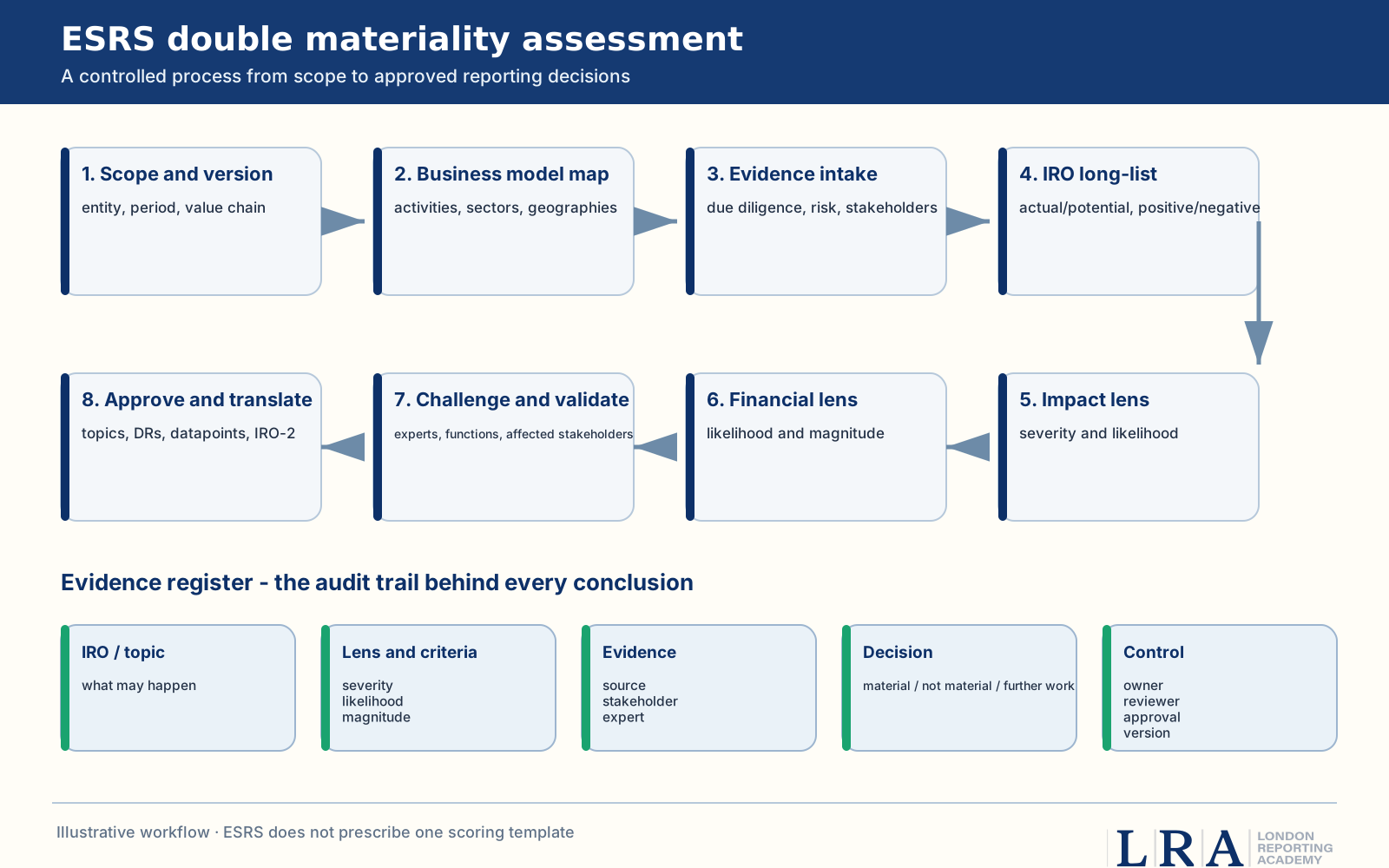
A defensible process defines scope and decision rules, understands the business model and value chain, gathers internal and external evidence, identifies actual and potential IROs, assesses impact materiality and financial materiality using their respective criteria, validates conclusions with relevant functions and stakeholder evidence, obtains governance approval, and translates the outcome into the IRO register and disclosure matrix. The methodology, thresholds, sources, judgements and changes should remain traceable.
Rule
ESRS-MAT-001
ESRS Double Materiality Assessment: A Step-by-Step Guide for 2026. From scope and business-model evidence to impact and financial tests, challenge, approval and the disclosure architecture.
In practice
Type
| Type | Tier | Audience — Current context |
|---|---|---|
| Double materiality assessment methodology guide | Tier 4 · Expert How-to Guide | DMA owners, functional experts, reviewers and governance bodies — Revised ESRS 1 and ESRS 2 materiality provisions; no prescribed scoring template |
Rule
2026 VERSION GATE
The revised ESRS were adopted by the European Commission on 3 July 2026 as Commission Delegated Regulation (EU) 2026/1563 and published in the Official Journal on 21 September 2026 (OJ L, 2026/1563). The Regulation enters into force on 10 November 2026 and applies to financial years beginning on or after 1 January 2027. For financial years beginning between 1 January and 31 December 2026, Article 2 gives undertakings two routes: (a) apply either the 2023 ESRS (Delegated Regulation (EU) 2023/2772 as last amended by Delegated Regulation (EU) 2025/1416) or the revised ESRS; or (b) apply the 2023 ESRS together with specified reliefs from revised ESRS 1: the top-down DMA (paragraph 27), undue cost or effort and the value-chain limitation in the DMA (paragraphs 32-33), acquisitions and disposals (paragraphs 74-75), metrics for non-significant activities (paragraph 90), partial reporting scope of the value chain (paragraph 91), joint operations (paragraph 92), Taxonomy disclosures in a separate appendix (paragraph 106) and the executive summary (paragraph 110). The sustainability statement must clearly state which version is applied (Article 2(2)). Every project should record its version decision for financial year 2026, together with any reliefs used, and control it through the reporting cycle. For a double materiality assessment, this means the top-down approach (paragraph 27) and paragraphs 32-33 can already be used for financial year 2026, including by undertakings that otherwise report under the 2023 ESRS (Article 2(1)(b)(i)-(ii)). The article below explains the revised text.
Why this question matters
Double materiality is both a reporting decision and a governance judgement. An overbuilt methodology can consume months scoring thousands of theoretical IROs without improving the conclusion. An underbuilt methodology can miss severe impacts, rely on unsupported management views or produce a topic list that cannot be defended during assurance. The practical objective is not to maximise the number of scores; it is to identify material IROs and material information using appropriate evidence, criteria and review.
The revised ESRS expressly allow top-down, bottom-up or combined approaches, qualitative analysis where sufficient, and focus on areas where material IROs are likely. They do not prescribe a universal scoring model. Nevertheless, the outcome must be grounded in the criteria for impact and financial materiality and disclosed through ESRS 2 IRO-1 and IRO-2.
Quick orientation
Quick orientation
- Applies to
- Undertakings designing, refreshing or challenging an ESRS DMA for a reporting period.
- Primary decision
- Which IROs and related topics are material, what evidence supports the conclusion and what information enters the statement.
- Key sources
- Revised ESRS 1 paragraphs 22-50 and AR 9-31; revised ESRS 2 IRO-1 and IRO-2.
- Common confusion
- Believing that a coloured matrix or numerical cut-off is itself the ESRS materiality conclusion.
The twelve-step DMA workflow
Figure 2. ESRS DMA process and the evidence register behind each conclusion.
In practice
| Step | Action | Key evidence — Output / control |
|---|---|---|
| 1. Lock scope and version | Define the reporting undertaking, own operations, upstream/downstream value chain, reporting period, time horizons and applicable ESRS text. | Legal scope, group chart, consolidation perimeter, acquisition/disposal information. — Approved DMA scope note and version register. |
| 2. Understand the business model | Map activities, products/services, significant sectors, geographies, sites, resources, channels, customers and key relationships. | Strategy, budgets, risk register, asset map, procurement spend, revenue and value-chain map. — Business-model evidence map and likely-hotspot hypotheses. |
| 3. Assemble existing evidence | Use due diligence, enterprise risk, compliance, incidents, grievances, audits, scientific data, stakeholder processes and peer/sector evidence. | Internal and external source inventory. — Evidence register with owner, date, coverage and limitations. |
| 4. Identify potential IROs | Describe actual/potential, positive/negative impacts and risks/opportunities, including dependencies and value-chain connections. | Incident data, complaints, expert input, regulation, scenario and trend information. — IRO long-list with clear descriptions and locations. |
| 5. Obtain stakeholder and expert input | Use existing affected-stakeholder engagement where relevant and supplement it when evidence or representation is insufficient. | Worker, community, supplier, customer, scientific and external-expert evidence. — Documented input, disagreement and follow-up. |
| 6. Define decision rules | Specify qualitative considerations, any quantitative thresholds, time horizons, aggregation, evidence hierarchy and escalation rules. | Approved methodology and examples tested on known cases. — Controlled threshold and judgement protocol. |
| 7. Assess impact materiality | Assess actual negative impacts by severity; potential negative impacts by severity and likelihood; positive impacts separately using scale, scope and, for potential impacts, likelihood. | Scale, scope, irremediability, likelihood, affected-stakeholder and context evidence. — Impact conclusion and rationale for each IRO or topic. |
| 8. Assess financial materiality | Assess risks and opportunities by likelihood and potential magnitude of financial effects, including dependencies and value-chain relationships. | Risk models, budgets, forecasts, scenarios, asset exposure, access-to-finance and cost data. — Financial-materiality conclusion and rationale. |
| 9. Consolidate conclusions | Determine topics/sub-topics linked to material IROs; decide aggregation/disaggregation and whether focused analysis changes a high-level conclusion. | IRO results, group/site differences, combined effects and interconnections. — Approved candidate material topic set. |
| 10. Validate and challenge | Challenge evidence quality, severe impacts, minority views, vulnerable groups, silent nature, low-likelihood/high-severity cases and financial assumptions. | Functional workshops, independent review, stakeholder/expert feedback. — Challenge log with accepted or rejected changes. |
| 11. Approve and record | Obtain management and governance approval of methodology, thresholds, material IROs, changes and limitations. | Board/committee papers and minutes. — Final IRO and evidence registers, approval record. |
| 12. Translate to reporting | Link IROs to topics, ESRS 2, topical DRs/ARs, entity-specific information, datapoints, owners and statement locations. | Disclosure matrix and information-materiality decisions. — IRO-1 process disclosure, IRO-2 outcome and content index. |
Thresholds and scoring: what is and is not required
ESRS require materiality criteria and appropriate qualitative considerations or quantitative thresholds, but they do not prescribe one numerical method. A qualitative conclusion may be sufficient, especially in a top-down assessment or where the facts clearly establish severity or financial exposure. Quantitative scoring can improve consistency and workflow, but it should not create false precision or override a severe impact that is evident from the context.
In practice
| Method choice | When it may help | Control needed |
|---|---|---|
| Qualitative conclusion | The evidence makes materiality or non-materiality evident; data do not support a meaningful score; human-rights severity requires contextual judgement. | Written rationale, evidence references, reviewer challenge and consistent decision criteria. |
| Ordinal scoring scale | Large IRO population needs structured comparison across functions, geographies or business units. | Defined anchors, calibration examples, treatment of missing evidence and override protocol. |
| Quantitative threshold | Financial exposure or measurable impact variables can be linked to meaningful decision criteria. | Method, unit, assumptions, sensitivity, aggregation rules and governance approval. |
| Hybrid approach | Different topics require different evidence and levels of granularity. | Document why methods differ and how conclusions remain comparable and reviewable. |
In practice
Evidence register: recommended fields
| Field | Purpose |
|---|---|
| Record ID and version | Maintain a stable reference and change history. |
| IRO description and related topic/sub-topic | State the event or condition, not merely a broad ESG label. |
| Lens and nature | Impact or financial; actual/potential; positive/negative; risk/opportunity. |
| Connection and location | Own operation, product/service, business relationship, geography, site, value-chain tier. |
| Time horizon | Short, medium or long term, with any entity-specific definition. |
| Evidence source | System data, due diligence, incident, stakeholder input, expert/scientific source, risk model or estimate. |
| Criteria and threshold | Severity characteristics, likelihood, magnitude, qualitative consideration and any quantitative cut-off. |
| Conclusion and rationale | Material, not material or further work, with reasons and uncertainties. |
| Owner, reviewer and approver | Separate preparation, challenge and governance approval. |
| Disclosure mapping | Related topic, DR, datapoint, entity-specific information and final statement locator. |
Worked example: water, workforce and energy
Evidence retained includes site withdrawals and basin context, community and regulator records, labour-intermediary contracts and worker interviews, the energy risk model, the threshold protocol, functional challenge notes and the approval paper. The example is illustrative; a real conclusion depends on facts and applicable requirements.
Hypothetical scenario
ILLUSTRATIVE SCENARIO
A beverage group operates plants in water-stressed and water-abundant regions. It also relies on seasonal labour and energy-intensive refrigeration. The DMA identifies: (1) actual community and ecosystem impacts from abstraction at two sites; (2) a potential negative impact on seasonal workers from recruitment fees charged by labour intermediaries; and (3) a financial risk from electricity-price volatility. Water abstraction is assessed as material under the impact lens and, because production permits and capacity may be constrained, also under the financial lens. Recruitment fees are impact-material because of severity and vulnerability even though management cannot yet quantify a material financial effect. Electricity-price volatility is financially material, while the evidence does not establish a significant external impact of the same nature. The group documents three different conclusions rather than forcing them into one score.
Illustrative only. It shows how the decision is made, not wording that can be copied or relied on.
What IRO-1 and IRO-2 need from the process
IRO-1 requires a concise, undertaking-specific description of the process and decision-making steps, including value-chain coverage, methodologies, inputs, assumptions, thresholds or qualitative considerations, how impacts were assessed by severity and likelihood, the use of due diligence and stakeholder/expert consultation, significant process changes and the latest update date. Boilerplate that merely repeats the ESRS criteria is not enough.
IRO-2 reports the outcome: concise descriptions of material IROs and their location in own operations or the value chain, changes from the prior period, the list and location of DRs complied with, supplementary information, specified heightened labour-risk information where applicable, and the table of EU-law datapoints. If climate change is assessed as non-material and ESRS E1 is omitted, the basis for that conclusion is specifically disclosed.
Common mistakes
Starting with a questionnaire of all ESRS datapoints. Datapoints are not the unit of the DMA; material IROs and related topics are.
Using stakeholder voting to determine materiality. Stakeholder evidence informs the assessment, but management remains responsible for applying the criteria and approving the conclusion.
Reducing impact materiality to likelihood and financial materiality to a current P&L amount. Both lenses have broader criteria and time horizons.
Treating existing policies as evidence that a potential negative impact is no longer material before the policies and actions are implemented and reasonably effective.
Netting positive impacts against negative impacts or describing legal compliance and mitigation of connected harm as a positive impact.
Failing to retain evidence for non-material conclusions. Assurance and governance review need to understand why the topic did not enter the statement.
Keeping the IRO register separate from the disclosure matrix, leading to unexplained gaps or disclosures with no materiality basis.
Myth
'ESRS requires every IRO to receive a numerical score in a standard 1-5 matrix.'
Reality
The undertaking must apply the ESRS criteria and explain its methodology, inputs and any thresholds. Qualitative analysis can be sufficient, and top-down, bottom-up or combined approaches are allowed. A scoring system is an implementation tool, not the ESRS conclusion itself.
Readiness
DMA quality checklist
- Scope, reporting entity, value chain, time horizons and standard version are controlled.
- IRO descriptions are specific enough to identify what happens, to whom or what, where and through which activity or relationship.
- Actual and potential, positive and negative impacts are not collapsed into one category.
- Impact and financial criteria are applied separately, with documented interactions.
- Severe human-rights impacts, vulnerable stakeholders and nature context receive explicit challenge.
- Thresholds and qualitative overrides are approved, calibrated and consistently applied.
- Data gaps are treated as evidence limitations, not as proof of non-materiality.
- Stakeholder and expert evidence is traceable and disagreement is documented.
- The governance body approves the methodology, conclusions and significant changes.
- The IRO register links directly to IRO-1, IRO-2 and the disclosure matrix.
Self-check
- Would a reviewer understand why two similar IROs received different conclusions?
- Can the team distinguish a missing evidence point from a genuinely non-material IRO?
- Does the public IRO-1 disclosure describe the undertaking’s actual process rather than a generic ESRS summary?
Sources
Primary sources
- Commission Delegated Regulation (EU) 2026/1563 of 3 July 2026 amending Delegated Regulation (EU) 2023/2772 (OJ L, 2026/1563, 21.9.2026)
- EFRAG Knowledge Hub, Revised ESRS 1 General Requirements (Delegated Act version)
- EFRAG Knowledge Hub, Revised ESRS 2 General Disclosures (Delegated Act version)
- European Commission, adoption announcement, 3 July 2026
- EFRAG Knowledge Hub home page
- EFRAG, IG 1 Materiality Assessment Implementation Guidance (prepared for the 2023 ESRS; non-authoritative)
Framework references
Disclosures this page affects
Take it with you
The checklists as a working spreadsheet
Every checklist and table on this page, with empty status, owner and evidence columns for your team to fill in and keep.
✓ Knowledge Hub AI Assistant · Human-in-the-loop

Ask about this guide
It answers from this page, and reaches into the linked disclosure cards when your question is about the standard itself.
Go deeper · ESRS
Certified ESRS (CSRD) Applied Sustainability Reporting
This page settles one Disclosure Requirement. The ESRS / CSRD course walks the whole European cycle — double materiality, datapoints, evidence and assurance — with drafting exercises on your own data.