Short answer
The answer, before the reasoning
ESRS and the Corporate Sustainability Due Diligence Directive (CSDDD) are connected, but they are not interchangeable. ESRS determines what material sustainability information an undertaking must disclose.
CSDDD requires in-scope companies to operate a risk-based human rights and environmental due diligence process, including identification, prioritisation, prevention, mitigation, remediation, stakeholder engagement, complaints and monitoring. A single operating process can generate evidence for both regimes, but it must preserve separate legal scope tests, decision criteria, records, approvals and compliance statements.
Why this distinction matters
The language of impacts, value chains, stakeholders, actions and remediation appears in both regimes. That creates a tempting shortcut: build one due diligence process, describe it once, and assume the organisation has met both sets of obligations. The shortcut is unsafe.
A sustainability statement may accurately describe a policy and still reveal that the policy is not implemented effectively. Conversely, a company may perform extensive due diligence but omit material ESRS information, use the wrong reporting boundary or fail to explain methods and limitations. The reporting team, legal team and operational owners therefore need a shared evidence base without collapsing the two legal conclusions into one.
In practice
| Quick orientation | ESRS | CSDDD |
|---|---|---|
| Primary function | General-purpose sustainability reporting | Substantive risk-based due diligence conduct |
| Core question | What material information must be disclosed? | What must the company do about actual and potential adverse impacts? |
| Main output | Sustainability statement in the management report | Policies, assessments, actions, remediation, monitoring and evidence of compliance |
| Typical reviewer | Management, board, statutory auditor or assurance provider, regulator and users | Supervisory authority, courts where relevant, legal/compliance review and affected stakeholders |
| Key warning | Disclosure does not prove effective conduct | Conduct does not automatically produce a complete ESRS statement |
The central legal distinction: disclosure obligations versus conduct obligations
The revised ESRS in Delegated Regulation (EU) 2026/1563 state expressly that ESRS do not mandate behaviour except behaviour specifically related to the reporting of sustainability information, and that reporting under ESRS does not exempt an undertaking from other obligations, including due diligence obligations under Union law (ESRS 1 paragraph 6). The Commission’s final text adds a dedicated coherence rule: ESRS 1 paragraph 57 states that ESRS do not impose any conduct requirements in relation to due diligence, nor do they extend or modify the role of the administrative, management and supervisory bodies with regard to the conduct of due diligence, and that ESRS are without prejudice to the CSDDD for undertakings in its scope. Paragraph 56 refers directly to Directive (EU) 2024/1760 as the source of due diligence requirements. This is the cleanest starting point for the comparison.
CSDDD, by contrast, requires Member States to ensure that in-scope companies conduct risk-based human rights and environmental due diligence. The required actions include integrating due diligence into policies and risk management, identifying and assessing impacts, prioritising where necessary, preventing and mitigating potential impacts, bringing actual impacts to an end or minimising them, providing remediation in defined circumstances, engaging stakeholders, maintaining notification and complaints mechanisms, monitoring effectiveness and communicating publicly.
The practical consequence is simple:
• ESRS asks for a fair presentation of material impacts, risks and opportunities and how the undertaking manages them.
• CSDDD creates duties to establish and operate a due diligence process and take appropriate measures.
Neither conclusion should be inferred from the other without testing the applicable legal requirements and facts.
In practice
Side-by-side comparison
| Dimension | ESRS reporting logic | CSDDD due diligence logic — Integration implication |
|---|---|---|
| Applicability | Determined under the Accounting Directive and national implementation; from FY2027 the amended EU threshold is more than EUR450 million net turnover and more than 1,000 employees, at individual or consolidated level as applicable | EU companies generally above 5,000 employees and EUR1.5 billion worldwide turnover; separate tests apply to non-EU companies, ultimate parents and certain franchising or licensing models — Maintain two legal-scope memoranda. Do not use the ESRS scope conclusion as the CSDDD conclusion |
| Subject matter | Material sustainability impacts, risks and opportunities under double materiality | Actual and potential adverse human rights and environmental impacts within the Directive's defined scope — A shared impact universe is useful, but classification and legal coverage must remain tagged by regime |
| Value-chain concept | Upstream and downstream value chain for reporting material IROs and related information | Own operations, subsidiaries and business partners in the chain of activities — Build one relationship map, then apply separate perimeter rules and terminology |
| Identification | Double materiality assessment identifies material impacts, risks and opportunities and related topics | Risk-based scoping identifies areas where adverse impacts are most likely and most severe, followed by in-depth assessment — Reuse evidence, not conclusions. Preserve separate assessment records |
| Prioritisation | Materiality determines reportable matters and information; impact severity and likelihood inform impact assessment, and severity takes precedence over likelihood for potential negative human rights impacts (ESRS 1 paragraph 40). ESRS 1 paragraph 59 also recognises that due diligence allows action to be prioritised based on severity and likelihood where not all impacts can be addressed at once | If all impacts cannot be addressed at once, prioritisation is based on severity and likelihood — One impact scoring model may support both only where criteria, purpose and thresholds are explicitly distinguished |
| Stakeholders | Disclosures explain stakeholder engagement, views and how engagement informs strategy, materiality and management | Meaningful consultation is required at specified stages, including impact identification, action planning and remediation — Maintain engagement plans that record purpose, participants, timing, accessibility, outcomes and follow-up |
| Policies and actions | Disclose policies, actions, resources, metrics and targets for material matters, including transparent no-policy or no-target situations | Integrate due diligence into relevant policies and risk systems and take appropriate preventive, corrective and other measures — The policy register can be shared; the legal adequacy test and reporting materiality test cannot |
| Remediation | ESRS may require information about remediation processes, actions and outcomes when material | Where the company caused or jointly caused an actual adverse impact, it must provide remediation — Do not turn a disclosure about grievance handling into a claim that remediation duties were fulfilled |
| Monitoring | Disclose metrics, targets, progress, outcomes, methods and limitations when material | Periodic assessments must monitor adequacy and effectiveness, after significant change, at least every five years and when reasonable grounds arise — Use one monitoring plan but tag each indicator by its legal purpose and review frequency |
| Public communication | ESRS sustainability statement with material disclosures and assurance | Annual CSDDD website statement, subject to an exemption for companies covered by specified Accounting Directive sustainability reporting requirements — Map CSDDD content to ESRS, but confirm whether the Article 16 exemption applies and whether national rules add requirements |
| Evidence | Evidence supports fair presentation, methods, estimates, controls and assurance | Documentation must demonstrate performance of due diligence obligations and supporting evidence must generally be retained for at least five years — Create a common evidence register with separate retention, access, privilege and disclosure classifications |
Scope and timing are different - and changing
From financial years beginning on or after 1 January 2027, the amended CSRD scope applies to undertakings that exceed both EUR450 million net turnover and an average of 1,000 employees during the financial year, including at consolidated group level where applicable. For the 2025 and 2026 financial years, Member States may use a derogation to exempt first-wave undertakings that fall below the new thresholds. Every group should therefore maintain a dated legal-scope conclusion by entity, jurisdiction and reporting period.
The amended CSDDD has a much higher general threshold: more than 5,000 employees and more than EUR1.5 billion net worldwide turnover for EU companies, with corresponding group, non-EU and franchising or licensing tests. Member States must transpose the CSDDD amendments by 26 July 2028 and apply measures from 26 July 2029, while the communication provisions apply for financial years starting on or after 1 January 2030.
These timelines mean many organisations will report under ESRS before they become directly subject to CSDDD. Even so, their ESRS disclosures may already describe due diligence, business relationships, affected stakeholders, actions and remediation. The reporting should describe the process that actually exists; it should not imply early legal compliance with CSDDD unless the company has completed a specific legal assessment and chooses carefully qualified wording.
How impact identification connects - and where it separates
Both regimes benefit from a common impact inventory. A robust inventory records the affected people or environmental receptors, location, business activity or relationship, value-chain position, actual or potential status, severity factors, likelihood, source evidence, responsible owner, actions and current status.
The inventory should then feed two controlled analyses.
ESRS analysis
The double materiality assessment determines whether impacts, risks or opportunities are material and which topics and information are reportable. Due diligence information is an important input: the revised ESRS explain that impact identification and assessment performed in due diligence informs the assessment of material negative impacts for reporting. The resulting disclosure must still pass ESRS information-materiality and fair-presentation tests.
CSDDD analysis
CSDDD requires a risk-based scoping exercise using reasonably available information to identify general areas where adverse impacts are most likely and most severe, followed by an in-depth assessment in those areas. If the company cannot address all identified adverse impacts simultaneously and fully, prioritisation is based on severity and likelihood.
The same underlying incident or risk may therefore have different statuses in the two systems. It may be material for ESRS reporting, prioritised for CSDDD action, both, or neither after the relevant tests. The system should store each conclusion separately rather than overwrite a single field called “material”.
Stakeholder engagement: evidence input versus substantive process duty
ESRS requires useful disclosure about stakeholder interests and views and, where relevant, how engagement informed strategy, the materiality assessment and management of material impacts. Under ESRS 1 AR 24, where the undertaking engages with affected stakeholders as part of its due diligence process, the results provide input to the materiality assessment without the need for a separate engagement process. The quality of the disclosure depends on specific evidence: who was engaged, why, on what issues, how barriers were addressed, what was heard, what changed and what limitations remained.
CSDDD goes further by requiring effective engagement and consultation at defined stages. These include gathering information to identify, assess and prioritise impacts; developing prevention and corrective action plans; and adopting remediation measures. Consulted stakeholders may request additional relevant information, and a refusal requires written justification. Where effective stakeholder engagement is not reasonably possible, credible expert input is required as an additional source.
A shared engagement programme should therefore distinguish:
1. engagement used to understand impacts and inform the ESRS materiality assessment;
2. consultation undertaken to satisfy a CSDDD process step;
3. routine commercial engagement with suppliers or customers;
4. grievance, notification or remedy interactions requiring confidentiality and protection from retaliation.
Policies, actions and remediation
Under ESRS, the organisation reports the policies and actions it has in place for material matters. The standard does not convert a reported policy into a conduct obligation, nor does it allow an organisation to imply effectiveness merely because a policy exists. Balanced reporting may need to identify coverage gaps, delayed actions, resource constraints, unresolved incidents and outcomes that did not meet expectations.
Under CSDDD, policy integration and appropriate measures are substantive duties. Depending on the circumstances, measures may include prevention or corrective action plans, investments, operational changes, contractual assurances, support to business partners, collaboration and, as a last resort and subject to safeguards, suspension of business relationships. Where the company caused or jointly caused an actual adverse impact, remediation is required; where a business partner alone caused it, the company may provide voluntary remediation and use leverage.
A grievance mechanism is evidence of a channel, not evidence that all impacts have been identified, that complaints were handled fairly, or that remediation was effective. The evidence chain should connect the concern to assessment, decision, action, communication, outcome and closure review.
A shared evidence architecture without merged legal claims
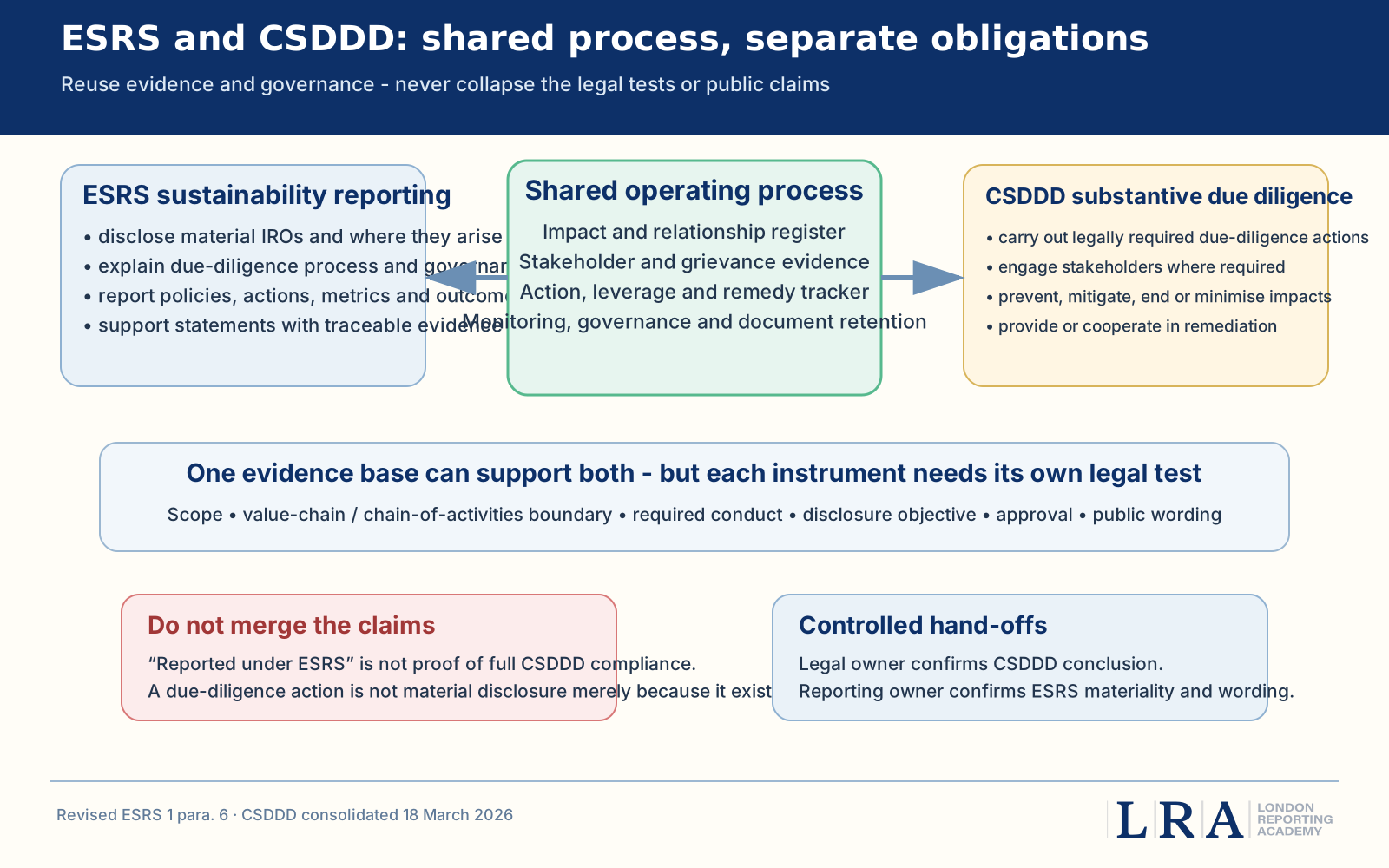
A practical integrated model has six layers.
Figure 2. Comparison of ESRS reporting and CSDDD due diligence responsibilities. Branded educational visual by London Reporting Academy.
Governance rule
The integrated process may have one steering committee, one data platform and one evidence register. It should still require separate sign-off from the sustainability reporting owner and the legal or compliance owner. The board should receive a paper that distinguishes:
• what the organisation has done;
• what the ESRS sustainability statement discloses;
• what is required under current national law;
• what remains part of future CSDDD readiness;
• where evidence or remediation is incomplete.
In practice
| Layer | Shared record | ESRS-specific control — CSDDD-specific control |
|---|---|---|
| 1. Legal perimeter | Entity, turnover, employees, group position, jurisdiction, reporting period | CSRD/Accounting Directive scope conclusion and ESRS edition — CSDDD scope and national transposition conclusion |
| 2. Relationship map | Operations, subsidiaries, products, services, suppliers, distributors and other business relationships | Upstream/downstream value-chain reporting boundary — Chain-of-activities and business-partner analysis |
| 3. Impact register | Impact description, affected stakeholder, location, severity, likelihood, evidence | Double materiality and information-materiality outcomes — Scoping, in-depth assessment and prioritisation outcomes |
| 4. Response register | Policy, action, resources, target, grievance, remediation and outcome | Disclosure mapping to ESRS 2 and topical standards — Legal duty, appropriate-measures rationale and completion status |
| 5. Evidence register | Source file, owner, period, approval, confidentiality, retention | Assurance evidence and report traceability — Compliance demonstration, privilege and at least five-year retention where applicable |
| 6. Claims register | Proposed public and legal statements | ESRS basis of preparation and fair-presentation review — CSDDD compliance statement and legal approval |
Hypothetical example: a supplier labour-rights issue
Context. A diversified manufacturer receives credible reports that migrant workers at an indirect supplier paid recruitment fees and had passports retained. The supplier sits in a high-risk geography and produces a component with several alternative sources.
Available evidence. Worker interviews by an independent organisation, procurement records, an audit report, the supplier code, grievance records and correspondence with the direct supplier.
ESRS work. The company assesses the potential and actual impacts on value-chain workers, considers severity and likelihood, evaluates whether the matter is material and determines the disclosures needed under ESRS S2 and general requirements. The reporting team describes the issue, boundary, response and limitations without identifying workers or making unsupported effectiveness claims.
CSDDD work. The due diligence team records the matter as identified, performs the required assessment, determines whether it is caused, jointly caused or linked through a business partner, develops appropriate measures, engages affected stakeholders or representatives, considers remediation, uses leverage and monitors outcomes. Legal counsel tests the decision against the applicable national implementing law.
Shared evidence. The impact record, engagement evidence, action plan, supplier communications and outcome indicators support both workstreams.
Separate conclusions. “This impact is material under ESRS” is not the same statement as “the company has fulfilled all CSDDD obligations”. Each conclusion has its own criteria and approval.
In practice
Weak versus stronger wording
| Weak wording | Why it is weak | Stronger, fact-specific pattern |
|---|---|---|
| “Our ESRS report demonstrates full compliance with CSDDD.” | Reporting and conduct obligations are merged; national transposition and factual performance are not tested | “Our sustainability statement describes the due diligence processes and actions relevant to material impacts. CSDDD readiness and compliance are assessed separately under the applicable legal framework.” |
| “All suppliers comply with our human rights policy.” | Absolute claim is unlikely to be supportable and a policy acknowledgement does not prove performance | “Direct suppliers in the defined programme were required to acknowledge the code. Monitoring identified specified gaps; corrective actions and unresolved cases are described.” |
| “Our grievance mechanism ensures effective remediation.” | A mechanism is a channel, not evidence of outcome | “The mechanism received X cases in the reporting boundary. We explain assessment, response times, remedy outcomes, unresolved matters and limitations.” |
Common mistakes and corrections
1. Using one scope spreadsheet for both regimes without separate legal logic. Add regime-specific scope fields, dates, group tests and legal approval.
2. Calling every business relationship part of the same perimeter. Map the relationship once, then apply ESRS value-chain and CSDDD chain-of-activities definitions separately.
3. Treating the materiality matrix as the due diligence action plan. Materiality supports reporting decisions; action prioritisation requires its own rationale, owners, timing and follow-up.
4. Using supplier questionnaires as the primary evidence for high-risk impacts. Combine supplier information with independent sources, worker or community input, grievance data and expert evidence.
5. Equating policy coverage with implementation. Track implementation, non-conformance, resources, outcomes and remediation.
6. Publishing a broad compliance statement before national transposition is analysed. Use controlled readiness language and obtain legal sign-off.
7. Leaving confidential due diligence evidence in the public reporting workspace. Separate public, restricted, privileged and personal-data records while preserving traceability.
Readiness
Implementation checklist
- Separate ESRS and CSDDD legal-scope memoranda are current by entity, group and reporting period.
- The value-chain and chain-of-activities maps use controlled definitions and record exclusions.
- The impact register stores ESRS materiality and CSDDD prioritisation outcomes in separate fields.
- Stakeholder engagement records identify purpose, stage, accessibility, participants, evidence and follow-up.
- Policies, actions, resources, targets and remediation are linked to specific impacts and legal duties.
- Each public claim has an evidence owner and a legal or technical approval route.
- Grievance and remedy records protect confidentiality and vulnerable stakeholders.
- Evidence retention rules include CSDDD's minimum documentation period where applicable.
- ESRS assurance evidence and CSDDD compliance evidence can be retrieved without exposing restricted material unnecessarily.
- The board paper distinguishes reporting conclusions, conduct conclusions, readiness gaps and unresolved actions.
Self-check
- Can the organisation explain why an impact is material for ESRS and separately why it is prioritised for action under CSDDD?
- Is every statement about remediation supported by evidence of outcomes rather than only process activity?
- Would a reviewer be able to identify which parts of the evidence support reporting and which support legal compliance?
Related standards and disclosure areas
• Revised ESRS 1 (Delegated Regulation (EU) 2026/1563): objective, entity-specific disclosures, fair presentation, double materiality, due diligence (paragraphs 56–59, including the paragraph 57 coherence rule with the CSDDD) and value-chain reporting.
• ESRS 2 GOV-3 (Delegated Regulation (EU) 2026/1563): statement showing where the main due diligence steps are disclosed. In the 2023 ESRS, the equivalent disclosure is GOV-4.
• ESRS 2 GOV-4 (Delegated Regulation (EU) 2026/1563): risk management and internal controls over sustainability reporting. In the 2023 ESRS, this is GOV-5.
• ESRS 2 SBM-2 and IRO-1: stakeholder interests and views; materiality assessment process.
• GDR-P, GDR-A, GDR-M and GDR-T: policies, actions, metrics and targets for material topics.
• ESRS S2, S3 and S4: value-chain workers, affected communities, consumers and end-users.
• CSDDD Articles 5 and 7-16: due diligence actions, policy integration, identification, prioritisation, prevention, corrective action, remediation, engagement, complaints, monitoring and communication.
Frequently asked questions
Does CSDDD replace ESRS due diligence disclosures?
No. CSDDD creates conduct duties. ESRS determines what material information is disclosed and how it is presented. CSDDD evidence can support ESRS disclosures, but the reporting requirements remain separate.
Can one impact assessment support both?
Yes, one inventory and evidence-gathering process can support both. The organisation should apply separate criteria, record separate outcomes and obtain separate approval for each legal conclusion.
Does a CSRD reporter need a separate CSDDD annual website statement?
CSDDD Article 16 exempts companies subject to specified Accounting Directive sustainability reporting requirements, including certain exempt group entities, from the separate annual statement. The organisation must still confirm that the exemption applies to its facts and national implementation.
Is supplier audit evidence enough?
Usually not on its own. High-quality evidence may also require affected-stakeholder input, grievance information, independent sources, operational data, remediation records and outcome monitoring.
Framework references
Disclosures this page affects
Take it with you
The checklists as a working spreadsheet
Every checklist and table on this page, with empty status, owner and evidence columns for your team to fill in and keep.
✓ Knowledge Hub AI Assistant · Human-in-the-loop

Ask about this guide
It answers from this page, and reaches into the linked disclosure cards when your question is about the standard itself.
Go deeper · ESRS
Certified ESRS (CSRD) Applied Sustainability Reporting
This page settles one Disclosure Requirement. The ESRS / CSRD course walks the whole European cycle — double materiality, datapoints, evidence and assurance — with drafting exercises on your own data.