
UK SRS S1 & S2 — the UK-issued Sustainability Reporting Standards, February 2026

UK SRS S1 & S2: Sustainability and Climate Reporting in Practice

4.9/5 average satisfaction score across all LRA courses
Course text, activities and assignments: English

The UK now has its own sustainability reporting standards. UK SRS S1 and UK SRS S2 were issued in February 2026, and the first UK reporting cycle is being prepared right now. This course takes you through that cycle end to end on one continuing case — from the reporting purpose and the requirements map to an authorised, released report — and teaches the UK amendments that make these texts behave differently from IFRS S1 & S2 as issued by the ISSB. Practitioner-led by Dr Ross Kurinko, human-in-the-loop on every learning route.

Best if:
  • You prepare, review or sign off disclosures for a UK listed company in scope of the FCA's final UK SRS rules, which begin with 2027 accounting periods.
  • You report for a UK private company answering investor, lender or customer requests before any rule applies.
  • You advise UK reporters and need a defensible method for a first cycle rather than a summary of the standards.
4.9/5 Student Rating 9,600+ Graduates across EMEA GRI Certified Trainer MarCom Gold Award Winner 15+ Years ESG Experience

A first UK reporting cycle, worked rather than described.

UK SRS S1 and S2 are the UK-issued sustainability reporting standards published in February 2026. They are built on the ISSB texts, and they are not identical to them. This course is a complete, practitioner-built path through a first cycle under the UK texts — built on 15+ years of ESG-reporting practice and delivered inside the AI-powered LRA Study Studio, with real human support on every route.

What you leave with
A requirements and disclosure index · a risk, opportunity and materiality record · drafted UK SRS disclosures with their evidence · a release and next-cycle plan · a verifiable LRA certificate
Why this lands on your desk

The standards exist. Only one route has dates attached.

In-scope listed companies now have final FCA rules and a start date; everyone else has an open policy question — and investors asking anyway. This is the sequence most UK teams are working through.

1

The UK texts are published

UK SRS S1 and S2 were issued in February 2026 with UK amendments to the ISSB standards. The standards are final; who applies them is decided separately.

2

The FCA sets the listed-company rules

PS26/19, published on 30 September 2026, puts UK SRS S1 and S2 — Scope 3 included — on a comply or explain basis for in-scope listed companies from 2027 accounting periods, with time-limited reliefs.

3

Everyone else is asked anyway

Private companies have no timetable, and a live consultation on corporate reporting. Investors, lenders and customers do not wait for one before asking.

4

You prepare the first cycle

Purpose, requirements map, judgements, evidence, drafting, review and release. That is the work this course does with you, on one continuing case, from start to authorised release.

No basic. No advanced. Just report-ready.

Many training providers split sustainability reporting into "basic", "advanced" or "professional" levels — or confine it to one methodology, or to a single standard taught in isolation. We don't. Our goal is different: every LRA graduate should be able to produce a real, defensible sustainability report — from scoping and data collection to the finished, issued document.

The difference is in how you get there. The AI-powered LRA Study Studio adapts to your background, role, sector and current level of maturity — and so do the people behind it. A group financial controller, a sustainability manager and an audit adviser do not need the same explanations — but they all need the same professional outcome: disclosures that survive review, and a reporting file that supports every word of them.

"A first cycle is not a drafting exercise. It is a traceable set of decisions — and the file behind them is what makes the report defensible."
What sets this course apart

Five reasons it's not another UK SRS webinar.

The UK texts, including what the UK changed

Taught from the UK-issued S1 and S2 of February 2026, with the UK amendments worked through rather than mentioned: the removed effective date, climate-first reporting without a time limit, the Scope 3 provision, the SASB and GICS changes, and the removal of the relief that let a first report be published later than the financial statements.

One continuing case, fourteen modules long

Alderwick Industrial Group runs from Module 01 to Module 14 — a group with subsidiaries, two operating sites, a December year end and a planned release date. Its facts arrive module by module, the way they do in a real cycle, and the work you produce accumulates into one file.

Built by senior practitioners

Designed by Dr Ross Kurinko — GRI and ISSB-IFRS S1 & S2 Certified Global Trainer, PhD, University of Cambridge, 15+ years on FTSE 100 and Fortune Global 500 disclosures — and delivered by seasoned ESG and financial-reporting practitioners. Not third-party content licensors.

Dated facts, not confident guesses

The UK application landscape is moving. Lesson 0.10 states the position with its date and its sources — the FCA's final listing rules and the Technical Note still under consultation, the Companies Act consultation, the assurance position and transition plans — and teaches you to reconfirm before you rely on any of it.

One expert curriculum, four professional learning routes

Same curriculum, different cadences and audiences. Pick what fits your role, your schedule and your budget. Across every route — including Guided Flex — you can hand the AI thread to a real human. Never AI-only.

What changes with UK SRS

Two comparisons you have to get right. Neither is a formality.

If you reported under TCFD, the work grows. If you know IFRS S1 and S2 as issued by the ISSB, the UK text is close enough to be dangerous. Both comparisons are taught paragraph by paragraph, in the course's own words, against the supplied UK texts.

Coming from TCFD

Where the additional work actually is

The Investor Relations Society's response to the FCA's CP26/5 consultation estimated that around three-quarters of the data points are new or more demanding than under TCFD. Four areas absorb most of that effort.

  • 01Quantification — current and anticipated financial effects, not a qualitative discussion
  • 02Industry-based metrics — selected, explained and calculated
  • 03Scope 3 — a requirement rather than a conditional, with its own screening and quality work
  • 04Scenario analysis — designed, documented and used, not cited
  • 05Connected information — sustainability and financial reporting that agree on the same facts
  • 06An evidence file a reviewer can follow from the sentence back to the source
Coming from IFRS S1 & S2

The UK amendments, and what each one changes

The UK texts are built on the ISSB standards with deliberate changes. These are the ones that change what a preparer does.

  • S1The IFRS effective date is removed — applicability is set by UK regulators
  • E3Climate-first reporting is permitted without the ISSB's first-year time limit, with UK paragraph E4 on comparatives
  • 73AUsing the climate-first relief prevents a full S1 compliance assertion, and the use must be disclosed
  • 73BWhere UK law or regulation requires application, those rules govern
  • C4Scope 3 may be omitted without the ISSB's first-year limit, with C5 and C6 on comparatives and UK rules
  • SASBSASB references move from “shall” to “may” — while disclosing appropriate industry-based metrics keeps “shall”
  • GICSThe requirement to use GICS is removed; another classification may be used
  • 64The first-year relief on timing is removed — disclosures are published with the financial statements, from year one
  • B59AA UK addition on financed emissions where same-period estimation is impracticable
Lesson 0.10 — the part most courses leave out

Who must report, when, and what else applies — stated with its date

The standards do not decide who applies them. Lesson 0.10 sets out the UK application landscape, starting with the FCA's final PS26/19 rules: comply or explain for UK SRS S1 and S2, Scope 3 included, for in-scope listed companies from accounting periods beginning on or after 1 January 2027 — and why using the one-year Scope 3 or two-year non-climate S1 relief is not the same as explaining an unmet requirement. It also covers the Companies Act consultation that gives private companies no timetable at all, the assurance position after ISSA (UK) 5000, and the transition-plan position — S2 does not require a company to have a plan, but it does require disclosure about one that exists.

Every claim in that lesson is an external regulatory fact with a source and a date — the FCA position as at 30 September 2026, other items as checked on 25 September 2026 — not a requirement of UK SRS S1 or S2. The lesson instructs you to reconfirm each one before relying on it in a real reporting decision.

See Module 00 →
Controlled position

What UK SRS does not settle.

Four things that are widely assumed and are not true as the standards stand. Each is taught in the course, and each is worth knowing before you enrol.

Who must apply them

The UK texts carry no effective date of their own. Application is a matter for UK regulators — final FCA comply or explain rules for in-scope listed companies from 2027 accounting periods, and an open policy question for everyone else.

Mandatory assurance

The FCA's final rules do not require third-party assurance of UK SRS disclosures; in-scope listed companies must say whether they obtained it. The course builds the evidence file that makes a disclosure reviewable, and never describes it as an assurance engagement.

A required transition plan

S2 does not require a company to have a transition plan. It requires information about a plan the company has, including its key assumptions and dependencies. The FCA's final rules ask the relevant listed companies to say whether they have published one — not to produce one.

Equivalence with ESRS

There is no equivalence mechanism between the European standards and the ISSB Standards. A UK SRS report is not a CSRD report, and the course does not imply otherwise.

Choose your format

One expert curriculum, four professional learning routes.

Same materials, same standards — different cadences, different audiences. Human support is available on every route.

Guided Flex

Learn on your schedule, never on your own.

Flexible learning through the AI-powered LRA Study Studio, with structured assessments and specialist UK reporting professionals available to answer your questions through the platform.

15 modules · 81 lessons · approximately 80 hours of guided study · 180 knowledge-check questions · two human-reviewed assignments · 12 months Studio access
£349+ VAT where applicable
Enrol & Pay
Live Cohort

Learn alongside peers, in live sessions led by Dr Ross Kurinko.

Everything in Guided Flex, plus scheduled live online lectures in a shared group, led by Dr Ross Kurinko, with cohort-based progression and peer discussion of the judgements a first UK cycle actually turns on.

15 modules · live online lectures · assignments reviewed by the LRA team · peer cohort · 12 months Studio access
Intakes: the first UK SRS cohort is forming — dates confirmed on request
£749+ VAT · scheduled live online sessions
Enrol & Pay
1:1 Expert Mentorship

Private expert guidance for your reporting context.

Everything in Guided Flex, plus direct mentor sessions with Dr Ross Kurinko or a senior LRA mentor (subject to mentor availability), personalised guidance and line-by-line review of your UK SRS disclosure drafts.

15 modules · private mentor sessions · personalised guidance · draft review · 12 months Studio access
£1,249+ VAT · 5 × 1.5h mentor sessions · online or Canary Wharf by agreement
Enrol & Pay
1:1 Expert Mentorship — Applied Practice

Blended study + consulting on your real first report.

Everything in 1:1 Expert Mentorship, plus your existing working documents are reviewed alongside the mentor sessions — requirements map · GHG inventory and method notes · scenario and resilience work · draft S1 and S2 disclosures. Mentor + practitioner-consultant in one engagement, working with your real cycle via email, file-share and scheduled mentor sessions under NDA. Studio platform stays standard — your documents are not uploaded to the platform; we work them as files.

10 × 1.5h mentor sessions · your working documents in scope (NDA) · improved outputs returned · 12 months Studio access
£1,995+ VAT · 10 × 1.5h · Applied Practice · online or Canary Wharf by agreement
Enrol & Pay

What's included on each route

Every route includes the same expert curriculum, real human support and one verifiable certificate — the table shows what each format adds on top.

Scroll sideways to compare →

What you get Guided Flex£349 Live Cohort£749 1:1 Expert Mentorship£1,249 Applied Practice£1,995
12 months Study Studio access IncludedIncludedIncludedIncluded
Full UK SRS curriculum — 15 modules, 81 lessons, approximately 80 hours of guided study IncludedIncludedIncludedIncluded
180 knowledge-check questions with instructor explanations IncludedIncludedIncludedIncluded
Two assignments, reviewed by a person and required for the certificate IncludedIncludedIncludedIncluded
Real human supportAsk questions through the platform and get practical, timely replies from experienced ESG professionals, so you can keep moving through the course. IncludedIncludedIncludedIncluded
Peer cohort + scheduled live online sessions led by Dr Ross Kurinko Not includedIncludedNot includedNot included
Private 1:1 mentor sessions (online or Canary Wharf by agreement) Not includedNot includedIncludedIncluded
Line-by-line review of your disclosure drafts Not includedNot includedIncludedIncluded
Your real working documents reviewed, under NDA Not includedNot includedNot includedIncluded
LRA Alumni Club membership — Included Included Included
Verifiable certificate Same certificate Same certificate Same certificate Same certificate

Corporate Programme is bespoke and quoted on request — see below. Not sure which route fits your reporting context?

For teams and for advisers

Train the people who will own the first cycle.

Bespoke UK SRS programmes for finance, sustainability, risk and internal audit teams, and for advisory and audit practices building a UK SRS service line. Delivered online, on-site, in London, or as a hybrid programme. Price on request.

View corporate programmes →
If your scope is wider than the UK

Reporting outside the UK as well? The ISSB baseline is the companion course

UK SRS is the UK-issued version of the ISSB standards. If you also report, or advise, in other adopting jurisdictions, the Certified IFRS S1 & S2 (ISSB) Applied course covers the global baseline as the ISSB issued it. Complete this course on an engaged route and Alumni Club pricing applies to it.

See the IFRS S1 & S2 course
How each route works

The same UK SRS programme, shaped to four professional paths.

From day one to certificate — what the journey looks like on each route.

Guided Flex

Independent learning, with human support through the platform.

Best for: finance and reporting people fitting a first UK cycle around the day job.

  • Onboarding — tell the Studio your role, sector, listing status and reporting timetable.
  • Studio access — your personalised learning workspace opens.
  • Core learning — 15 modules on the continuing case, with 180 knowledge-check questions.
  • Two human-reviewed assignments — after Module 04 and Module 13; the LRA team reviews each one.
  • Certificate — issued once every module is complete and both assignments are accepted.
Enrol in Guided Flex →
Live Cohort

Studio first, cohort layered on.

Best for: people who want to hear how other UK reporters are making the same judgements.

  • Onboarding — tell the Studio your role, sector, listing status and reporting timetable.
  • Start in the Studio today — no waiting for the next intake to begin.
  • Core certificate path — progress through the curriculum at your pace.
  • Cohort intake — join the next scheduled cohort — the first UK SRS cohort is forming now.
  • Live sessions + certificate — scheduled live online sessions led by Dr Ross Kurinko; the same LRA certificate as every learner.
Enrol in the Live Cohort →
1:1 Expert Mentorship

Dual onboarding, private mentor time.

Best for: anyone preparing a first UK SRS report against a board-approved timetable.

  • Studio onboarding — tell the Studio your role, sector, listing status and reporting timetable.
  • Mentor kickoff — dedicated session to map your reporting entity, boundaries, data sources and deadline.
  • Personalised plan — your mentor calibrates the sequence to your year end, your listing status and the data you actually have.
  • Private sessions + draft review — Mentor time with Dr Kurinko or a senior LRA mentor (subject to mentor availability), online or at Canary Wharf by agreement; line-by-line drafts.
  • Certificate — the same LRA certificate as every learner.
Choose 1:1 Expert Mentorship →
Corporate Programme

Bespoke programme for your team or your client base.

Best for: reporting teams preparing together — and firms building a UK SRS service line.

  • Request a quote — share scope, team size and reporting context.
  • Scope alignment — we map the modules to your sector, your listing status and your reporting calendar.
  • Custom programme design — modules, exercises and cases built around your team or your client portfolio.
  • Delivery — online, on-site, Canary Wharf London or hybrid blend.
  • Team certificates — each learner receives the LRA certificate on the same rule — every module complete and both assignments accepted.
Discuss a programme →
Want the full learning model? Dive into onboarding, the Study Studio, human support, certificates and the full delivery model on a dedicated page.
How We Deliver Our Courses →
How it is taught

One company, fourteen modules, one accumulating file.

The continuing case is the spine of the course. Facts arrive when they would arrive in a real cycle, and nothing is handed to you complete.

A continuing case with a year end and a deadline

Alderwick Industrial Group — a parent with two wholly owned subsidiaries, two operating sites, a December year end and a planned joint release with the financial statements. Its facts arrive module by module, and your outputs accumulate into one reporting file rather than fifteen disconnected exercises.

Two assignments, reviewed by a person

Assignment 1 follows Module 04 and sets Briarfield Technical Group, an independent fictional company: you establish a defensible reporting approach (four to five hours). Assignment 2 follows Module 13 and sets Dunmere Services Group: you take the evidence through to linked disclosures (five to seven hours). You request each brief in your Homework Workspace, work offline and upload your response; a person reviews it and either accepts it or returns it with targeted revision required. There are no marks or points.

180 knowledge checks that ask for a judgement

Twelve situational questions per module, each with an instructor explanation of why the other answers fail. They test the decision, not the definition.

Thirty films that frame and consolidate

An opening film sets the practical problem for each module and a closing film consolidates the result, presented by Dr Ross Kurinko. The detailed text carries the learning; the films make sure you know what it was for.

Human support on every route

Async support from the LRA team on Guided Flex; live online sessions led by Dr Ross Kurinko on Live Cohort; private sessions with Dr Ross Kurinko or a senior LRA mentor, subject to mentor availability, on 1:1 Expert Mentorship; a trainer on Corporate routes. The form of contact varies; the human presence stays.

AI for speed, humans for judgement

A frontier-model AI Tutor is pinned to every page — translate, simplify, exemplify, ask a follow-up — and weak topics surface into a focused revision plan. The judgement calls stay with you and your mentor.

Course outline

15 modules, 81 lessons — from the standards to an authorised release.

Approximately 80 hours of guided study. 81 lessons across 15 modules, 180 knowledge-check questions (12 per module, each with an instructor explanation), 30 module films, and two human-reviewed assignments — one after Module 04, one after Module 13. The study-time figure is an LRA planning estimate, not an accredited-hour allocation.

Chapter 01 · Orientation

Read a report, meet the documents, find your way around them.

  • Module 00 · Understanding reporting and the UK SRS Standards — document identities, guided tours of S1 and S2, navigation, the materiality bridge, and lesson 0.10 on the UK application landscape · 10 lessons · 12 knowledge checks
Chapter 02 · Purpose, requirements and judgement

Why you are reporting, what is required, and what is material.

  • Module 01 · Your first UK SRS report: purpose, users and the reporting outcome · 4 lessons · 12 knowledge checks
  • Module 02 · Reading the requirements: build the first disclosure map · 5 lessons · 12 knowledge checks
  • Module 03 · Risks, opportunities and material information · 6 lessons · 12 knowledge checks
Chapter 03 · The reporting basis

Entity, boundaries, periods, connected information — and the first assignment.

  • Module 04 · Establishing the basis of preparation · 6 lessons · 12 knowledge checks
  • Assignment 1 · Briarfield Technical Group: a defensible reporting approach · reviewed by a person · four to five hours
Chapter 04 · The core S1 disclosures

Governance, risk management, strategy and financial effects.

  • Module 05 · Governance and risk management · 5 lessons · 12 knowledge checks
  • Module 06 · Strategy, business model and financial effects · 6 lessons · 12 knowledge checks
Chapter 05 · Climate under S2

Climate risks and opportunities, resilience, scenarios and emissions.

  • Module 07 · Climate-related risks and opportunities · 5 lessons · 12 knowledge checks
  • Module 08 · Climate resilience and scenario analysis · 5 lessons · 12 knowledge checks
  • Module 09 · Greenhouse gas emissions, including Scope 3 screening and quality · 7 lessons · 12 knowledge checks
Chapter 06 · Metrics, targets and connections

Beyond emissions: the metrics you choose and the targets you can defend.

  • Module 10 · Selecting and explaining useful metrics, including industry-based metrics · 5 lessons · 12 knowledge checks
  • Module 11 · Targets, actions, transition-plan information and connected disclosures · 5 lessons · 12 knowledge checks
Chapter 07 · Running and releasing the cycle

Organise the project, assemble the draft, review it, authorise it, release it.

  • Module 12 · Organising your first reporting project · 5 lessons · 12 knowledge checks
  • Module 13 · Data, evidence and the first integrated draft · 6 lessons · 12 knowledge checks
  • Assignment 2 · Dunmere Services Group: from evidence to linked disclosures · reviewed by a person · five to seven hours
  • Module 14 · Review, authorisation and release, with a closing look beyond the course · 6 lessons · 12 knowledge checks
Upon completion

By the end, you will confidently.

  • Navigate the UK texts and their origins — identify issuer, status, edition and purpose, move a question across S1 and S2 without dropping the general requirements, and tell a UK paragraph from its ISSB ancestor.
  • Set a reporting basis you can defend — reporting entity, boundaries, periods and connected information, recorded so a reviewer can follow the decision a year later.
  • Build a requirements and disclosure index — every relevant requirement mapped, with coverage, evidence, drafting status and the annual update recorded separately.
  • Produce the core S1 and S2 disclosures — governance, risk management, strategy and financial effects, climate risks and opportunities, resilience and scenario analysis, greenhouse gas emissions, metrics and targets.
  • Handle the UK amendments correctly — climate-first reporting and what it costs you in compliance wording, the Scope 3 provision, industry-based metrics without a mandated classification, and publication at the same time as the financial statements.
  • Run the project and release the report — work packages, requests, review gates, an evidence index, a change log, authorisation and a next-cycle plan.
Who this is for

From the board sponsor to the first-cycle preparer.

Same curriculum, different starting points. The Studio calibrates to your role and context from day one, and no prior UK SRS experience is assumed.

Director, CFO or audit committee member

You approve what is published and carry the consequences. Get to working depth fast — what the standards require, which reliefs the UK text allows and what using them costs in compliance wording, and the ability to challenge and sign off the work without drafting it yourself.

Group financial controller or reporting manager

In most companies this lands on finance. Leave with a reporting project you can run the way you run a year end: a requirements index, owners, a calendar built backwards from the release date, review gates and an evidence file.

In-house sustainability, climate or risk lead

You own the source data and the scenario work. Learn exactly which figure each disclosure wants, on which boundary, and how to evidence it so nobody re-derives it next year.

Adviser, auditor or consultant

You need a repeatable method across clients, and a clear view of where UK SRS departs from the ISSB texts. The course gives you both, with the paragraph references behind them.

Career changer moving into reporting

Module 00 starts with reading a report and navigating the standards, before any drafting. Business literacy is enough to begin; the two human-reviewed assignments give you applied work to show.

What you get

Six things a standards briefing doesn't have.

Authored by Dr Ross Kurinko

GRI and ISSB-IFRS S1 & S2 Certified Global Trainer, PhD, University of Cambridge, 15+ years on FTSE 100 and Fortune Global 500 disclosures. Not a third-party content licence.

A working method, not a slide pack

Requirements and disclosure index · risk and opportunity register · materiality judgement log · basis-of-preparation note · scenario passports · GHG calculation pack · metric and target passports · evidence index · release record.

The UK amendments, paragraph by paragraph

A one-page memo of every UK departure from the ISSB texts, with the paragraph references and what each one changes for a preparer.

Dated regulatory facts with sources

Lesson 0.10 states the UK application landscape with its sources — the FCA's final rules as at 30 September 2026 — and teaches you to reconfirm rather than rely on a course slide.

Mistake Coach

Weak topics auto-surface into a focused revision plan — gaps close before they show in your real report.

Human review where it counts

Both assignments are reviewed by a person on every route — the LRA team on Guided Flex, Live Cohort and Corporate Programme, your mentor on 1:1 Expert Mentorship — and on 1:1 Expert Mentorship your mentor also reviews your disclosure drafts line by line, on top of the AI feedback layer.
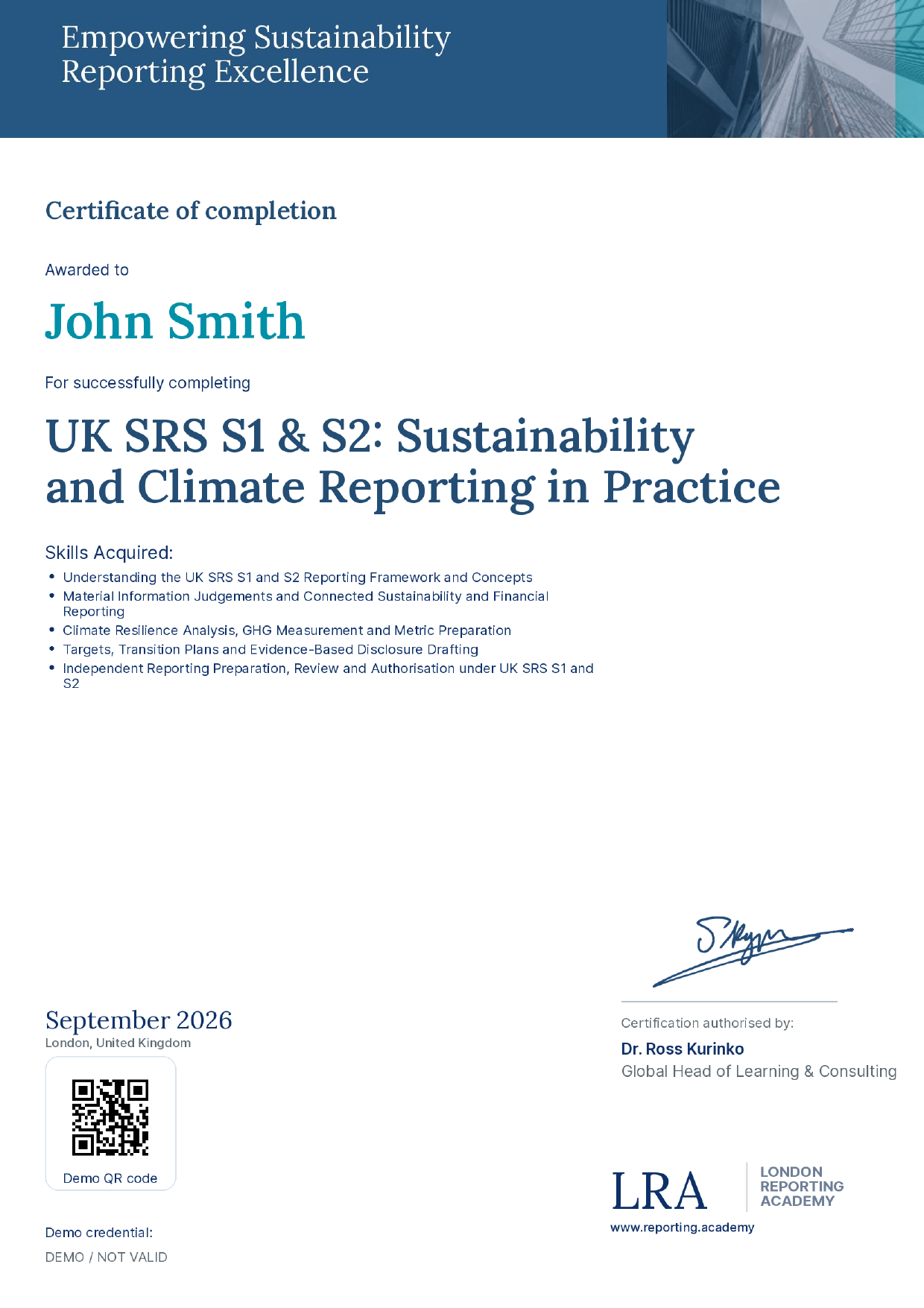
Certificate

An internationally recognised credential.

The LRA certificate goes beyond methodological knowledge. It certifies that the graduate has demonstrated practical capability to prepare disclosures under UK SRS S1 and S2 — from the reporting purpose and basis of preparation, through governance, strategy, climate and emissions disclosures and the evidence behind them, to an authorised and released report.

The certificate is the same on every route; it does not name the route you chose.

Globally verified

LRA-certified capability in UK SRS S1 & S2 reporting

  • Practical competence, not just methodology — graduates demonstrate the ability to turn the UK Standards into drafted, evidenced disclosures and an authorised release.
  • Two human-reviewed assignments — applied work on separate companies, reviewed by a person rather than scored by a machine. The certificate is issued once every module is complete and both assignments have been accepted.
  • Built on real disclosures — curriculum and case work distilled from 200+ live ESG disclosure projects across sectors.
  • Verification when it matters — credentials carry a QR code, a unique credential ID and a permanent verification link auditors, employers and procurement teams can confirm on request. Counts toward the LRA International Diploma in Sustainability Reporting.

LRA-issued certificates confirm completion of the relevant LRA professional training programme. They do not constitute a licence to practise, a statutory qualification, regulatory accreditation, or accreditation by any regulator, professional body or standard-setter, unless expressly stated for a named third-party credential.

London Reporting Academy — sample certificate of completion
Dr. Ross Kurinko
Author and facilitator of the course
Ross Kurinko, Dr.

Distinguished expert with 15+ years in sustainability, ESG, integrated ESG communications and corporate reporting. PhD, University of Cambridge · GRI and ISSB-IFRS S1 & S2 Certified Global Trainer · Strategic ESG Advisor on IFRS S1 & S2, GRI and ESRS.

Throughout his career, he has been instrumental in establishing ESG governance frameworks and comprehensive disclosure systems — notably building one from scratch for one of Europe's largest railway companies — and has guided over 20 prominent businesses and educated hundreds of professionals across FTSE 100 and Fortune Global 500 disclosures.

The LRA Alumni Club

Graduate once. Stay connected — for life.

Complete this course on a Live Cohort, 1:1 Mentorship or Applied Practice route and you join the LRA Alumni Club — a private network of LRA graduates with continuing access to expertise, peers and tangible benefits for life — no expiry. Reporting is a profession, not a one-off course — the Club is built to support your career, not just your enrolment.

01

Annual LRA Alumni Summit

Once a year, hybrid event (London + online): case studies from peer alumni, expert panels on emerging frameworks, and structured networking. Free attendance for Club members.

02

Quarterly peer benchmarking calls

Small-group calls with Dr. Kurinko and 6–12 alumni — we work through your real reports under NDA, compare approaches, debug edge cases. The kind of conversation reporting professionals can't get anywhere else.

03

Monthly office hours with Dr. Kurinko

60-minute Zoom Q&A every month — open to Club members. Bring a specific question from your current reporting cycle, get a direct, practitioner-grade answer.

04

Alumni-only Slack channel

A private workspace where alumni from every cohort exchange tips, share intel on new regulations, and ask peer questions. The kind of network you'd otherwise need to attend a year of conferences to build.

05

30% off any future LRA course — for life

30% off any LRA course, any format, any standalone — including the five new courses launching by end of 2026 and every LRA course after that. Stack credentials across the LRA portfolio at member pricing.

06

Early access to new courses

Four weeks of early access before every public launch — plus a vote on which frameworks LRA covers next. Alumni shape the curriculum.

07

Quarterly briefings on emerging regulations

Short, member-only video briefings on what's actually changing — ESRS amendments, IFRS S1/S2 updates, SB 253 enforcement, CSRD waves. Built so you stay current without doomscrolling LinkedIn.

08

Job board & talent network

LRA quietly maintains relationships with corporate ESG teams and consultancies. When they ask for trained reporters, Club members go on the shortlist. Featured Alumni Spotlight on LRA channels every quarter.

Routes that unlock the Club: Live Cohort · 1:1 Expert Mentorship · Applied Practice.

Guided Flex doesn't unlock Club membership — that's deliberate. The Club is designed for learners who chose an engaged format: live time, mentorship or applied work. It's a long-term commitment from LRA, so we reserve it for learners who made an equivalent commitment.

Mapped to national occupational standards

We specialise in ESG Disclosure and Sustainability Reporting training, mapped to Skills England ST0934 and ST0748, with practical coverage of GRI, ISSB/IFRS S1/S2, ESRS/CSRD, data controls, materiality, assurance readiness and anti-greenwashing.

Trusted by professionals worldwide

Real participants. Real LinkedIn reviews.

Verified posts from sustainability practitioners who completed our programmes — open any to read the original LinkedIn comment in full.

Fees

Choose your UK SRS learning route.

All routes include the full 15-module curriculum, approximately 80 hours of guided study, 180 knowledge checks, both human-reviewed assignments, 12 months of Studio access and a verifiable LRA certificate. Prices exclude VAT where applicable.

Guided Flex
£349+ VAT where applicable
Buy · £349
Live Cohort
£749+ VAT · first UK SRS cohort forming — dates confirmed on request
Buy · £749
1:1 Expert Mentorship
£1,249+ VAT · 5 × 1.5h mentor sessions · online or Canary Wharf by agreement
Buy · £1,249
1:1 Expert Mentorship — Applied Practice
£1,995+ VAT · 10 × 1.5h · your working documents in scope under NDA
Buy · £1,995
Corporate Programme
On requestScope agreed during planning
Request a quote

Reporting outside the UK too? The Certified IFRS S1 & S2 (ISSB) Applied course teaches the global baseline as the ISSB issued it. The two courses are complementary — this one is the UK-issued text with its amendments — and Alumni Club pricing applies to the second course when you complete this one on an engaged route.

Flexible payment. Need to spread the cost? Instalment plans are available — email lra@reporting.academy and we'll set one up for your enrolment. Self-funded learners and groups of three or more from the same organisation can request a 20% discount (the two don't stack). And you're covered by a 14-day cancellation right: a full refund within 14 days of purchase if you haven't yet entered the Study Studio.

UK SRS course — frequently asked

Course-specific questions — before you enrol.

01Coverage & curriculum

Which text does the course teach — the UK SRS or the ISSB standards?

The UK-issued texts. UK SRS S1 and UK SRS S2 were published in February 2026, and they are the normative basis of every module. The ISSB standards appear as their origin, so that you can see exactly where the UK text departs from them.

Those departures are taught, not listed: the removed effective date, climate-first reporting without the ISSB's first-year limit together with UK paragraphs E4, 73A and 73B, the Scope 3 provision in C4 with C5 and C6, SASB references moving from "shall" to "may", the removal of the GICS requirement, publication at the same time as the financial statements from the first year, and the UK addition on financed emissions at B59A.

How long is the course, and how many hours should I plan?

Approximately 80 hours of guided study, across 15 modules and 81 lessons, including the two human-reviewed assignments — four to five hours for Assignment 1 and five to seven hours for Assignment 2.

That figure is an LRA planning estimate built from the module-level estimates in the curriculum. It is not an accredited-hour allocation, not a certification promise and not a measured completion time, and the course says so in the modules themselves.

The reporting cycle is a second clock, and a longer one. Module 12 plans it explicitly, working backwards from the release date.

What is the continuing case, and why does it matter?

Alderwick Industrial Group — a parent with two wholly owned subsidiaries, two operating sites, a December year end and a planned joint release with the financial statements. It runs from Module 01 to Module 14.

Its facts arrive module by module, the way they arrive in a real cycle: incomplete, sometimes inconsistent, and occasionally after you have already drafted around them. The two assignments deliberately use different companies — Briarfield Technical Group and Dunmere Services Group — so that the method has to travel rather than the memory of one case.

Does the course tell me whether my company has to report?

It gives you the picture with a date on it, and teaches you to check it yourself. Lesson 0.10 sets out the FCA position as at 30 September 2026: the final PS26/19 rules apply UK SRS S1 and S2, Scope 3 included, on a comply or explain basis to in-scope listed companies for accounting periods beginning on or after 1 January 2027. A one-year Scope 3 relief and a two-year relief for non-climate S1 information are available, and the lesson teaches why using a relief is not the same as explaining an unmet requirement. It also covers the Companies Act consultation under which private companies have no timetable at all, the assurance position and the transition-plan position.

Your company's position still depends on its listing category, its accounting period and any other rules that apply to it. Every claim in the lesson is an external regulatory fact with a source, not a requirement of UK SRS, and the lesson instructs you to reconfirm before relying on it. The FCA's proposed Technical Note 803.1, open for comment until 28 October 2026, is taught as guidance under consultation, not final guidance. The course gives the FCA's date because the FCA has set one, and no date for private companies, because nobody has.

02Is it right for me?

Do I need prior sustainability reporting experience?

No. The course is pitched beginner to intermediate for a first reporting cycle. It assumes business literacy and no prior UK SRS experience: Module 00 starts by reading a report and navigating the two Standards before any drafting begins.

Practitioners who already report under GRI, ESRS or IFRS S1/S2 can move quickly through the opening modules and spend their time on the UK amendments, the quantified financial effects and the scenario and emissions work.

I already took the IFRS S1 & S2 course. Is this a repeat?

No. The IFRS S1 & S2 course teaches the ISSB global baseline. This course teaches the UK-issued texts and runs a full first cycle on a continuing case, with two human-reviewed assignments.

If your reporting is UK-only, start here. If you report or advise across several jurisdictions, the two are complementary, and Alumni Club pricing applies to the second course when you complete the first on an engaged route.

I report under CSRD as well. Does a UK SRS report cover that?

No. There is no equivalence mechanism between the European standards and the ISSB Standards, and the course states that plainly rather than implying a shortcut. What does travel is the underlying work — the same emissions data, the same governance facts and the same evidence file support both, if you build them properly the first time.

03What's included & how it runs

How is the work assessed?

Twelve situational knowledge-check questions in each of the 15 modules — 180 in total — each with an instructor explanation of why the other answers fail. They ask for a judgement rather than a definition.

Two assignments carry the applied assessment, both reviewed by a person and both required for the certificate.

Assignment 1, after Module 04, sets Briarfield Technical Group, an independent fictional company, and asks you to establish a defensible reporting approach: the reporting basis, the entity and its boundaries, risks, opportunities and material information, reporting periods and time horizons, first-application provisions and a selected requirements map, ending in a recommendation and a draft public basis extract. Suggested effort: four to five hours.

Assignment 2, after Module 13, sets Dunmere Services Group, an independent fictional service group, and takes you from evidence to linked disclosures: evidence and version decisions, reproducible calculations, corrections to eight defective claims, one connected candidate disclosure covering the workforce and a climate-related power dependency, a traceability index and a review handover. Suggested effort: five to seven hours.

Both run in your Homework Workspace: you request the brief, work offline and upload your response. Your mentor reviews it on 1:1 Expert Mentorship; the LRA team reviews it on Guided Flex and Live Cohort. There are no marks or points: each assignment is either accepted or returned with targeted revision required. You have a first submission and two revisions; asking a question in the clarification thread does not use an attempt. If a third submission is still not accepted, your work goes to the lead reviewer, who decides the next step with you. No automated score decides the outcome.

Do I need to pass the assignments to get the certificate?

Yes. The LRA certificate is issued once every module is complete and both assignments have been accepted. If an assignment is returned with targeted revision required, you revise it and upload it again. This applies on Guided Flex, Live Cohort and 1:1 Expert Mentorship alike.

The certificate is the same on every route. It does not name the route you chose. Learners on a Corporate Programme follow the same rule: the LRA team reviews their assignments, and the certificate is issued once every module is complete and both assignments are accepted.

Which languages is the course available in?

English only. The course text, the films and both assignments are in British English, and there is no translated version of this course. The AI Tutor can still translate any passage inline while you study, but the curriculum, assessments and certificate are English.

Who delivers the mentor sessions, and when do they have to be used?

Dr Ross Kurinko or a senior LRA mentor, subject to mentor availability. The mentor kickoff session, a separate scheduled call before the regular sessions begin, captures your reporting context and is used to assign the best-fit mentor for your route.

Your mentor engagement starts and finishes within six months of purchase. Studio access continues for the full 12-month term in parallel.

Does the course carry CPD hours or a regulator's endorsement?

No CPD figure is claimed, because the curriculum states none. The study-time estimate on this page is exactly that — a planning estimate.

The certificate is issued by London Reporting Academy. It carries no endorsement from the FCA, the FRC, the IFRS Foundation or any other body, and completing the course is not a licence to practise or a statutory qualification.

04Practical matters

How current is the course content — and how often is it reviewed?

Every LRA curriculum is reviewed monthly. We re-read it against the standard or regulation it teaches — ESRS and EFRAG guidance, IFRS S1 & S2, GRI and the jurisdictional rules each course covers — and revise the material whenever something has actually moved. A month in which the standard didn't move is a month in which the course doesn't change; the review still happens.

The date of the most recent review is shown on this page — in the header and under the course outline. It's a record rather than a badge: it moves only when a review has been done, and it is removed rather than quietly carried forward if one lapses.

Because every route runs inside the Study Studio, a revision reaches everyone with active access — there's no superseded edition to be stuck on.

Is there a final exam — how is the work assessed?

No academic-style multiple-choice exam. Across every route, assessment is built around applied disclosure work: you draft, structure and defend disclosures the way you'd produce them in a real reporting environment.

  • On every route, your homework is reviewed by people — by the LRA team on Guided Flex, Live Cohort and Corporate Programme, and by your mentor on 1:1 Expert Mentorship. Along the way, the Studio's AI feedback flags missing data, weak logic and thin evidence in your drafts, and the Mistake Coach groups gaps by topic.
  • On 1:1 Expert Mentorship, your mentor also reviews your disclosure drafts line by line in private sessions. Live Cohort adds live online sessions led by Dr Ross Kurinko in a shared group, and a Corporate Programme is delivered to your team by a senior trainer.

GRI Standards Certified Training follows the GRI partner format — see the GRI course page.

What do 1:1 Expert Mentorship sessions actually cover?

Private sessions move you from theory to your own reporting context. Depending on your goals and the mentor kickoff (a separate scheduled call before regular sessions begin), they typically include:

  • clarifications on standards, regulations and disclosure requirements
  • line-by-line review of your programme and course disclosure drafts and assignments
  • discussion of real-life reporting examples and best practice
  • personalised assignments and feedback
  • additional materials, templates and resources
  • support with developing an ESG reporting roadmap
  • advice on data collection, validation and stakeholder communication
  • adaptation of the curriculum to your specific industry, region or learning objectives

Sessions are normally held online so learners across time zones can join. For London-based learners, in-person 1:1 sessions at our Canary Wharf, London office can be arranged by prior agreement, subject to mentor and room availability.

I've bought a course on 1:1 Expert Mentorship — what happens next?

You get immediate Studio access plus a dual onboarding sequence:

  • Studio onboarding — the same flow as Guided Flex. Your Learning Profile (role, sector, jurisdiction, reporting context, preferred output language) feeds the AI Tutor.
  • Mentor kickoff — a separate scheduled call with Dr. Ross Kurinko or a senior LRA mentor (subject to mentor availability) before regular sessions begin. The mentor captures your real objectives, current draft work and organisational challenges, and tailors the rest of the route around them.

After kickoff you receive a scheduling link to book sessions at times that work for you. You can begin and complete your mentor engagement within six months of purchase.

Can I start with Guided Flex and add 1:1 Expert Mentorship later?

Yes. Format upgrades from Guided Flex to 1:1 Expert Mentorship are available on an individual basis — your Studio progress and Learning Profile carry over, so you keep the work you've already done and layer mentor sessions on top.

Email lra@reporting.academy to review options for your enrolment.

What if I can't finish within 12 months?

Standard Studio access is 12 months — usually comfortable, since the materials are concise and applied rather than padded.

If life intervenes, contact lra@reporting.academy: a further 12-month extension is available for 25% of the original fee.

Does the Studio work in my language?

Yes. The Study Studio and AI Tutor read and reason in eight languages — Arabic, English, French, German, Italian, Dutch, Russian, Spanish.

Your output language is set in your Learning Profile, so explanations, drafts and feedback come back in your preferred language. Standards quotations and regulatory text are preserved in their official versions; everything else adapts.

Are there discounts for self-funded learners or groups?

Yes — two discounts on the standard course fee:

  • Self-funded individuals — if you're paying personally rather than through a company or organisation, you can request a 20% discount. Email lra@reporting.academy before you enrol.
  • Groups — when three or more people from the same organisation enrol on the same course, the group qualifies for 20% off, regardless of who settles the invoice.

The two don't stack — the maximum on any enrolment is 20%. Three self-funded colleagues enrolling together get 20%, not 40%.

This is a simple headcount discount on a standard course — not the Corporate Programme. The Corporate Programme is a bespoke engagement: tailored materials, a dedicated trainer and scoped delivery. A group discount just means several people from one organisation taking the same standard course. See the Corporate Programme →

Can I pay in instalments?

Yes — and it's interest-free, with no charge for spreading the cost. As a rule of thumb, fees up to £1,000 are split into two payments, and larger fees step up on the same basis — broadly one further instalment for each additional £1,000 or so. We'll confirm the exact split for your course and fee — email lra@reporting.academy and we'll set up your plan.

Your first payment confirms your enrolment and opens your Study Studio access straight away. Each subsequent instalment is normally due one month after the previous due date, according to the payment schedule agreed with you.

Instalment plans follow the same cancellation rules, pro-rata to the amount paid — see the refund question below.

What's your refund / cancellation policy?

14-day cancellation right. If you haven't yet entered the Study Studio, you can cancel within 14 days of purchase for a full refund (UK consumer statutory right under the Consumer Contracts Regulations 2013). Email lra@reporting.academy.

Once you enter the Studio, that statutory right ends — at checkout you give explicit consent to immediate digital access. After that, refunds are at LRA's discretion, considered on individual circumstances.

  • 1:1 Expert Mentorship — your mentor engagement starts and finishes within 6 months of purchase. If LRA can't assign a senior mentor and schedule your kickoff within roughly four weeks, the mentorship component is pro-rata refunded (Studio access stays for its full 12-month term). Sessions not commenced within the 6-month window lapse; extensions by written agreement only.
  • Live Cohort — if a cohort doesn't run, the cohort layer is fully refunded or rolled to the next intake (Autumn / Spring). Studio access stays.
  • Instalment plans — same rules, pro-rata to the amount paid.
  • Corporate Programme — governed by your enrolment agreement.

Postponements (extending Studio access rather than refunding) can usually be arranged — contact us before opening a refund case.

Full terms: Terms of Use §8. Governed by the laws of England and Wales.

Still have a question we haven't covered? Email lra@reporting.academy — a real human reads every message.

Access starts on day one

Ready to prepare a first UK SRS cycle properly?

Enrol on a course and the workspace, the AI Tutor — and your route's human support — go live the same day. Human-in-the-loop on every route. We're never AI-only.