Nature-related Reporting: What You May Have Missed in July and Early August
Nature is moving further into the corporate reporting agenda. Recent developments from the CBD, GRI, ISSB and TNFD show how expectations are becoming more specific across policy, disclosure and risk assessment.

July and early August brought several important developments in nature-related reporting. The most relevant changes concern global policy expectations, impact reporting, investor-focused disclosure and the practical assessment of nature-related risks.
These developments are taking place across different but increasingly connected parts of the reporting landscape. The Global Biodiversity Framework provides the policy context for corporate assessment and disclosure, GRI addresses organisations’ impacts on biodiversity, while the ISSB is developing investor-focused requirements for nature-related risks and opportunities. TNFD, in turn, is refining the practical approaches used to identify and assess those issues.
CBD Sets the Broader Policy Context
The Kunming–Montreal Global Biodiversity Framework (GBF) sets 23 global targets for 2030. In July, the Secretariat of the Convention on Biological Diversity (CBD) published a revised global report on collective progress under the Framework following peer review. The report will inform the first global review at COP17 in Yerevan in October. The document also informed discussions at the Subsidiary Body on Implementation (SBI) meeting in August, where CBD Executive Secretary Astrid Schomaker said progress remained uneven and stressed that implementation would need to accelerate to meet all the targets.
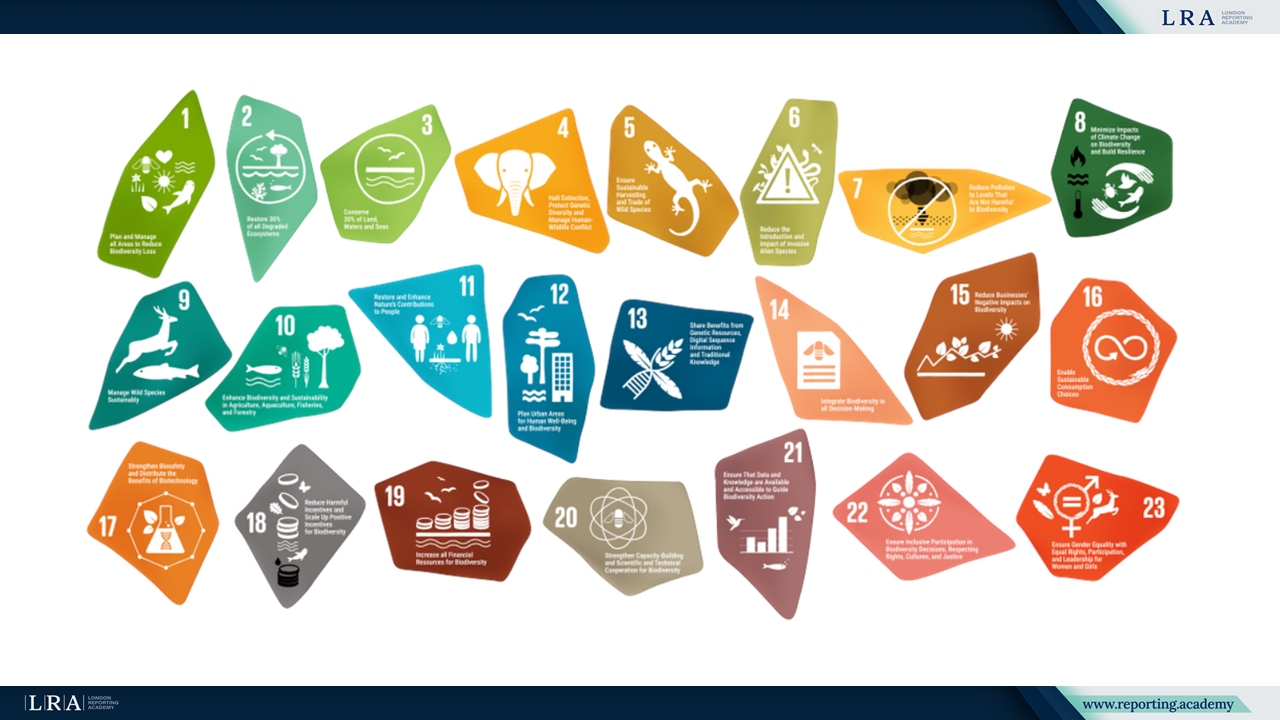
Source: Kunming–Montreal GBF Targets for 2030, Kunming–Montreal GBF Branding Toolkit
Among the GBF’s targets, Target 15 is the most directly relevant to corporate reporting because it specifically addresses how businesses assess and disclose biodiversity-related information. It calls on Parties to take legal, administrative or policy measures to encourage and enable business and, in particular, to ensure that large and transnational companies and financial institutions regularly monitor, assess and transparently disclose their risks, dependencies and impacts on biodiversity.
The scope extends to operations, supply and value chains and, for financial institutions, portfolios. The monitoring framework for Target 15 also includes indicators covering companies publishing sustainability reports and organisations that have signalled an intention to start adopting the TNFD recommendations.
The role of financial institutions is receiving broader attention ahead of COP17. Schomaker has highlighted portfolio exposure to ecosystem decline, support for client transitions and clearer disclosure rules as key areas of focus.
GRI Reinforces the Impact-Reporting Perspective
In July, the Global Reporting Initiative (GRI) endorsed the Kumamoto Declaration, which calls for globally consistent, standards-based approaches to reporting, assessment, target-setting and transition planning. GRI argues that consistent reporting on impacts provides the information needed for corporate action, public accountability and informed decision-making.
GRI 101: Biodiversity 2024 enables organisations to report their most significant biodiversity impacts and how they manage them. Importantly, GRI positions this reporting as extending beyond financial risks to show how business activities affect ecosystems, species and people who depend on them.
ISSB Moves Towards an Exposure Draft
The main reporting development in July came from the International Sustainability Standards Board (ISSB). On 21 July, the Board confirmed completion of the required due process and plans to publish an Exposure Draft in October 2026 with a 120-day comment period.
The proposed document would take the form of an IFRS Practice Statement on nature-related disclosures. The Practice Statement would be non-mandatory, although jurisdictions could require its application. IFRS S1 already requires material information about sustainability-related risks and opportunities that could reasonably be expected to affect an entity’s prospects.
Proposed metrics include the amount and percentage of assets or business activities vulnerable to identified nature-related risks and aligned with identified nature-related opportunities. Location would be particularly important because exposure can vary between sites, ecosystems and parts of the value chain. Companies would use reasonable and supportable information available without undue cost or effort.
Under the ISSB’s tentative decisions, entities would also be required to use nature-related scenario analysis to assess the resilience of their strategy and business model to nature-related risks. The approach would reflect an entity’s skills, capabilities and resources, while nature-related resilience assessments are expected to be more location-specific and asset-specific than climate-related assessments.
The ISSB has also tentatively decided to provide guidance on connections between climate-related and nature-related risks and opportunities, including trade-offs and co-benefits, as well as interactions with Indigenous Peoples, Local Communities and affected stakeholders where relevant to nature-related risks and opportunities.
The proposal would build on existing resources. TNFD’s LEAP approach could support identification and assessment but would not be mandatory. Entities would continue to refer to and consider the applicability of relevant nature-related metrics in the SASB Standards, while TNFD metrics and relevant ESRS and GRI Standards could provide additional guidance.
TNFD Focuses on the Assessment Problem
TNFD’s July discussion paper identifies two priority areas for possible refinement: the Assess phase of the LEAP approach and nature-related scenario analysis. The focus is on clearer guidance, practical tools and examples that can support more consistent and comparable assessments.
The main challenge is translating environmental information into business risk. Data on water use, land conversion, pollution, ecosystem condition or supplier locations can identify dependencies and impacts, but it does not by itself show how these could affect revenue, operating costs, asset values, financing or business continuity.
TNFD points to practical difficulties in constructing causal pathways, integrating nature-related issues into enterprise risk management and quantifying potential financial effects. Scenario analysis also remains difficult because of methodological complexity, data limitations and the lack of standardised approaches.
The work therefore focuses on making the connection between dependencies and impacts, identifiable risks and opportunities, and financial effects more consistent. TNFD also intends the work to inform regulators and standard setters developing approaches to nature-related risks and opportunities.
TNFD also published a separate discussion paper in July on invasive alien species (IAS) metrics. It proposes refinements to the existing core global disclosure metric and additional disclosure metric, together with new implementation guidance for measuring the proposed core metric. Following consultation, TNFD plans to finalise the IAS disclosure metrics and accompanying guidance in October 2026.
A further market-wide update is expected in September, when TNFD plans to publish its second Status Report during Climate Week NYC. It will provide a global stocktake of progress in nature-related assessment, reporting and decision-making, including implementation trends and challenges.
What Comes Next
Further major developments are expected in October. The ISSB plans to publish its Exposure Draft for consultation, while COP17 in Yerevan will conduct the first global review of collective progress under the Kunming–Montreal Global Biodiversity Framework. TNFD also plans to finalise its disclosure metrics on invasive alien species and accompanying measurement guidance following consultation.
Together, these developments will provide further detail across corporate disclosure, global biodiversity policy and the practical measurement of nature-related issues.