UNCTAD Sustainable Finance Policy Monitor 2026: A Global Snapshot
UNCTAD’s 2026 Monitor provides a global view of how sustainable finance policy is evolving across regions and regulatory systems.
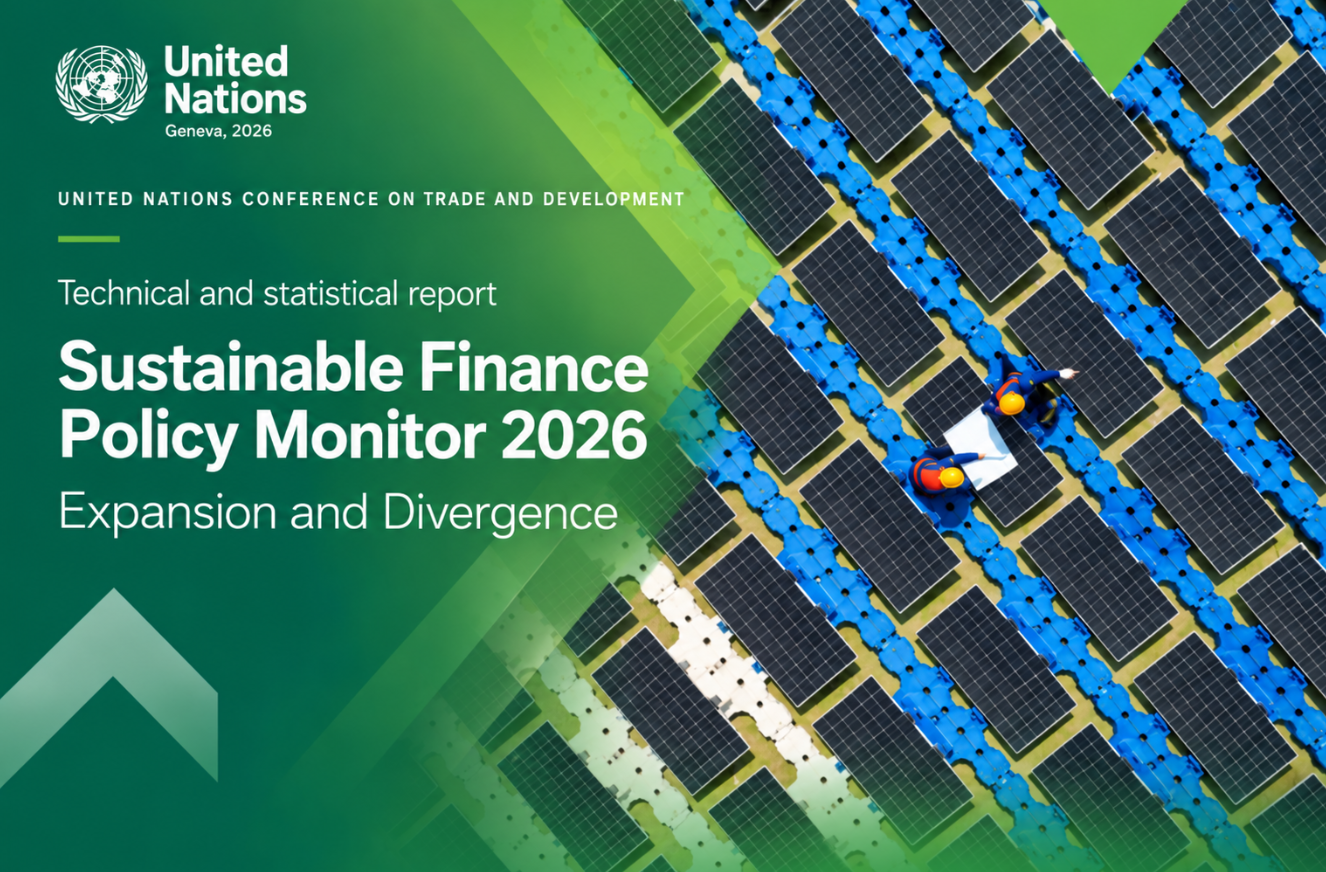
Sustainable finance policymaking expanded further in 2025. Across the 35 economies monitored by the United Nations Conference on Trade and Development (UNCTAD), 143 new policy measures were introduced, up from 99 in 2024. Together, these economies account for 93% of global gross domestic product (GDP).
UNCTAD identifies three overarching trends:
- continued expansion of sustainable finance regulation, responding to jurisdictional priorities and economic and environmental risks;
- a shift towards implementation and operational effectiveness;
- greater use of carbon pricing and transition finance as policy tools.
At the same time, jurisdictions are converging around some common principles while diverging in regulatory design and ambition.
Europe remains the most developed sustainable finance regulatory ecosystem in UNCTAD’s monitoring.
Sustainability Disclosure Remains the Largest Policy Category
Sustainability disclosure accounted for 44% of the measures introduced in 2025. Governments adopted 63 disclosure-related measures during the year, more than twice the number recorded in 2024.
UNCTAD identifies increasing alignment with international standards, particularly IFRS Sustainability Disclosure Standards, as jurisdictions pursue greater standardisation, harmonisation and cross-border interoperability.
Sustainability disclosure is also becoming more closely connected with financial stability. UNCTAD notes that disclosure can support risk management where climate-related risks affect asset values and the wider financial system. It is also increasingly considered a macroprudential tool.
Similar Standards, Different Regulatory Pathways
In Europe, recent EU policy has focused on simplification and narrower reporting obligations. This has occurred alongside stronger enforcement in areas such as greenwashing.
Asia-Pacific is moving from framework development towards integration and implementation. The region introduced 40 new measures in 2025, down from 49 in 2024, while national strategies and sustainability disclosure accounted for almost 63% of new measures. UNCTAD describes the direction of policy as one of greater coherence, scalability and system integration.
In Africa, several jurisdictions are building core sustainable finance frameworks in parallel. Disclosure requirements, taxonomies and carbon-market frameworks are developing at the same time, with some national systems also designed to support regional interoperability.
In North America, policy development remains fragmented. Canada continues to develop sustainable finance regulation, while the United States shows a widening gap between federal and state-level approaches.
In Latin America, policy development is consolidating around practical instruments, particularly taxonomies, product regulation and carbon markets.
Implementation is Becoming a Central Challenge
UNCTAD identifies several recurring implementation constraints, particularly in developing countries:
- High compliance costs – implementing ISSB-aligned disclosure, assurance, taxonomy classification and transition planning can be costly, especially for smaller firms.
- Data and reporting gaps – many companies, particularly SMEs, still lack reliable sustainability data, greenhouse gas emissions inventories and adequate internal controls.
- Regulatory fragmentation – jurisdictions need to balance alignment with international standards against domestic priorities and institutional capacity.
- Implementation capacity gaps – regulators, companies, auditors and financial institutions may lack the technical expertise, systems and data needed to implement disclosure requirements, taxonomies and carbon-market regulation effectively.
UNCTAD also identifies limited access to sustainable finance as a separate challenge and points to the need for further development of instruments such as green bonds, sustainability-linked loans, transition finance and carbon credits.
Carbon Markets Are Moving Beyond Pilot Schemes
Carbon-pricing policies accounted for more than 12% of new measures introduced in 2025. UNCTAD notes that carbon markets are moving from pilot phases towards more operational and, in some cases, economy-wide systems.
Taxonomies are also evolving beyond “green-only” classifications towards broader transition frameworks. These approaches can address the decarbonisation of hard-to-abate sectors alongside investment in renewable energy.
Interoperability Will Shape the Next Phase
UNCTAD identifies interoperability as a defining challenge for the next phase of sustainable finance policymaking: increasingly diverse national frameworks will need to remain sufficiently interoperable to support efficient global capital allocation and sustainable development.
The report describes sustainable finance policy as moving into a phase with greater emphasis on implementation, integration and economic alignment.