UK Consults on Principles-based Strategic Reporting and Changes to Sustainability Disclosures
The UK is considering a more principles-based approach to strategic reporting, with significant implications for sustainability disclosures.

A new UK government consultation proposes a broad redesign of corporate reporting under the Companies Act 2006. Open from 7 September to 30 November 2026, the consultation proposes wide-ranging changes to the UK corporate reporting framework.
For sustainability reporting, the central proposal is to refocus the strategic report on financially material, decision-useful information for existing and potential investors and creditors. Directors would have greater discretion in determining which information is financially material to investors and creditors.
A New Baseline Model for the Strategic Report
Most existing strategic reporting requirements could be replaced by five baseline areas:
- Business model
- Performance review
- Resources and relationships
- Company strategy
- Risks
The level of detail would reflect the size and complexity of the business.
The proposed resources and relationships disclosure would also replace the existing section 172(1) statement, which currently covers matters including employees, business relationships, communities and the environment.
Key performance indicators (KPIs) and information on main trends and factors would no longer sit as separate explicit requirements. Material KPIs, metrics, trends and factors would instead be used where relevant across the baseline areas.
The scope of the new baseline model has not yet been determined. The government is consulting on whether it should apply to publicly listed and large private companies, companies meeting a possible new “very large” threshold, or publicly listed companies only. It is also seeking evidence on the value of mandatory non-financial reporting for private companies.
A possible “very large” category could also be used to consolidate some of the different thresholds currently applied to non-financial reporting requirements. The government has not decided how such a threshold should be defined or which requirements would apply.
Specific ESG Disclosure Requirements Could Be Removed
Under the Companies Act 2006, section 414C(7)(b) and the relevant non-climate provisions of section 414CB currently impose topic-specific non-financial disclosure requirements on certain companies.
The consultation proposes removing explicit requirements covering:
- environmental matters;
- employees;
- social matters;
- community matters;
- respect for human rights;
- anti-corruption and anti-bribery matters.
Section 414CB currently requires disclosures on policies and their outcomes, due diligence processes and principal risks, including, where relevant and proportionate, relevant business relationships, products and services, as well as risk management and non-financial KPIs.
Separately, the government proposes removing the statutory requirement to disclose the sex breakdown of directors, senior managers and employees. The disclosure is currently required regardless of whether the company considers it material to performance or success.
Removal of the explicit topic requirements would not eliminate reporting on these matters. Companies in scope would still be expected to disclose them where they are financially material to performance or operations. A company with material financial risks arising from dependency on natural resources, for example, would be expected to reflect those risks across the relevant baseline disclosures.
Recognised frameworks could still be used for these disclosures, including the UK Sustainability Reporting Standards (UK SRS) and the Taskforce on Nature-related Financial Disclosures (TNFD).
Existing Climate-related Disclosure Requirements Are Not Being Reconsidered
Existing climate-related financial disclosure (CFD) requirements under the Companies Act 2006 are not being reconsidered through this consultation.
They are subject to a separate Post-Implementation Review (PIR), due to be completed by spring 2027. Any subsequent changes would be subject to further consultation.
Streamlined Energy and Carbon Reporting (SECR) is also being handled separately. Because the government has already announced plans to remove the directors’ report, SECR disclosures will need to move elsewhere within the annual report. Companies in scope would have flexibility to place them in any section of the first half of the annual report.
The Department for Energy Security and Net Zero (DESNZ) plans a separate consultation on SECR and the Energy Savings Opportunity Scheme (ESOS) later in 2026. It will consider longer-term options for energy and carbon reporting.
UK SRS and Future Company Law
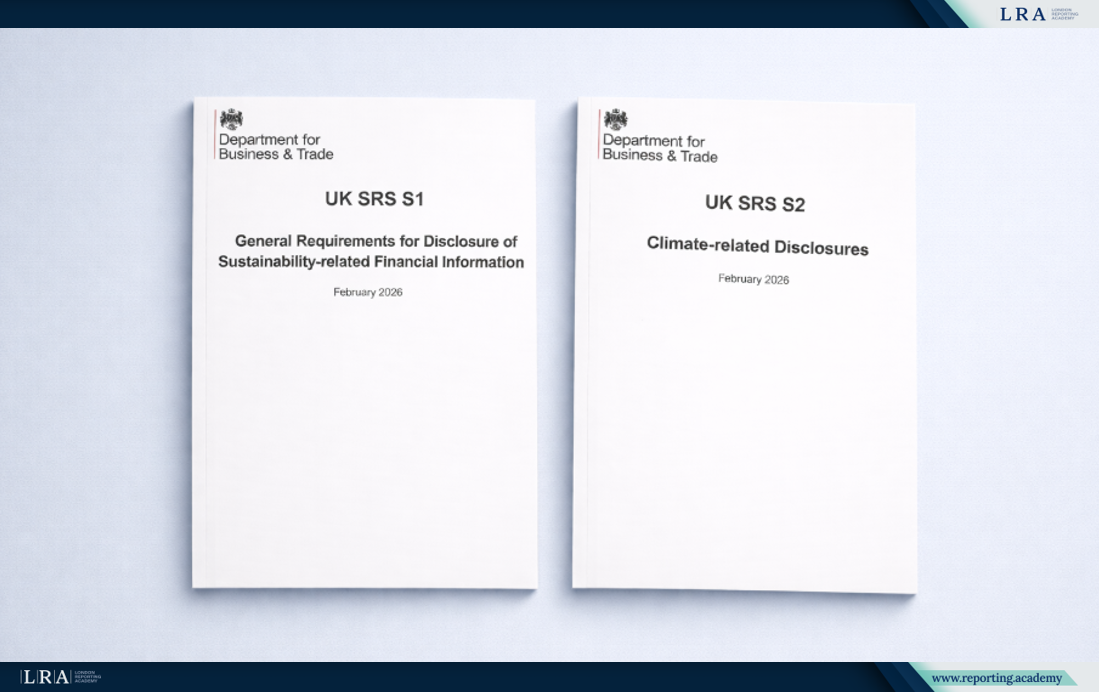
UK Sustainability Reporting Standards (UK SRS 1 and UK SRS 2) were published in February 2026 following the government’s assessment of IFRS S1 and IFRS S2 for use in the UK. The government will next consider how UK SRS should be reflected in the Companies Act 2006, taking account of this consultation, the CFD review and related processes.
For listed companies, the Financial Conduct Authority (FCA) has separately consulted on requirements linked to UK SRS. Its proposal would require disclosure of climate-related risks and opportunities under UK SRS 2 and application of relevant UK SRS 1 provisions. Scope 3 greenhouse gas emissions and non-climate reporting under UK SRS 1 would follow a comply-or-explain approach. Final listing rules are expected in autumn 2026.
Some companies could fall within both the FCA’s proposed UK SRS 2 requirements and the existing Companies Act CFD regime. Section 414CB(6) allows companies to use a national, EU-based or international reporting framework for CFD reporting, thereby avoiding duplication of information. Subject to the outcome of the FCA process, the government intends to clarify that UK SRS is a national reporting framework for this purpose.
Transition plan reporting is being considered through a separate policy process. The government is assessing its interaction with UK SRS 2 and the wider corporate reporting review.
Location of Sustainability Information
Under the current proposal, climate and other sustainability information could be integrated into the baseline sections or presented separately within the strategic report. The government states that sustainability disclosures in the annual report should remain strategic and financially material regardless of their location.
The consultation also seeks views on placing sustainability-related financial disclosures elsewhere in the front section of the annual report. If they were moved outside the strategic report, the government would seek to extend the relevant legal protections for directors under section 463 of the Companies Act 2006.
No Mandatory Sustainability Assurance Proposed
No new requirement for assurance over future UK SRS reporting or other strategic reporting topics is proposed at this stage. The government’s preferred approach is to leave the decision on external assurance with the reporting entity.
Instead, it is considering greater transparency around whether assurance has been obtained, the nature of the assurance, the standards applied and whether it provided limited or reasonable assurance.