Revised ESRS Datapoints: What Changed in 2026
EFRAG’s 2026 Draft List significantly reduces the number of ESRS datapoints and changes how they are structured and mapped.

On 28 August 2026, the European Financial Reporting Advisory Group (EFRAG) Secretariat published the 2026 Draft List of Datapoints for the Revised European Sustainability Reporting Standards (ESRS). The package includes a clean version, a mapping version linking the revised datapoints to the 2023 ESRS and 2024 IG 3, and an Explanatory Note.
The 2026 Draft List is based on the Revised ESRS Delegated Act published by the European Commission on 3 July 2026. The corresponding Draft XBRL Taxonomy was prepared on the same basis. Together, the Draft List and Draft XBRL Taxonomy translate the revised disclosure requirements into structures for human use and digital reporting.
Datapoint Reduction
EFRAG’s August 2026 Explanatory Note reports 783 ‘shall’ datapoints excluding General Disclosure Requirements (GDRs) in the July 2023 ESRS Delegated Act. EFRAG’s December 2025 Technical Advice contained 314, while the July 2026 Revised ESRS contain 292 ‘shall’ datapoints on the same basis.
This represents an approximately 63% reduction compared with 2023.
The comparison is not fully like-for-like because EFRAG also changed aspects of datapoint modelling and counting.
EFRAG defines a datapoint as a clearly separable and specific piece of information required by an ESRS Disclosure Requirement, generally at paragraph or subparagraph level. Two complementary criteria are used to define datapoints: semantic separability and data type.
Datapoints previously stemming from Application Requirements (ARs) were removed from the Revised ESRS or transformed into guidance. ARs can still affect datapoint modelling, for example by specifying a disaggregation or permitted data type. The Excel links relevant ARs through a Related Guidance field.
Disaggregations, such as breakdowns by country or gas type, are recorded as attributes and are not counted as separate datapoints. Several narrative elements within one continuous paragraph may also be represented as a single narrative datapoint.
EFRAG summarises the change in the datapoint count across the successive simplification stages in Figure 2 below.
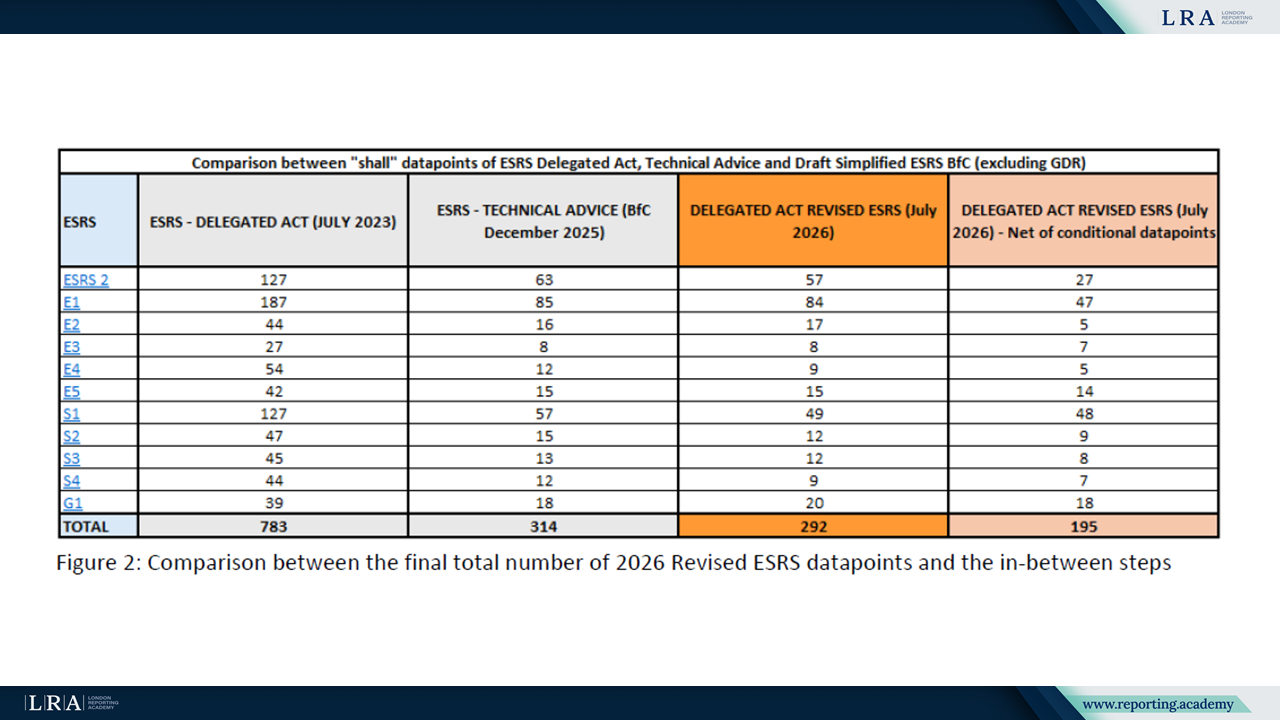
Source: Evolution of ESRS datapoint counts, Explanatory Note
Where the Datapoints are Concentrated
Most datapoints are concentrated in three standards: ESRS E1, ESRS 2 and ESRS S1. Together, they account for 190 of the 292 datapoints, or approximately 65% of the total.
Of the 292 datapoints, 83, or 28%, are mapped to EU legislation listed in Appendix A of ESRS 2, including SFDR, Pillar 3, the Benchmark Regulation and the Climate Law. EFRAG notes that mapping to other EU legislation, such as the CSDDD, has not yet been carried out.
Materiality and Conditionality
The number of datapoints does not correspond to the number of disclosures in an individual sustainability statement. An undertaking may assess individual datapoints, sub-topics or entire topics as not material and omit the related information.
Under ESRS 1 paragraph 24, an undertaking does not disclose information prescribed by an ESRS datapoint when that information is not material. Unlike the 2023 ESRS, the Revised ESRS contain no mandatory datapoints that must be disclosed irrespective of the materiality assessment.
EFRAG’s statistics report 195 datapoints net of conditional datapoints. Where a datapoint is conditional, the relevant condition in the standard must also be met. The Excel identifies conditional datapoints and separately indicates where the relevant condition is defined in another paragraph.
EFRAG counts six technical ESRS 2 BP-1 datapoints separately. These provide metadata about the sustainability statement and are not subject to the double materiality assessment.
GDR disclosures are also outside the 292 count. Disclosures on policies, actions and targets apply only where the undertaking has adopted the relevant policies, actions or targets for a material topic or sub-topic.
The topical sheets include placeholders referring users to applicable GDR-P, GDR-A and GDR-T requirements. These placeholders are not datapoints and are not included in the 292 total.
GDR-M is expected to be applied to each material metric datapoint, including additional entity-specific metrics. It is not included as a virtual datapoint in the topical worksheets. EFRAG therefore provides a separate appendix identifying metric datapoints to be used for GDR-M in the XBRL taxonomy.
Datapoint Structure and Phase-ins
EFRAG groups data types into three main categories:
- Narrative;
- Semi-Narrative, including enumeration lists and Boolean datapoints, often forming part of a narrative disclosure;
- Numerical Elements, covering data types that are neither narrative nor semi-narrative.
Numerical datapoints are classified further by format or unit. The list also identifies alternative presentation where the standards permit more than one form of disclosure.
Disaggregation requirements are recorded separately from the datapoint count. Mandatory breakdowns are marked with an asterisk (*), while optional or conditional breakdowns are identified as "may" or "if applicable". These breakdowns do not normally create additional datapoints.
The Excel includes three phase-in columns linked to ESRS 1, distinguishing between wave-one undertakings above and below the thresholds in paragraphs 125 and 126, and other undertakings covered by paragraph 127.
Mapping to 2024 IG 3
The mapping version is particularly relevant for undertakings that already use the 2024 IG 3 List of ESRS Datapoints.
Each revised datapoint receives a new identifier beginning “ESRS26_”. EFRAG introduced the new IDs to ensure uniqueness and avoid overlap with the IDs used in the 2024 IG 3.
The mapping links revised datapoints to the 2023 ESRS and 2024 IG 3 wherever possible. The relationship is not one-to-one. Some revised datapoints consolidate several 2024 IG 3 datapoints, while some previous datapoints are split across several revised entries.
Existing ESRS data registers therefore require reconciliation with the revised datapoints, not only replacement of paragraph references or IDs.
EFRAG identifies data gap analysis and amendment of existing sustainability statements among the intended uses of the list.
Datapoint Names are Abbreviated
EFRAG states that datapoint names are shortened descriptions of disclosure requirements. They do not reproduce all information in the relevant ESRS paragraph and do not necessarily include conditions attached to the datapoint.
The Excel provides direct links from datapoint names to the corresponding paragraphs in the EFRAG ESRS Knowledge Hub. The full ESRS text remains necessary to determine scope, conditions, required content and applicable disaggregation.
Status and Next Steps
The Revised ESRS will become legally effective only after completion of the scrutiny period and publication in the Official Journal of the European Union.
The 2026 Draft List is non-authoritative EFRAG Secretariat supporting material. It is not part of the Revised ESRS and does not constitute Implementation Guidance.
EFRAG states that the list must not substitute the adopted ESRS text or be used as a checklist. It should be used together with the judgement applied to materiality. EFRAG also cautions that the current draft may contain errors or be incomplete.
The Draft List is designed for human use, while the corresponding XBRL Taxonomy is intended mainly for machine-readable digital reporting. Some technical details are therefore provided only in the taxonomy.
EFRAG plans to issue the Draft XBRL Taxonomy shortly after the Draft List for a separate formal public consultation. It then plans to hand the taxonomy to the European Securities and Markets Authority (ESMA) and the European Commission in November 2026.
The draft datapoint list is open for fatal-flaw review until 23 October 2026. EFRAG expects to publish the final version by the end of 2026.