EU ESG Ratings Regulation: What Changes for Rating Providers in 2026
ESG ratings can shape how companies are assessed by investors and other market participants, yet the methodologies behind them can vary significantly. The EU’s new regime is designed to make those methodologies, data sources and potential conflicts of interest more transparent.

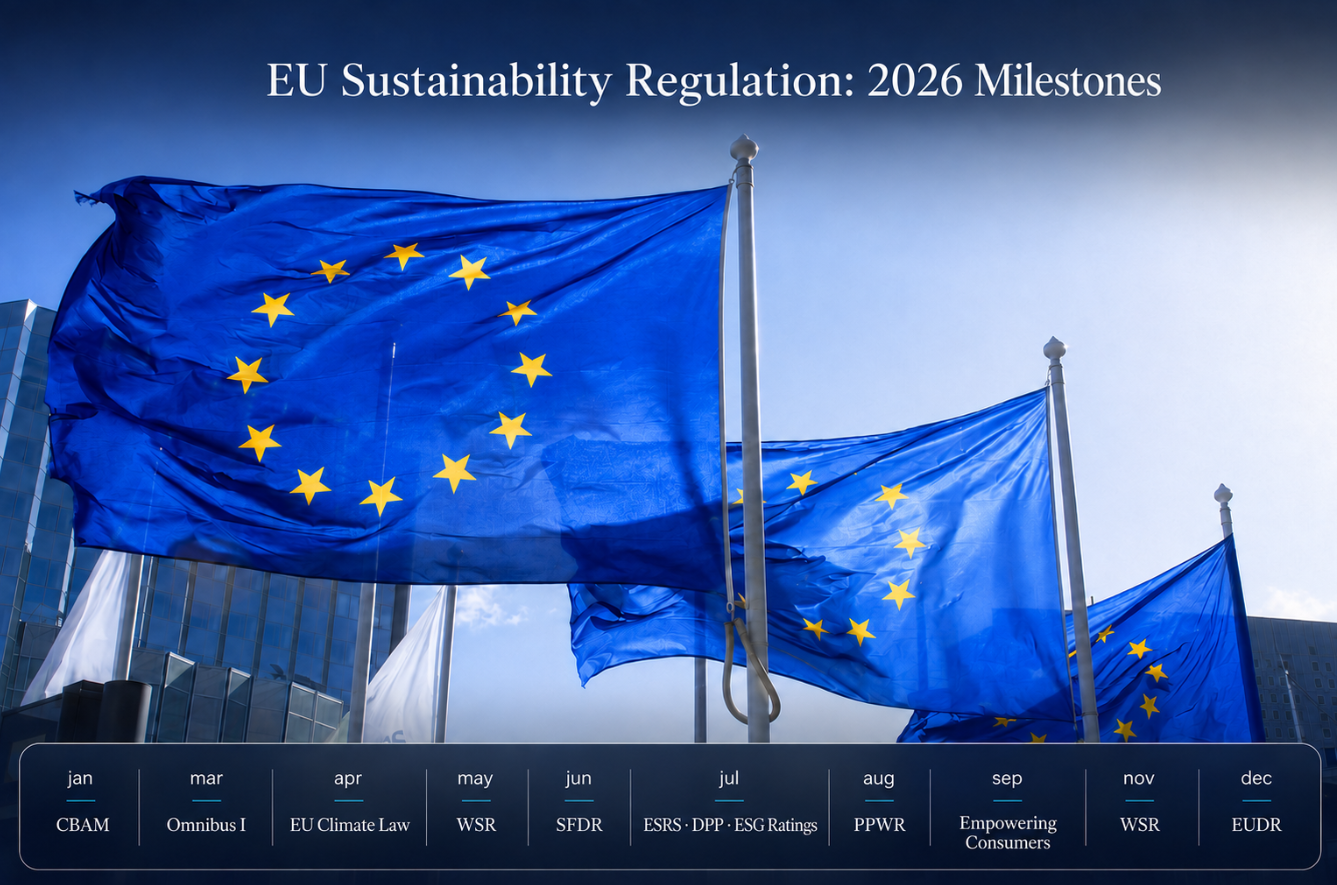
Since 2 July 2026, ESG rating providers within the scope of the EU regime have been subject to Regulation (EU) 2024/3005. Technical rules published in July and September now provide more detail on how the Regulation applies in practice.
For companies preparing sustainability reports, the effect is indirect. The rules do not introduce a new reporting obligation, but they change how ESG ratings are produced, explained and supervised.
What the Regulation Changes
ESG ratings can differ in:
- scope, including whether they cover individual E, S or G factors, an aggregated ESG rating or specific issues;
- data sources and data processes;
- methodologies, supporting models and key assumptions;
- industry classifications;
- rating categories and the basis used for comparison.
These elements are covered by the disclosure requirements in Article 23 and Annex III of Regulation (EU) 2024/3005, with further detail provided in Commission Delegated Regulation (EU) 2026/871.
Regulation (EU) 2024/3005 does not impose a single EU methodology or ESG score. As a general rule, where ratings cover E, S and G factors, providers must rate these factors separately. Providers may offer an aggregated ESG rating, but must disclose the weighting assigned to the E, S and G categories and explain the weighting method.
The Regulation also brings ESG rating providers under supervision by the European Securities and Markets Authority (ESMA) and sets requirements on transparency, governance and independence.
More Information Behind ESG Ratings
Commission Delegated Regulation (EU) 2026/871, published on 28 July, specifies the information providers must disclose about ESG rating products and methodologies.
The rules distinguish between information disclosed publicly and more detailed information provided to users of ESG ratings, rated items and issuers of rated items.
Providers must explain whether a rating assesses risks, impacts or both. If they use double materiality, they must describe how risk and impact materiality are taken into account. They must also explain what their E, S and G factors cover and, where relevant, whether the methodology considers the Paris Agreement or other international agreements.
Public methodology information includes supporting models and key assumptions, rating categories, data quality measures and the basis for comparison where ratings are relative. Providers must also disclose the date of the latest methodology update and describe changes from the previous version.
The rules also require providers to explain data limitations and the use of assumptions, proxies or estimates. More detailed disclosures cover methods for collecting non-public data and potential shortcomings of pre-established statistical or algorithmic systems or models.
Transparency also extends beyond methodology. Providers must disclose information on ownership links, their payment and business model, and fee-setting criteria. They must also identify the areas of their activities or organisation where the main risks of conflicts of interest may arise.
These disclosures can help users understand why ratings for the same company may differ.
Conflicts of Interest
Regulation (EU) 2024/3005 prohibits an ESG rating provider from also providing consulting, credit ratings, statutory audit of financial statements or assurance engagements on sustainability reporting.
Investment services and activities of credit institutions, insurers or reinsurers may coexist with ESG rating activities only under specific conditions and safeguards. Benchmark provision is possible through a separate derogation subject to ESMA authorisation.
Commission Delegated Regulation (EU) 2026/872 specifies the safeguards for permitted combinations. These include organisational separation, defined reporting lines and controls over access to confidential information. Employees directly involved in assessing a rated item must not perform activities covered by the separation requirements.
Authorisation and Recognition
Commission Delegated Regulation (EU) 2026/1119, published on 1 September, specifies the information providers must submit to ESMA when applying for authorisation or recognition.
Applications must describe the provider’s ownership and governance structure, ESG rating activities and methodology, as well as any outsourcing and other business activities. Providers must also state whether they expect to use sustainability information disclosed under the Sustainable Finance Disclosure Regulation (SFDR) and Directive 2013/34/EU, the Accounting Directive.
Recognition is one of the routes available to providers established outside the EU. It is available, subject to the conditions in Article 12, to providers or groups below specified turnover thresholds. Other third-country routes under the Regulation include equivalence and endorsement.
The transition is already under way. Providers that operated in the EU when the Regulation entered into force had to notify ESMA by 2 August 2026 if they wanted to continue operating and apply for authorisation or recognition. They generally have until 2 November 2026 to submit that application. Small ESG rating providers that fall under the separate transitional regime have until 2 November 2026 to notify ESMA.
Two further delegated regulations published in July deal with ESMA enforcement procedures (Commission Delegated Regulation (EU) 2026/904) and fees charged by ESMA to ESG rating providers (Commission Delegated Regulation (EU) 2026/910).
ESG Ratings and Sustainability Reporting
The new rules do not create an additional sustainability reporting requirement for a company simply because it receives an ESG rating.
Corporate sustainability disclosures and other ESG data can be used as inputs into an external assessment. The final rating still depends on the provider's methodology, assumptions, comparison basis and other information used.
An ESG rating should therefore not be read as a direct measure of compliance with ESRS, the EU Taxonomy or another sustainability reporting framework. Recital 37 of Regulation (EU) 2024/3005 also clarifies that ESG ratings should not be considered ESG labels providing assurance of compliance or alignment with the EU Taxonomy or other standards.