EU Sustainability Regulation in 2026: Current Status and What’s Ahead
In 2026, EU sustainability rules are moving from policy design into a more complex mix of implementation, revision and new legislative proposals. For companies, the result is a regulatory agenda that increasingly reaches beyond disclosure into products, trade, supply chains, investment and operational data.
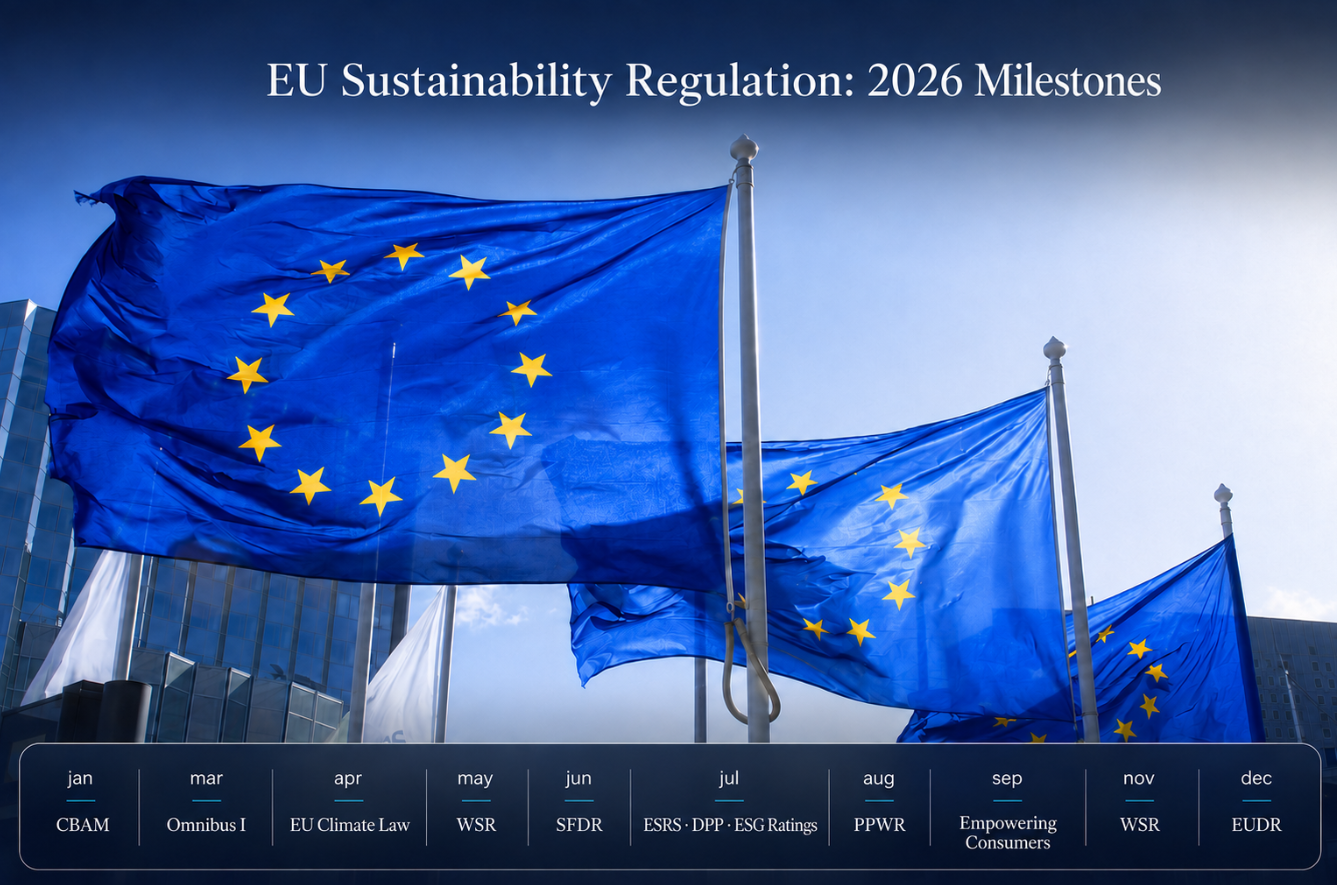
EU sustainability regulation has moved in different directions in 2026. Reporting obligations are being reduced for some companies, while product, trade and supply-chain rules are moving into application. For companies, the immediate task is to distinguish requirements that already apply from changes still subject to national transposition, EU scrutiny or legislative negotiations.
The relevant legal milestones also have different effects. Legislative approval, entry into force, a transposition deadline and an application date are not interchangeable, and individual provisions of the same regulation may apply at different times. The chronology below separates these milestones before turning to the substance of the rules and their implications for companies.

Table 1. Key EU sustainability regulatory milestones in 2026
The developments below have the most direct implications for sustainability reporting, corporate data, product requirements, supply chains and compliance processes. The focus is on what changes in practice for companies.
Reporting and Sustainable Finance
Several 2026 changes directly affect sustainability reporting and the use of ESG information in financial markets. They change reporting scope, disclosure requirements and the way sustainability information is used in financial products and ESG ratings.

Omnibus I: CSRD and CSDDD
Scope and requirements. The amended Corporate Sustainability Reporting Directive (CSRD) narrows mandatory sustainability reporting to undertakings exceeding both 1,000 employees and €450 million in net turnover. The amendments also introduce a value-chain cap, remove the mandate to adopt sector-specific ESRS, move the deadline for EU limited-assurance standards to 1 July 2027 and remove the planned EU reasonable-assurance standards. The Corporate Sustainability Due Diligence Directive (CSDDD) threshold rises to more than 5,000 employees and €1.5 billion in net turnover, while its climate transition plan obligation is removed.
Implications for companies. The number of companies subject to mandatory CSRD and CSDDD requirements falls substantially. Companies close to the previous thresholds may leave direct scope, while CSRD reporters face tighter limits on the sustainability information they can demand from protected companies in their value chains. The removal of mandatory sector-specific ESRS also changes how industry-specific reporting detail will develop, with guidance rather than mandatory sector standards expected to play a larger role.
Revised ESRS and EU Taxonomy
Published changes. Revised European Sustainability Reporting Standards (ESRS) adopted by the Commission on 3 July reduce mandatory data points by more than 60% and total data points by more than 70%. The delegated acts remain under scrutiny and are not yet in force. EU Taxonomy simplification measures apply from 1 January 2026 to FY2025, although companies can elect to begin applying them from FY2026.
Implications for reporting. If the revised ESRS complete the scrutiny period and enter into force, the volume of mandatory disclosures will fall substantially. Until then, companies should distinguish the July 2026 text from the ESRS currently in force. For Taxonomy reporting, the option to defer the simplified approach to FY2026 means companies need a clear and documented basis for which templates and calculations they use in the current reporting cycle.
ESG Ratings Regulation
Scope and requirements. Regulation (EU) 2024/3005 applies from 2 July and brings ESG rating providers operating in the EU under direct ESMA supervision. Different authorisation, recognition and registration routes apply depending on the provider.
Implications for companies. The regulation formalises how ESG rating activities are supervised and introduces greater structure around the information used in ratings. For rated companies, one practical consequence is the factual-review process: ESMA has clarified that providers must give an issuer or rated item access to the relevant dataset on request. This gives companies a clearer route to identify factual errors in the data underlying a rating.
SFDR review
Proposed changes. The Council's June position would introduce three categories of financial products: sustainable, transition and ESG basics. The proposal is intended to replace the current situation in which Sustainable Finance Disclosure Regulation (SFDR) classifications have often functioned as an informal product-labelling system.
Points to monitor. The proposed categories could materially change how sustainability-related funds and other financial products are classified and communicated to investors. They remain part of the Council's negotiating position, so financial market participants should not treat them as the final SFDR framework until the legislative process is completed.
Trade, Products and Supply Chains
A second group of 2026 measures shifts sustainability requirements into trade, product design and supply-chain processes. They affect the data companies need on imports, materials, packaging, product origin, waste movements and consumer-facing information.

CBAM
Scope and requirements. Importers above the 50-tonne annual threshold for cement, iron and steel, aluminium and fertilisers, together with importers of electricity and hydrogen, fall within the definitive Carbon Border Adjustment Mechanism (CBAM) authorisation requirements. Covered importers must account for embedded emissions. The first declaration covering 2026 imports is due by 30 September 2027. Importers may use Commission default values or actual emissions data, with actual data requiring verification.
Implications for companies. CBAM places product-level carbon data directly into customs and import compliance. Companies using actual emissions values depend on verified information from non-EU producers, so emissions data becomes part of supplier relationships rather than information collected only for sustainability reporting. CBAM certificate obligations also make the carbon intensity of covered imports a direct cost factor.
WSR
Scope and requirements. Most revised Waste Shipment Regulation (WSR) provisions started to apply on 21 May together with the Digital Waste Shipment System (DIWASS). Prior informed consent procedures are now processed digitally. Plastic-waste exports to third countries require prior informed consent, and exports to non-OECD countries will be prohibited from 21 November. Green-listed waste can continue using the previous paper procedure until 31 December 2026.
Implications for companies. Waste movements become a more traceable and data-driven compliance process. Companies using cross-border waste routes need to account for the destination country, waste classification and relevant digital documentation when planning disposal or recovery arrangements. The non-OECD plastic-waste ban can also require changes to existing treatment and recycling routes.
ESPR and DPP
Scope and requirements. The Ecodesign for Sustainable Products Regulation (ESPR) establishes a framework for product-specific ecodesign requirements covering areas such as durability, reparability, resource and energy efficiency, recycled content and environmental footprint. It also introduces the Digital Product Passport (DPP) as a structured source of product information. From 19 July 2026, large companies are prohibited from destroying specified unsold apparel, clothing accessories and footwear, subject to defined derogations. DPP requirements will apply progressively through product-specific delegated acts.
Implications for companies. ESPR shifts sustainability requirements further into product design and product data. For affected product groups, compliance will increasingly depend on information being available at model, batch or item level and in a structured, interoperable format. The DPP Registry became operational on 20 July 2026 and provides the infrastructure for registering unique product identifiers and associated metadata.
PPWR
Scope and requirements. The Packaging and Packaging Waste Regulation (PPWR) covers all packaging and packaging waste regardless of material or origin. It sets requirements for manufacturing, composition and the reusable or recoverable characteristics of packaging, together with packaging-waste prevention and management measures. The Regulation applies from 12 August 2026, although many individual obligations have later application dates.
Implications for companies. The effects extend into packaging design, material selection, supplier specifications and product data. The 12 August date does not bring every PPWR obligation into application at once. Companies need to follow the timetable for the provisions relevant to their packaging and products, including later requirements on recyclability, reuse, recycled content and harmonised labelling.
Empowering Consumers for the Green Transition
Scope and requirements. The Directive changes EU consumer-law rules concerning environmental claims, sustainability labels and information on durability and reparability. Member States had to transpose it by 27 March, with national rules applying from 27 September.
Implications for companies. Consumer-facing sustainability information now carries a clearer compliance risk. Environmental claims and sustainability labels used on packaging, websites and sales materials need to be reviewed against the new rules. For old stock produced or distributed before the application date, authorities may use a proportionate approach where genuine transitional difficulties exist, but companies are still expected to take timely compliance steps.
EUDR
Scope and requirements. The EU Deforestation Regulation (EUDR) covers cattle, cocoa, coffee, palm oil, rubber, soy and wood and specified derived products. Operators must demonstrate that covered products are deforestation-free and produced in accordance with relevant legislation in the country of production. The Commission revised the product scope in July and adopted technical rules for the EUDR Information System. Products newly added in July will not become subject to the Regulation until 30 December 2027.
Implications for companies. Product origin becomes a regulatory data point. Companies need to connect supplier information and product records with due diligence statements in the EUDR Information System. Procurement and supplier-management teams therefore become part of the control environment for EUDR compliance. Companies should also recheck Annex I following the July changes and update their product-scope assessment accordingly.
Vehicle Circularity Regulation
Scope and requirements. Regulation (EU) 2026/1738 introduces requirements covering vehicle design, reusability, recyclability, recycled content, information on parts and materials, extended producer responsibility and management of end-of-life vehicles. The Regulation entered into force on 13 August 2026. General application begins on 1 September 2028, while some provisions start earlier.
Implications for companies. Automotive businesses will need to integrate circularity requirements into product design, materials information and end-of-life processes. The Regulation also illustrates why legal dates need to be tracked provision by provision: publication in 2026 does not mean that the full operational regime applies immediately.
Climate and Industrial Policy
The 2026 climate and industrial policy agenda combines a new 2040 emissions target with measures affecting carbon pricing, industrial decarbonisation, circularity and climate resilience.

European Climate Law
Scope and requirements. Regulation (EU) 2026/667 sets a binding EU target to reduce net greenhouse gas emissions by 90% by 2040 compared with 1990.
Implications for companies. The 2040 target sets the direction for the next phase of EU climate legislation, with implications for future carbon-pricing, energy and industrial-policy measures.
EU ETS revision
Proposed changes. The Commission's July proposal would revise free allocation and its interaction with CBAM, strengthen the aviation and maritime Emissions Trading System (ETS) and gradually extend emissions trading to municipal waste incineration.
Points to monitor. Changes to free allocation and CBAM interaction could affect future carbon costs for ETS-covered industries. Companies should therefore distinguish assumptions based on the July proposal from costs arising under the ETS rules already in force.
IAA
Proposed changes. The Industrial Accelerator Act (IAA) would introduce low-carbon and European-origin requirements in parts of public procurement and public-support schemes. The proposal also addresses permitting and sustainable manufacturing.
Points to monitor. If adopted, product carbon performance and origin could influence access to certain public contracts and support programmes. Companies supplying the sectors covered by the proposal should therefore follow how those criteria are defined during negotiations.
Omnibus VIII
Proposed changes. Omnibus VIII would simplify rules and procedures concerning industrial emissions, circular economy requirements and geospatial data. The Council agreed its position on key parts of the package in June.
Points to monitor. The relevant issue for companies is which administrative procedures, reporting requirements and permitting steps are ultimately changed. Current environmental obligations remain applicable while the simplification package moves through the legislative process.
Omnibus XII
Proposed changes. Omnibus XII would simplify energy and tyre labelling rules for suppliers and retailers and expand the use of digital options.
Points to monitor. The proposal could change how product information is provided and maintained, particularly where digital information replaces or supplements existing labelling processes. Those changes remain proposed and should not yet be built into compliance systems as final requirements.
CEA
Current direction. Commission work on the Circular Economy Act (CEA) is focused on secondary raw-material markets, access to circular feedstocks and reducing dependence on imported critical raw materials. The proposal is scheduled for Q3 2026.
Points to watch. Companies using recycled inputs should pay particular attention to any measures affecting sourcing, market access and the conditions for using secondary materials. Until the proposal is published, these policy directions do not create new corporate requirements.
European Climate Resilience and Risk Management Integrated Framework
Current direction. The Commission plans to adopt the framework during the second half of 2026. Preparatory work has covered harmonised climate-risk assessments, resilience in policies and investment, nature-based solutions and long-term adaptation finance.
Points to watch. The final package could influence how climate risk is incorporated into investment and preparedness decisions. No specific new corporate requirement should be assumed until the package is adopted.
Governance Regulation revision
Current direction. A Q4 proposal is planned to revise the Governance Regulation on the Energy Union and Climate Action. Commission work includes the post-2030 policy architecture, performance indicators and a stronger investment role for National Energy and Climate Plans.
Points to watch. The direct obligations primarily concern EU and Member State climate and energy governance. For companies, the downstream relevance will come through national sector policies, investment priorities and implementation measures developed under the revised framework.
Sustainability Data Across Business and Compliance
The 2026 developments covered above show that sustainability regulation increasingly reaches into operational business processes. CBAM links emissions data to imports. EUDR connects product origin and supply-chain information with due diligence. PPWR brings packaging composition and product information into compliance, while ESPR and DPP require increasingly structured product-level data.
Sustainability data are therefore increasingly used beyond disclosure. The same information may now support customs, product compliance, sourcing, supplier controls and regulatory reporting. For companies, the challenge is to keep these data traceable to their source, supported by evidence and consistent across systems and functions.
In 2026, sustainability compliance increasingly depends on the quality, ownership and traceability of operational data across the business.