EBA Proposes Climate Module for 2027 Bank Stress Test
EBA’s draft 2027 stress-test package reduces the data request while adding a dedicated climate risk module. The proposal links climate-related data more directly to credit risk, provisions and impairments.
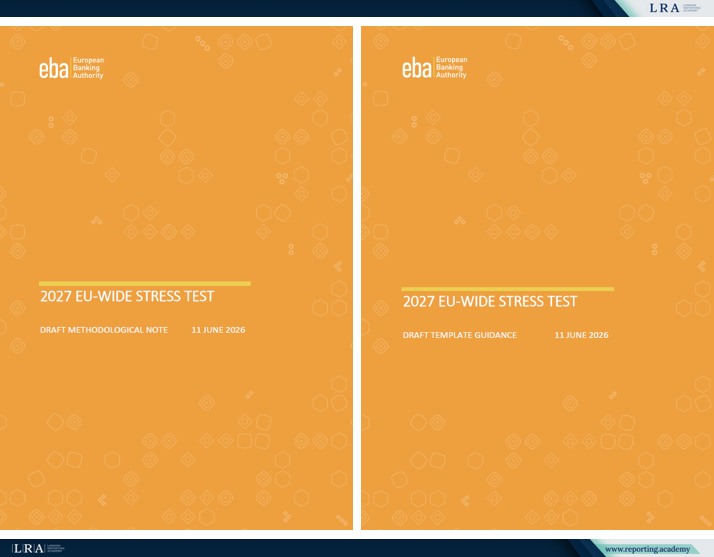
The European Banking Authority has published its draft package for the 2027 EU-wide stress test. This is the exercise used to test how banks could cope with severe economic conditions. For 2027, EBA also proposes a dedicated climate risk module.
Under the draft package, banks would assess how selected climate shocks affect selected credit exposures. In simple terms, they would test whether climate-related shocks, including policy and flood shocks, could increase borrower defaults, credit losses, provisions and impairments.
The module is limited. It focuses on credit losses, provisions and impairments for selected exposures. It does not mean that EBA is proposing a separate climate capital requirement.
What EBA Has Published
On 11 June 2026, the European Banking Authority (EBA) released the draft methodology, templates and template guidance for the 2027 EU-wide stress test. These documents explain how participating banks would run the exercise and fill in the reporting templates.
The stress test covers the 2027–2029 period. It uses year-end 2026 figures as the starting point. It covers the main banking risk areas, including credit risk, market risk, net interest income, operational risks, non-interest income, expenses and capital. It also adds a dedicated climate risk module.
EBA presents the 2027 exercise as simpler in data terms. It would also add a dedicated climate risk component. Required data points are reduced by around 55% compared with the previous EU-wide stress test. Data points are the individual pieces of information banks must report. EBA says the reduction comes mainly from greater use of regular supervisory reporting and the removal of overlaps.
Status and Supervisory Use
The documents are open for early consultation until 7 August 2026, so the methodology, templates and guidance may still change before the exercise is launched.
The stress test does not use fixed pass-or-fail thresholds. Its results feed into supervisory review processes and help supervisors assess bank resilience.
For reporting teams, the climate module should not be described as a separate climate capital requirement. The Draft Template Guidance also states that the climate summary template, CSV_CL_SUM, is not linked to the main profit and loss template, CSV_P&L.
Scope of the Exercise
The 2027 exercise will cover 63 banks from the EU and Norway. This includes 47 banks from the euro area. The sample represents around 75% of the EU banking sector.
The climate module applies only to selected credit exposures, such as loans where policy or flood shocks could affect the borrower or the collateral.
For transition risk, EBA focuses on exposures to non-financial corporations (NFCs). These are grouped by NACE sector, which means by economic activity. EBA also includes household exposures related to house purchases. These are grouped by the energy performance of the underlying properties.
Physical risk covers selected NFC loans and advances. This includes commercial real estate and other loans. It also covers residential real-estate-collateralised exposures exposed to river flood risk. The analysis is structured by EEA countries and flood severity categories.
How the Climate Module Works
The module separates climate risk into transition risk and physical risk.
Transition risk covers the move towards a lower-carbon economy. In the draft package, banks would assess non-financial corporation exposures by material NACE sectors and household house-purchase exposures by the energy performance of the underlying properties.
Transition risk is assessed over the three-year stress-test horizon, while the physical flood shock is applied in the first year of the adverse scenario.
Physical risk focuses on river flood risk. Banks would classify relevant exposures by flood risk category and, where required, connect collateral locations to flood-depth values in the JRC hazard map. They would then use damage functions to estimate additional real estate price shocks in the first year of the adverse scenario.
The module follows the static balance sheet assumption used in the wider EU-wide stress test. This means banks do not assume changes to their business model during the test. For climate risk, they also cannot assume energy-efficiency renovations, recovery of damaged property or management actions to reduce climate-related losses, unless the general framework allows this.
Practical Meaning for Reporting Teams
For sustainability and non-financial reporting teams, the issue is not a new disclosure format. It is whether climate-related data can support a supervisory stress-test process.
Ownership should be clear. The module would involve sustainability, credit risk, finance, regulatory reporting and data teams. Organisations will need to decide who owns sector mapping, property energy performance data, collateral location data, model assumptions and template completion.
Evidence needs to be traceable. Transition risk depends on sector data and energy performance information for real estate. Where actual energy performance data is unavailable, the template guidance allows reasonable and well-justified proxies. Where neither actual data nor reliable proxies are available, banks use a separate “no energy performance data available” bucket.
Physical risk requires location-based analysis of collateral assets. General country or sector descriptions will not be enough where the template requires asset-level information.
Controls should be considered early. EBA’s methodology allows banks to use internal approaches where relevant, but assumptions and methods must be documented. Competent authorities will review submitted data and results.
Teams should start with scope. They need to know whether the bank is in the EBA sample, which climate templates apply, which fields require bank input and which outputs may be published. External reporting language should follow the mechanics of the exercise.
What to Watch Next
Reporting teams should track the final methodology and any changes to the dedicated climate templates. They should also check how climate module results will be reflected in published stress-test outputs.
The practical question is whether climate-related data used for disclosures can be traced to the classifications, assumptions and template inputs required for the stress test.