OECD Assesses Sustainable Infrastructure Investment in Central and Southeast Asia
Central and Southeast Asia need substantial investment to expand and modernise infrastructure, yet the additional funding required to align it with sustainability objectives is often comparatively limited. The larger challenge is to translate climate commitments into project pipelines, appraisal methods and financing decisions.
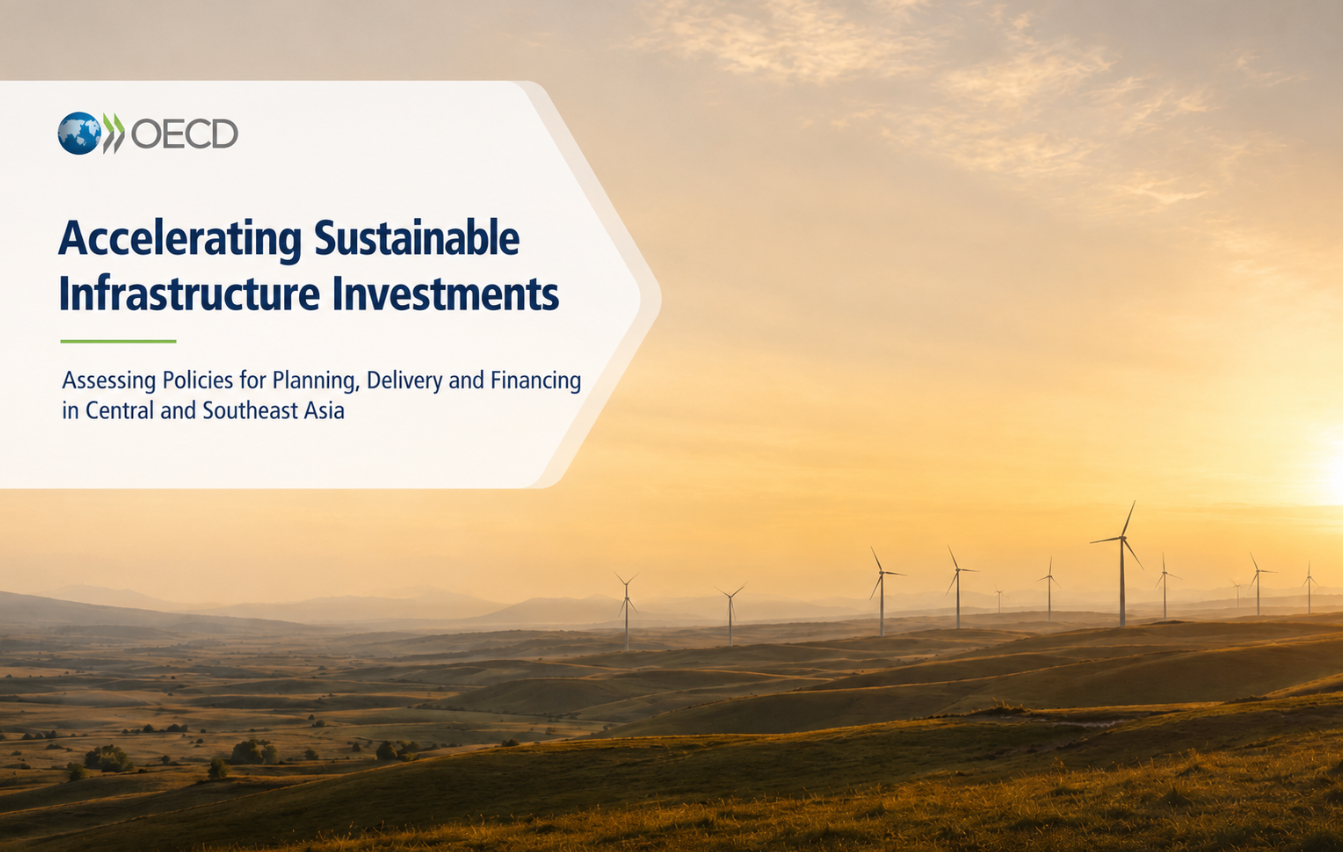
On 12 June 2026, the Organisation for Economic Co-operation and Development (OECD) published Accelerating Sustainable Infrastructure Investments, an assessment of infrastructure planning, delivery and finance in Central and Southeast Asia. It examines whether planned investment in energy, transport and industry supports lower emissions, climate resilience and wider sustainable development objectives.
The report distinguishes between the region’s overall infrastructure investment gap and the comparatively smaller additional investment required for sustainability-aligned infrastructure.
What the Report Examines
The publication consolidates findings from the Sustainable Infrastructure Programme in Asia (SIPA), implemented from October 2021 to June 2026. It covers Indonesia, Kazakhstan, Mongolia, the Philippines, Thailand and Uzbekistan.
The OECD assesses national planning, sectoral policies and financial systems, together with project appraisal, climate resilience, nature-based solutions and responsible business conduct. This is a policy assessment, not a regulation, reporting standard or mandatory framework.
The Main Challenge Is the Overall Investment Gap
Central and Southeast Asia face an annual infrastructure investment gap of about 5–7% of gross domestic product (GDP). In most countries assessed, alignment with climate and sustainability objectives would require an additional amount of around 1% of GDP.
The country estimates illustrate the range. Kazakhstan’s net-zero pathway to 2060 requires investment equivalent to 6% of GDP, compared with 5% under the reference scenario. Indonesia’s climate-adjusted annual gap is 5.1% of GDP, against 4.7%, while Uzbekistan’s respective estimates are 16.6% and 13.5%.
These estimates cover different sectors, time horizons and investment categories and rely on different modelling approaches. For example, some assess economy-wide infrastructure needs, while others focus only on sectors such as energy or transport. They therefore should not be used to rank countries directly. Taken together, however, they indicate that most investment would be required even under a reference scenario to expand and modernise infrastructure, while alignment with climate and sustainability objectives generally adds a smaller incremental requirement.
Investment Pipelines Remain Carbon-Intensive
Current infrastructure pipelines do not consistently reflect national climate commitments. At the wider regional level, Southeast Asia still has 31.9 GW of coal-fired power projects in the pipeline, while Central Asia has 12.7 GW. The regions also have substantial planned gas-fired capacity, exceeding 100 GW in Southeast Asia and reaching 13 GW in Central Asia.
Transport investment remains heavily concentrated in road infrastructure. Roads are projected to receive more than 60% of transport investment in both regions between 2020 and 2035, although rail and urban transport projects account for a growing share.
These plans sit alongside Nationally Determined Contributions (NDCs) and, in several countries, long-term low-emission development strategies. The OECD finds that such commitments are not yet systematically translated into budgets, sector plans and project selection, partly because responsibilities remain fragmented across institutions.
Project Appraisal Can Change the Investment Case
A shortage of well-prepared, bankable sustainable infrastructure projects across energy, transport and industry is one of the report’s main constraints. Traditional appraisal of infrastructure projects often excludes or undervalues environmental and social impacts, including emissions, health effects, ecosystem services, service disruption and distributional outcomes.
In SIPA pilot assessments of selected infrastructure projects, integrated cost-benefit analysis included environmental, social and indirect economic benefits that traditional appraisal often overlooked. As a result, the estimated benefit-to-cost ratio, which compares assessed benefits with project costs, was up to ten times higher than under the parallel traditional assessment.
A Bangkok study assessed climate-proofing measures for road and rail infrastructure. When the analysis counted only avoided repair and emergency-response costs, most packages had benefit-to-cost ratios (BCRs) below 1, meaning that their estimated benefits were lower than their costs. After wider losses avoided by infrastructure users and the public, such as income lost during transport disruption, were included, the BCRs rose to between 2.87 and 5.29. This means that every USD 1 spent was estimated to generate between USD 2.87 and USD 5.29 in benefits.
A separate gender equality, disability and social inclusion assessment examined one road treatment in more detail. After avoided income losses for retail vendors were included, its BCR reached 6.31. The result shows that including impacts on affected groups can materially change the economic assessment of a project.
Climate Resilience Is Not Yet Routine
Floods, droughts, heatwaves, landslides and sea-level rise already affect infrastructure across both regions. However, risk assessments remain incomplete, institutional co-ordination is weak and resilience criteria are not consistently built into planning, appraisal and investment decisions.
Work in Indonesia and the Philippines used ecosystem-service mapping to identify where mangroves, forests and wetlands could reduce flood and erosion risks and support sediment retention, coastal protection and water recharge. The OECD finds that uptake of such nature-based solutions remains constrained by regulatory gaps, inconsistent definitions, limited technical capacity and competing spatial-planning priorities.
Uzbekistan illustrates the financial significance of climate and broader disaster risks. Natural disasters affect around 1.4 million people in the country each year and cause losses equivalent to about 5% of GDP. Heat, freeze-thaw cycles and erosion have contributed to an annual road-maintenance backlog of USD 1 billion, while Uzbekistan’s transport adaptation needs could reach USD 60 billion by 2050.
Finance Frameworks Are Developing Unevenly
All six SIPA countries have adopted green or sustainable finance taxonomies. Reporting on portfolio alignment remains voluntary in most situations, except for green credit in the Philippines and state-backed investments in Uzbekistan.
Green bond issuance has begun to develop, but capital markets remain relatively shallow in several countries, particularly in Central Asia. Non-bank participation and the use of risk-sharing instruments also remain limited.
The taxonomies differ in their treatment of transition activities. Indonesia, Kazakhstan and Thailand allow certain gas-fired generation projects to qualify, while Indonesia can classify some new captive coal plants as transitional when specified emissions-reduction and closure conditions are met.
The OECD cautions that including fossil-fuel activities in transition categories may lock in carbon-intensive infrastructure, divert capital from lower-emission alternatives and create stranded-asset and greenwashing risks. Explicit climate adaptation and resilience criteria also remain limited across the taxonomies.
Fossil-fuel subsidies present another barrier. In Kazakhstan, regulated tariffs and state support weaken incentives for efficiency and renewables; subsidised gas and electricity continue to drive consumption in Uzbekistan; and Indonesia’s support structure remains heavily weighted towards fossil fuels. The report stresses that subsidy reform must account for effects on lower-income households.
The OECD also identifies gaps in responsible business conduct. It calls for stronger integration of these principles into planning and procurement in Indonesia and Thailand, stronger safeguards in the Philippines, and better enforcement among state-owned enterprises and large contractors in Kazakhstan, Mongolia and Uzbekistan.
What to Watch Next
The report recommends linking climate commitments more clearly to budgets, project pipelines and sector strategies. It also calls for stronger project preparation, wider use of integrated appraisal, fossil-fuel subsidy reform, greater use of risk-sharing instruments and systematic integration of resilience throughout the infrastructure lifecycle.
The next issue is whether sustainability criteria become part of routine project selection, appraisal, procurement and financing rather than remaining primarily within national strategies.