Santa Marta Report: Five Pathways Away from Fossil Fuels
The next phase of the fossil-fuel transition will depend on national roadmaps, financing conditions, extraction planning and trade. The Santa Marta report brings these areas into one implementation agenda, while leaving detailed mechanisms for further work.
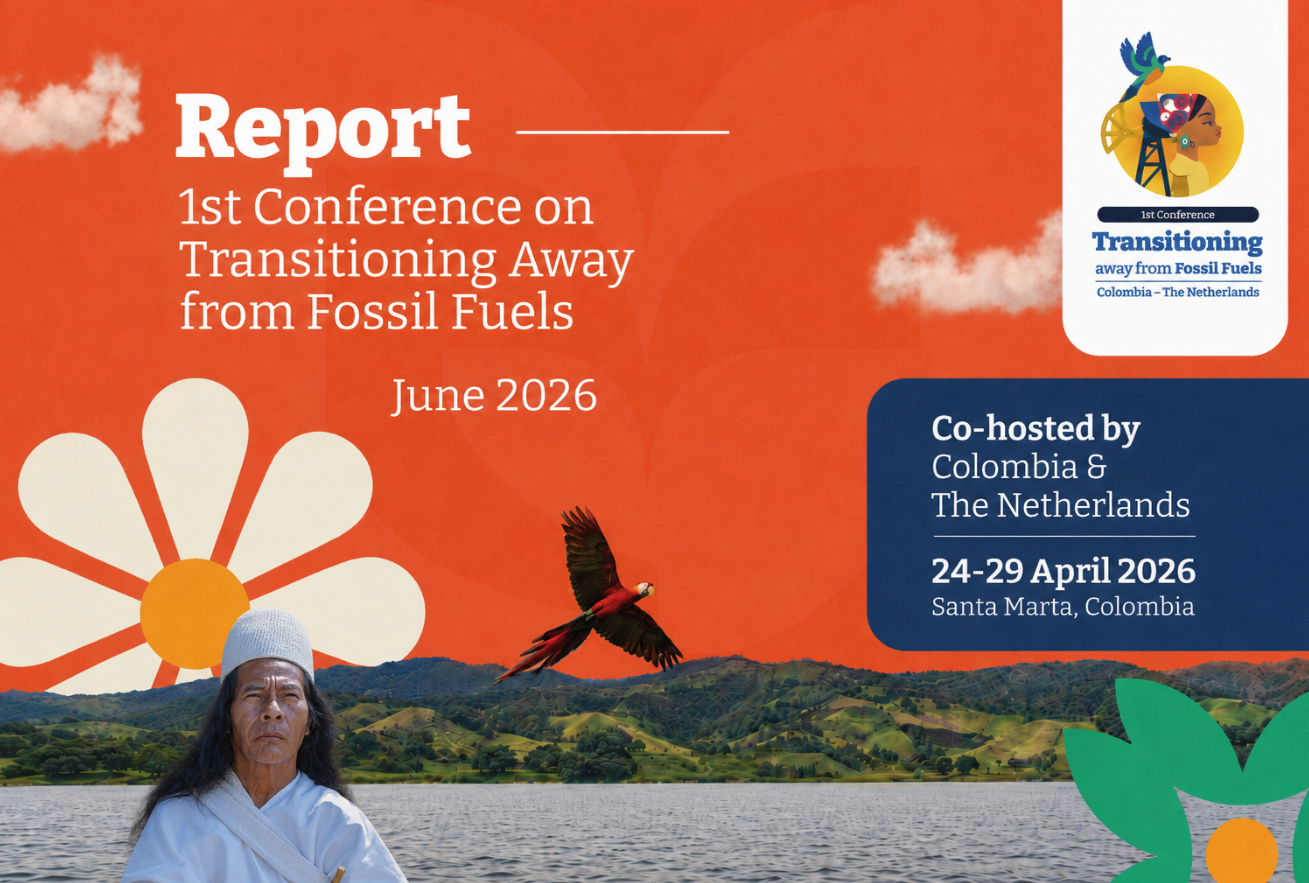
Colombia and the Netherlands published the report of the first Conference on Transitioning Away from Fossil Fuels on 23 June 2026. The conference, held in Santa Marta from 24 to 29 April, provided a forum for countries and stakeholders to examine how the COP28 commitment could be translated into practical cooperation on planning, finance, trade and economic diversification.
The document sets out the Santa Marta Vision and a programme of further work leading to the second conference in 2027. The report treats reducing dependence on fossil fuels as an objective for energy security, sovereignty, economic resilience and climate action.
What the Report Covers
The conference brought together 57 countries and more than 1,000 stakeholders. Participating countries represented about one-third of global gross domestic product (GDP), 30% of fossil-fuel demand and 20% of supply.
The Santa Marta Vision contains ten points. The report structures its discussions and proposed actions around five pathways:
- collective action;
- system-wide coordination;
- national and regional roadmaps;
- action on fossil-fuel-related macroeconomic dependencies;
- producer–consumer alignment towards decarbonised trade balances and green economic transformation.
It presents the transition as economic, political, social and institutional change involving public revenues, debt, investment, employment and territorial development. The Vision states that the transition should be rights-based and territorially grounded, without reproducing inequalities or creating new forms of extractivism or dependence.
Status of the Report
The report combines the co-hosts’ conclusions, participants’ submissions and suggestions for future work. Its contents do not constitute commitments formally adopted by all 57 countries.
The report is non-binding and does not impose obligations on participating countries or companies. No common deadline for ending fossil-fuel production or use was agreed.
Roadmaps, Extraction and Finance
The report proposes new or strengthened national and regional roadmaps for transitioning away from fossil fuels, aligned with the 1.5°C goal and countries’ Nationally Determined Contributions (NDCs) under the Paris Agreement. The proposed roadmaps would connect changes in fossil-fuel supply and demand with clean-energy deployment, economic diversification, workforce development, social protection and energy access.
A separate action area concerns planning the phase-down and definitive closure of fossil-fuel extraction. National decisions may need to set licensing and closure schedules and determine how stranded assets, environmental liabilities and decommissioning costs will be addressed. The specific instruments and allocation of responsibilities remain to be developed.
Financial and macroeconomic constraints are identified as major barriers to implementation. Many countries face high debt, high costs of capital, limited fiscal space and continued dependence on fossil-fuel revenues. Options discussed include concessional and non-debt-creating finance, risk-sharing instruments and stronger support from multilateral development banks.
The report also proposes national inventories and disclosure frameworks for fossil-fuel subsidies and other incentives. Forms of support discussed include tax expenditures, public guarantees, concessional lending, export credit support and other direct or indirect assistance. The report warns that reform could impose disproportionate costs on vulnerable households unless accompanied by targeted compensation, social protection and affordable clean alternatives.
Trade and Corporate Planning
The trade pathway focuses on coordinating changes in fossil-fuel supply and demand while developing cleaner products, markets and value chains. Private-sector submissions warned that carbon-related border measures, product standards and traceability requirements could create unintended barriers for developing-country exporters, particularly where access to finance, technology and capacity building is limited. The report separately records differing views on whether international investment protections, including investor–state dispute settlement mechanisms, constrain transition policies.
Private-sector submissions proposed corporate plans for transitioning away from fossil fuels (TAFF plans) that complement national roadmaps. They also called for standardised, science-based corporate transition plans, early capital allocation and clear sequencing of infrastructure and operational changes.
Next Steps
Three workstreams are expected to be launched at the end of July, when further information on their work will be provided. The NDC Partnership and the Scientific Panel for the Global Energy Transition (SPGET) will support work on national and regional roadmaps; the International Institute for Sustainable Development (IISD) will support the workstream on macroeconomic dependencies and financial architecture; and the Organisation for Economic Co-operation and Development (OECD), together with other experts, will support producer–consumer alignment.
The workstreams will refine the proposed actions and implementation options. Their results will inform the second conference in Tuvalu in 2027, preceded by a meeting in Ireland. Detailed roadmap design, financing arrangements and implementation mechanisms remain to be developed.