

Sustainable Development Report 2026: Progress, Gaps and the Post-2030 Agenda
Ten years after the SDGs were adopted, progress remains too slow and varies significantly across goals and regions.
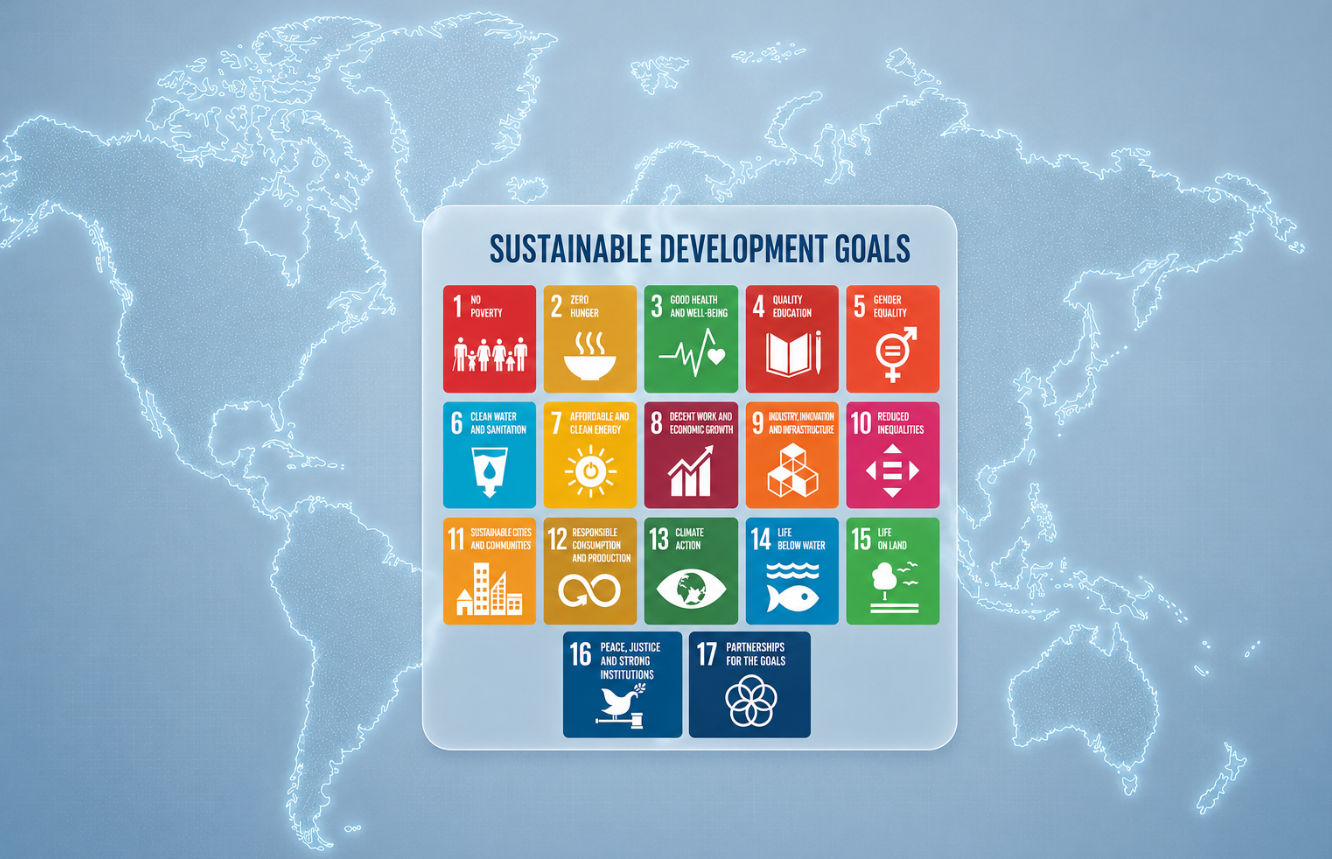
The SDG Transformation Center of the Sustainable Development Solutions Network (SDSN) published the 11th edition of the Sustainable Development Report in June 2026. As 2030 approaches, only 16.5% of assessed Sustainable Development Goal (SDG) targets are on track, and none of the 17 goals is expected to be fully achieved globally at current rates.
The central challenge is securing the finance, institutions, cooperation and data needed to deliver the goals.
What the Report Covers
Implementing Sustainable Development: 2030 and Beyond is an independent assessment of progress since all 193 UN member states adopted the SDGs in 2015. The report complements official UN monitoring by providing an independent benchmark of national SDG progress and implementation.
The report profiles all 193 member states and ranks 169 countries with sufficient data. The SDG Index uses 123 indicators: 101 global indicators and 22 additional indicators for Organisation for Economic Co-operation and Development (OECD) country dashboards.
The index includes international spillover indicators, while the dashboards also present assessments of country trends. The report separately presents an International Spillover Index, which tracks environmental and social impacts embodied in trade, impacts related to the economy and finance, and impacts related to UN-based multilateralism, peace and security. It also assesses support for UN-based multilateralism and government implementation efforts.
For the first time, rankings have been calculated retrospectively using a consistent set of indicators and quantitative thresholds, allowing more reliable comparisons over time.
Who Leads the 2026 SDG Index?
Finland ranks first with a score of 87.4, followed by Sweden and Denmark. Its profile also reports a 1.5 percentage-point improvement since 2015, based on 17 headline indicators rather than the full SDG Index score.
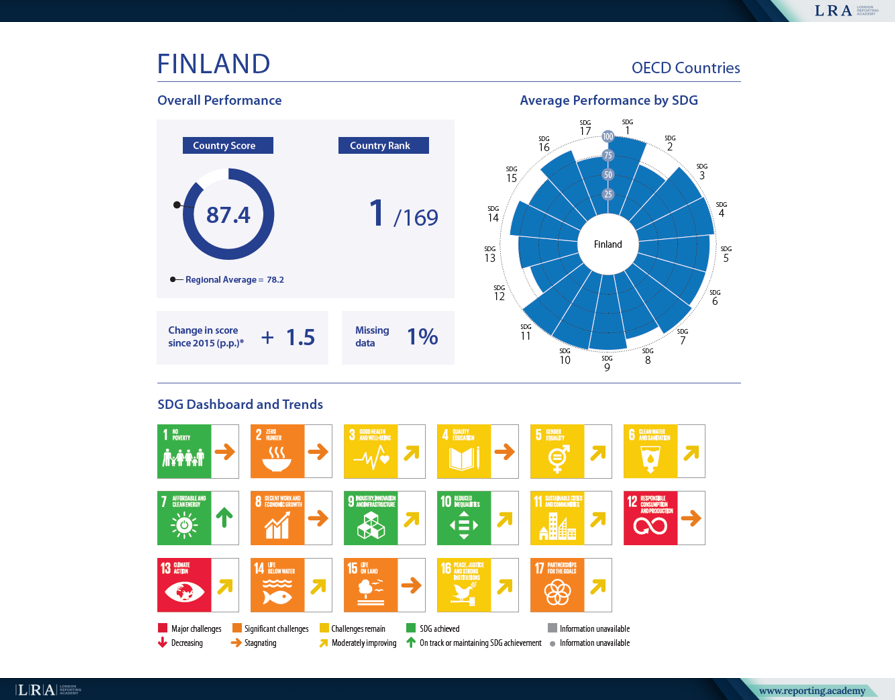
Source: Finland’s country dashboard, Sustainable Development Report 2026
Finland still faces challenges relating to responsible consumption, climate action, marine ecosystems and biodiversity. European countries continue to dominate the top of the 2026 ranking, with France in seventh place. East and South Asia recorded the fastest progress since 2015. In the retrospectively calculated SDG Index rankings, India moved up 18 positions relative to 2015, while China rose from 63rd to 49th place. By contrast, the United States fell from 40th to 45th place.
An index score represents progress towards the report’s defined optimal performance, not the percentage of SDGs completed.
Beyond the 2030 Deadline
The report does not present 2030 as the end of the SDG framework. Survey respondents broadly supported retaining the goals while strengthening financing, governance, science and data. The discussion will continue ahead of the SDG Summit in September 2027, as UN member states consider the agenda beyond 2030 and towards mid-century.
Peace is presented as the foundation of every SDG because conflict destroys infrastructure, diverts resources and weakens institutions.
The report organises SDG implementation around six interconnected structural transformations: education for all, universal health, clean energy and sustainable industry, sustainable food, land, water and oceans, sustainable cities and communities, and the digital revolution for sustainable development. Each transformation supports progress across several SDGs rather than corresponding to a single goal.
The authors’ wider eight-point agenda also calls for ending wars, setting a new implementation timeline, adopting long-term investment plans, strengthening regional and local action, financing global public goods, governing emerging technologies and creating new UN campuses in Asia, Africa and Latin America. These proposals form part of the authors’ recommended implementation agenda and have not been formally adopted by UN member states.
Reporting and Multilateralism
Since 2016, 190 countries have participated in the Voluntary National Review (VNR) process. Togo and Uruguay are due to present their fifth VNRs in July 2026, making them the countries with the highest number of VNRs globally. Haiti, Myanmar and the United States have not participated in the VNR process by submitting a full report or key messages, or by appearing on the list of forthcoming presenters. These figures indicate participation and reporting frequency, but do not assess the quality, completeness or assurance of the reviews.
The report also examines countries’ support for UN-based multilateralism. Barbados ranks first in the 2026 index, while the United States ranks last. According to the report, Argentina and the United States were the only two countries that systematically opposed UN General Assembly resolutions linked to sustainable development in 2025. The United States aligned with the international majority in only 5% of UNGA resolutions where a vote was recorded that year. The executive summary also states that the United States withdrew from more than 60 international organisations in January 2026. Even so, most UN member states continued to support SDG-related resolutions.
The Implementation Gap
The gap between strategy and delivery is visible in public finance. In the expert survey, 45% of assessed countries referred to the SDGs in national budgets, but only 15% included associated budget lines.
A broader survey of 1,098 respondents across 127 countries found that 89% viewed failure to implement approved strategies as a barrier, while 87% cited the shifting geopolitical landscape. The results reflect respondent perceptions and are not population-representative.
The report does not identify the most frequently disclosed SDGs. Respondents perceived more ambitious government efforts in education and digital technologies, and less ambitious efforts in agri-food systems and sustainable cities and communities.
Spillovers and Reporting Implications
Strong domestic SDG scores can coexist with negative impacts transferred abroad through consumption, trade and global value chains.
The report presents 14 spillover indicators. Thirteen are used to calculate each country’s International Spillover Index score, while the Financial Secrecy Score appears only in OECD dashboards.
For corporate reporting teams, these findings offer analogous implementation lessons, although the report does not prescribe company reporting or assurance requirements. The focus areas are ownership of SDG commitments, links to strategy and investment, evidence supporting claims, and the distinction between direct operational results and value-chain impacts.
The 16.5% figure should not be described as the share of SDGs already achieved, and an index score should not be presented as a completion rate. SDG references are stronger when they connect commitments, resources, responsibilities and measurable outcomes.
What Comes Next
The immediate question is how the post-2030 agenda will translate continuity in the goals into stronger financing, long-term planning and implementation mechanisms.
For reporting teams, SDG narratives will increasingly depend on evidence of implementation rather than the number of goals referenced. The points to watch are whether commitments are funded, assigned to accountable owners, measured over time and assessed beyond operational boundaries, including across value chains.