ISSB Proposes Nature-related Disclosure Requirements: What Would Change for Companies?
Nature-related risks are gaining greater prominence in sustainability reporting, raising questions about how companies should assess their exposure and communicate it to investors. The ISSB’s latest proposals seek to bring greater clarity and consistency to these disclosures while building on existing reporting requirements.
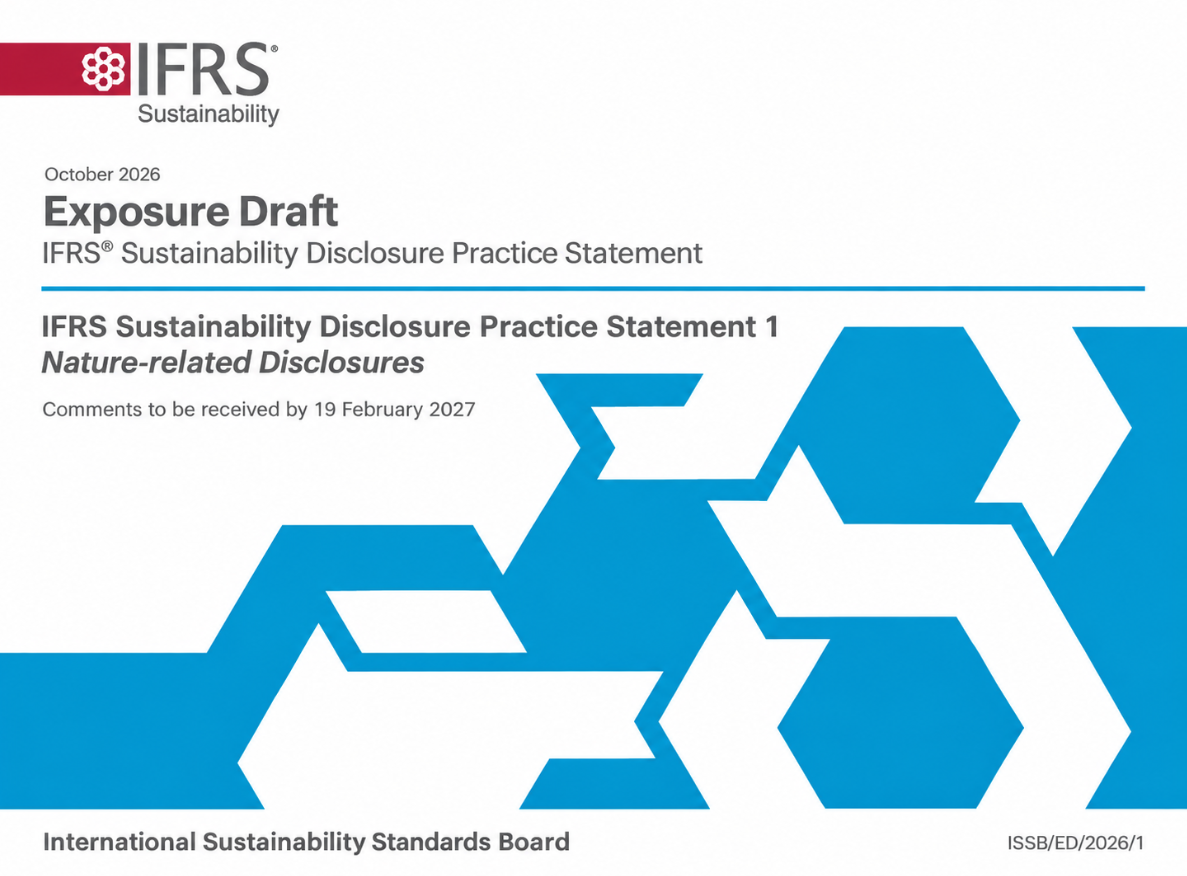
On 22 October 2026, the International Sustainability Standards Board (ISSB) published an Exposure Draft proposing new requirements for companies to disclose information about nature-related risks and opportunities. The consultation is open until 19 February 2027.
The proposals are set out in the draft IFRS Sustainability Disclosure Practice Statement 1 Nature-related Disclosures. The ISSB has proposed a separate document that companies could apply alongside IFRS S1 and IFRS S2, without introducing a new mandatory standard. The Board is also consulting on whether this is the most appropriate form for the final requirements.
Why Has the ISSB Chosen a Practice Statement?
Nature-related risks are already covered by IFRS S1 General Requirements for Disclosure of Sustainability-related Financial Information. The Standard requires companies to disclose material information about sustainability-related risks and opportunities that could reasonably be expected to affect their cash flows, access to finance or cost of capital over the short, medium or long term.
However, IFRS S1 does not establish detailed requirements specifically for nature-related disclosures. The proposed Practice Statement would address this gap while avoiding disruption to the implementation of IFRS S1 and IFRS S2, which is still under way in many jurisdictions.
Although developed through the IFRS Foundation's standard-setting due process, a Practice Statement is not an IFRS Sustainability Disclosure Standard. Companies would not need to apply it to claim compliance with ISSB Standards.
Companies could apply it voluntarily, while jurisdictions could decide whether to incorporate it into their national reporting frameworks or make its application mandatory. Adopting the Practice Statement would not be a condition for a jurisdiction to be recognised as an adopter of ISSB Standards.
A company claiming compliance with the Practice Statement itself would, however, need to meet all its applicable requirements alongside those of IFRS Sustainability Disclosure Standards. The consultation also invites views on alternative approaches, including issuing a separate Standard or amending existing requirements.
What Additional Nature-related Information Would Companies Disclose?
The Exposure Draft follows the four core disclosure areas established by IFRS S1: governance, strategy, risk management, and metrics and targets. It provides more detail on identifying and disclosing risks and opportunities arising from how companies depend on and affect nature.
Businesses may depend on water availability, soil quality, pollination and other ecosystem services. Changes in these resources, including those caused by business activities, can affect production, operating costs and business continuity.
Geographical location is particularly relevant to nature-related risks. Two facilities with similar water consumption may face different levels of risk depending on local water availability.
Under the proposals, companies would consider the location of assets and activities throughout their value chains, including the ecological characteristics of those locations, when identifying risks and preparing disclosures.
However, an asset's presence in an ecologically sensitive area would not automatically make information about it material. The assessment would also depend on its significance to the business and the potential financial consequences of the risk. Information about similarly exposed facilities could be aggregated, while a critical facility with distinct exposure might require separate disclosure.
The Exposure Draft also addresses interactions with Indigenous Peoples, Local Communities and affected stakeholders. Companies would consider these interactions, including engagement, when identifying nature-related risks and opportunities and preparing relevant disclosures on governance, strategy and risk management.
From Risk Identification to Financial Exposure and Business Resilience
The proposals introduce specific disclosures intended to help investors understand companies' financial exposure to nature-related risks and opportunities.
Companies applying the Practice Statement would disclose material information about the amount and percentage of assets or business activities vulnerable to nature-related risks, as well as those aligned with nature-related opportunities. These metrics follow an approach similar to the cross-industry metric categories under IFRS S2 and would not require separate reporting for physical and transition risks.
Scenario analysis is another important element. Companies would use nature-related scenarios to assess the resilience of their strategy and business model, explaining their approach, key assumptions and implications for their operations and prospects.
The ISSB proposes proportionality mechanisms comparable to those under IFRS S2. Qualitative analysis may be appropriate depending on a company's circumstances, while companies with high exposure to nature-related risks and sufficient capabilities and resources would be required to use more advanced quantitative methods.
Resilience would be assessed at each reporting date, although scenario analysis itself could follow the company's strategic planning cycle rather than being repeated annually.
The Exposure Draft also addresses companies' responses to nature-related risks and opportunities, including strategic decisions, planned actions and targets. For targets they have set or are legally required to meet, companies would disclose location-specific information and explain whether and how the targets have been informed by law or regulation. Disclosure of strategic responses would not depend on the existence of a formal nature-related transition plan.
The proposals also require companies to explain relevant connections between nature-related and climate-related risks and opportunities. For example, measures to reduce greenhouse gas emissions may affect local ecosystems, while ecosystem degradation can increase exposure to climate-related physical risks.
How Does the Proposal Relate to TNFD, SASB, GRI and ESRS?
The ISSB has drawn extensively on the Taskforce on Nature-related Financial Disclosures (TNFD) framework, but the proposed Practice Statement is not a direct adoption of its recommendations.
An important distinction concerns materiality. While TNFD accommodates different approaches, the proposed Practice Statement follows IFRS S1's investor-focused materiality requirements. Information about dependencies and impacts on nature would therefore be considered in relation to risks and opportunities that could reasonably be expected to affect a company's financial prospects.
Companies could use the TNFD's LEAP approach to identify and assess nature-related risks and opportunities, but its application would not be mandatory.
The proposals also distinguish between different sources of disclosure metrics. Companies would be required to refer to and consider relevant SASB Standards metrics. They could additionally consider TNFD metrics, Global Reporting Initiative (GRI) Standards and European Sustainability Reporting Standards (ESRS), provided these support the objectives of IFRS S1 and do not conflict with ISSB requirements.
The ISSB has considered interoperability with GRI and ESRS to reduce unnecessary duplication for companies reporting under multiple frameworks. Differences in materiality approaches and disclosure objectives would nevertheless remain.
What Happens After the Consultation?
The Exposure Draft proposes relief from providing comparative information for the first annual reporting period in which a company applies the Practice Statement.
If finalised in the proposed form, the Practice Statement would be available for use from its issuance date by companies applying IFRS S1 and IFRS S2. Initial application would begin at the start of an annual reporting period. The proposals do not change the existing requirements of IFRS S1 or IFRS S2.
The consultation closes on 19 February 2027. The ISSB will then consider stakeholder feedback before deciding whether to finalise the Practice Statement or pursue another approach to nature-related disclosure requirements.
Supporting Materials