UK to Regulate ESG Rating Providers from 2028
The UK is introducing mandatory regulation of ESG rating providers from June 2028, with new requirements for transparency, governance and independence, alongside proposals for annual fees to fund regulatory supervision.
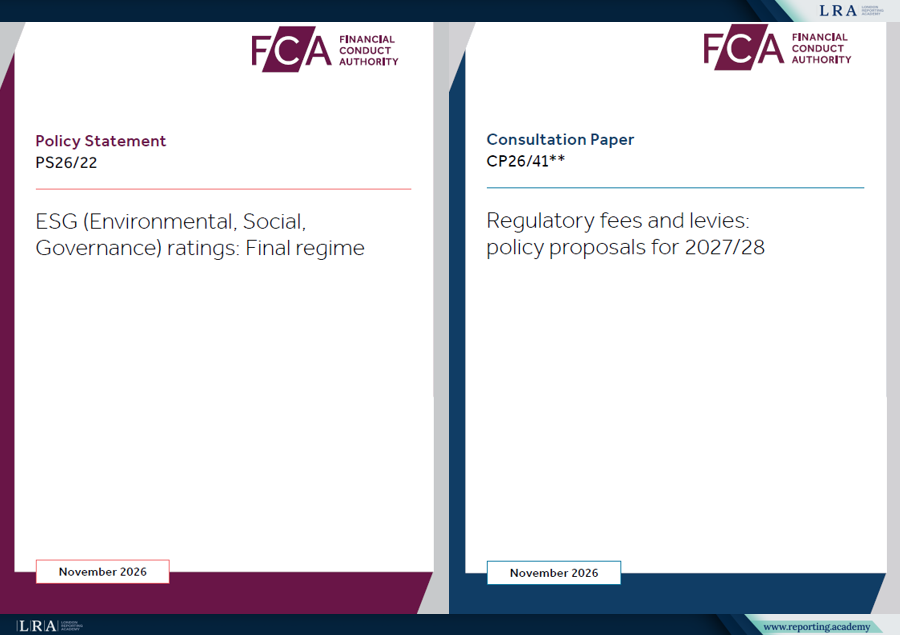
The UK Financial Conduct Authority (FCA) has finalised its regulatory framework for environmental, social and governance (ESG) rating providers.
Published on 3 November 2026, Policy Statement PS26/22 establishes requirements for transparency, governance, rating quality and independence. From 29 June 2028, providers within the scope of the regime will need FCA authorisation, subject to applicable transitional arrangements.
Following 90 consultation responses, the FCA has retained most of its original proposals, with the main changes concerning transparency and engagement with rated entities.
On 24 November 2026, the FCA published a separate consultation paper, CP26/41, proposing an annual fee structure based on providers’ income from regulated activities.
Which ESG Ratings Are in Scope?
The regime is based on the Financial Services and Markets Act 2000 (Regulated Activities) (ESG Ratings) Order 2025. It covers providers that produce and make available ESG ratings by way of business where those ratings are likely to influence a decision to make a specified investment, unless the provider could not reasonably have expected such use.
The rules apply to UK-based providers regardless of their customers' location and to overseas providers supplying ratings to UK recipients for remuneration from any person. Using an overseas intermediary does not remove a provider from scope if it reasonably expects its ratings to reach UK recipients.
The distribution of third-party ratings does not itself constitute regulated ESG rating activity. Products designed, marketed and used exclusively for non-investment purposes, such as supply chain management, generally fall outside the regime.
Certain exclusions also apply to ESG ratings produced as part of existing regulated activities or specified ancillary services, but not where firms provide standalone ESG rating services.
The voluntary ICMA Code of Conduct for ESG Ratings and Data Products Providers will continue to operate alongside the regime, particularly for ESG data providers outside its scope.
What Providers Must Disclose
The FCA introduces two levels of disclosure: public information and more detailed disclosures provided automatically to direct rating users and, upon request, to rated entities.
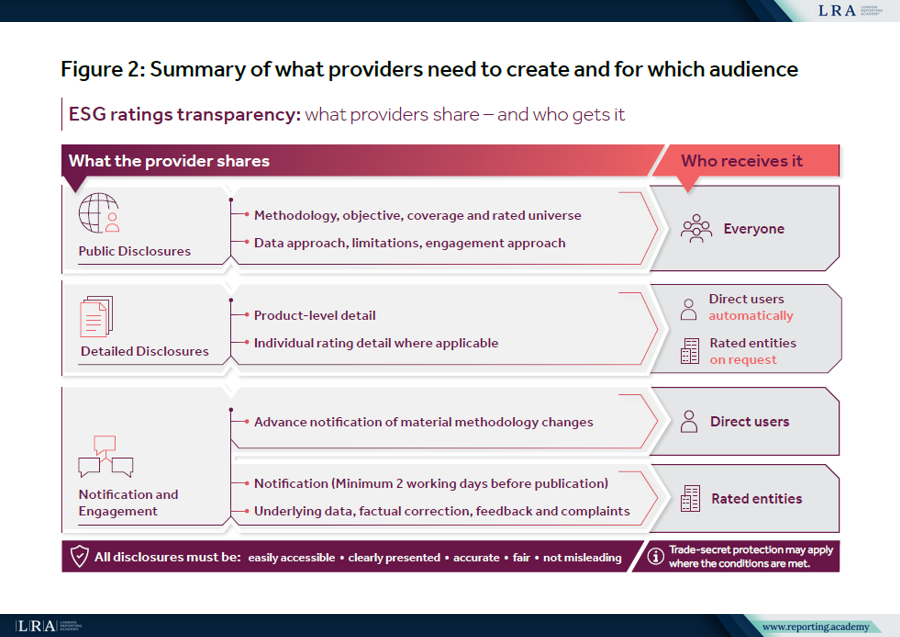
Source: Summary of what providers need to create and for which audience, PS26/22
Rating providers must publicly explain what their ratings measure, how they are produced and what limitations affect their reliability. The final rules place greater emphasis on data quality, methodology reviews and transparency around the use of artificial intelligence, including human oversight where applicable.
Providers must explain what constitutes a material methodology change and how the most recent change affected their ratings. Direct users must receive advance notice of such changes. For freely accessible ratings, this may take the form of a public notice.
The FCA does not prescribe a common rating methodology or require public disclosure of precise weightings or training data. Qualifying trade secrets may be withheld, but providers must identify which information has not been disclosed.
For investors, these requirements should make it easier to assess whether changes in ratings reflect corporate sustainability performance, revised methodologies or changes in underlying data.
Rating Quality and Independence
ESG rating providers will be classified as Core firms under the Senior Managers and Certification Regime (SM&CR), with individual accountability for senior managers.
Providers must establish effective data validation, quality assurance and methodology review procedures, while retaining sufficient evidence to explain how ratings were determined. Operational responsibility for the rating process must remain with the authorised provider, and firms must maintain sufficient presence and accountability in the UK.
The rules also require providers to identify, prevent and manage conflicts of interest. For firms offering both ESG ratings and consulting services, the FCA identifies separate teams and information barriers as examples of good practice.
No bespoke prudential requirements will be introduced, and the Consumer Duty will not apply to ESG rating provision.
What Changes for Rated Companies
Providers must give reasonably identifiable rated entities sufficient advance notice before making a new ESG rating available for the first time, with a minimum notice period of two business days.
Companies may request underlying data and propose factual corrections before or after publication. However, providers are not required to disclose the final rating in advance and may proceed with publication while the data are being reviewed.
Access to underlying data and factual correction procedures will also extend to previously issued ratings that remain available under the new regime.
Providers must establish feedback and complaints procedures. Complaints must be free to submit and may be raised within three years of the matter giving rise to the complaint. The rules do not establish a right of appeal against rating methodologies or analytical judgements.
FCA Authorisation and Transition
The FCA will offer free pre-application support from February 2027, with the authorisation gateway opening on 24 June 2027.
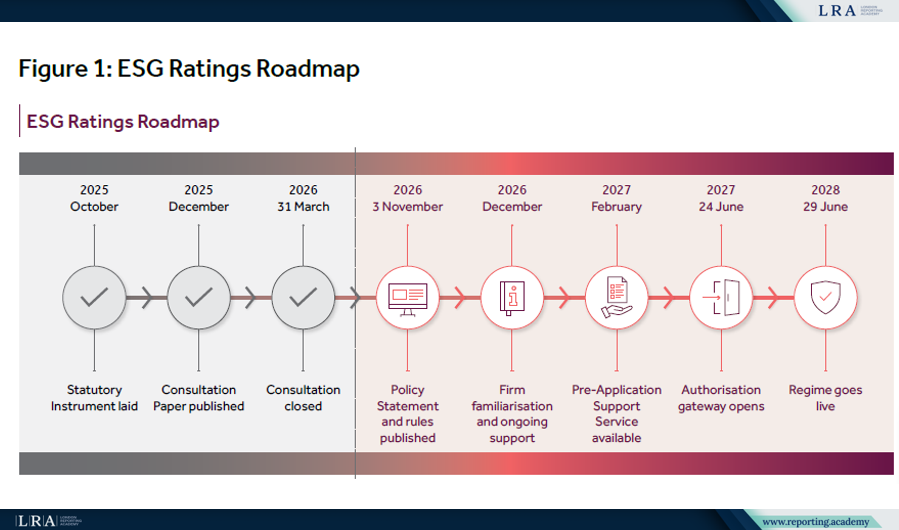
Source: ESG Ratings Roadmap, PS26/22
Application deadlines and fees depend on forecast revenue from UK ESG rating activities during the 12 months following submission:
- £500,000 or more: 24 June–29 July 2027, with a current application fee of £11,260.
- Below £500,000: 30 July–31 August 2027, with a current application fee of £2,820.
Following consultation, the FCA increased the revenue threshold for the higher application fee from £250,000 to £500,000. After the gateway period, all applicants will be subject to the Category 4 application fee, currently £2,820.
Providers applying within their designated period may continue operating and taking on new business if their applications remain undetermined when the regime takes effect. Those that miss the deadline, withdraw their applications or are refused authorisation will be unable to take on new business once the regime takes effect and must wind down their relevant activities under the transitional arrangements.
From 29 June 2028, carrying on regulated ESG rating activities without the required authorisation, unless otherwise permitted under the legislation, will constitute a criminal offence.
Authorised providers will be subject to risk-based FCA supervision and enforcement. Regulatory reporting will also become mandatory from the same date, initially through FCA information requests.
The FCA estimates that the final regime will generate costs of £99.80 million and net benefits of £569.82 million over ten years in present value terms.
Annual Regulatory Fees
On 24 November 2026, the FCA published a separate consultation (CP26/41) proposing a two-tier annual fee structure for ESG rating providers, based on their income from regulated activities.
Under the proposed model, providers with annual regulated income of up to £100,000 would pay only the minimum fee, currently set at £2,200 and subject to future adjustments. Those exceeding this threshold would pay an additional variable fee calculated on income above £100,000.
The FCA expects to begin recovering supervisory costs through annual fees in the 2029/30 financial year, with a consultation on the variable fee rate planned for spring 2029.
The current consultation closes on 19 January 2027.