EU Sustainability Reporting: Revised ESRS and Updated Digital Tools
New EU reporting requirements and updated EFRAG tools bring practical changes to sustainability disclosures, data collection and digital reporting.
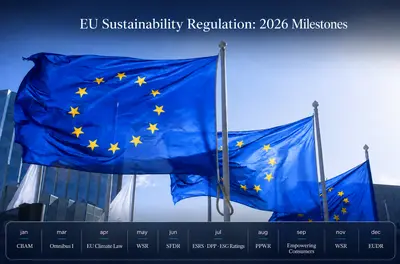
Last week, the revised European Sustainability Reporting Standards (ESRS) entered into force, introducing simplified disclosure requirements for companies within the scope of the Corporate Sustainability Reporting Directive (CSRD).
At the same time, EFRAG has updated its Digital Template, XBRL Taxonomy and converter for the Voluntary Sustainability Reporting Standard (VS), providing companies outside mandatory CSRD reporting with tools aligned to the final standard adopted by the European Commission.
Revised ESRS: What Applies in 2026 and 2027?
Commission Delegated Regulation (EU) 2026/1563 entered into force on 10 November 2026. The revised ESRS will apply to financial years beginning on or after 1 January 2027, with an option for early application in 2026.
The revision reduces mandatory datapoints by more than 60%. The changes include a revised approach to double materiality assessments, additional reporting reliefs and greater flexibility concerning value chain information.
The Omnibus reform has also narrowed the scope of mandatory CSRD reporting. Under Directive (EU) 2026/470, the general reporting threshold is more than 1,000 employees and €450 million in annual net turnover, subject to the applicable entity and group provisions.
For financial years beginning in 2026, companies within the scope of the existing ESRS may use the previous standards, adopt the revised standards early, or apply the previous standards together with the specific ESRS 1 reliefs permitted by Article 2 of Regulation (EU) 2026/1563. The version applied must be identified in the sustainability statement.
Companies reporting on a calendar-year basis will generally publish their first mandatory reports under the revised standards in 2028.
Reporting teams preparing 2026 statements should therefore confirm their selected approach before finalising disclosure mapping, data collection and materiality assessments.
From VSME to the New Voluntary Standard
Commission Delegated Regulation (EU) 2026/1560 establishes the VS, replacing the earlier VSME Recommendation. The new standard entered into force on 24 September 2026 and is available for voluntary use by undertakings outside mandatory CSRD reporting. It also provides the basis for the value chain cap protecting undertakings with no more than 1,000 employees.
The VS retains the Basic and Comprehensive Modules but introduces changes that affect data collection:
- Climate and environment: GHG emissions intensity and certain land-use disclosures have been removed. Water reporting now includes consumption in areas with water stress instead of the previous withdrawal metric for areas of high water stress. Waste disclosures have also been revised.
- Workforce: Employee turnover has moved from the Basic to the Comprehensive Module. Gender-disaggregated training information is no longer required, while calculations relating to occupational accidents and fatalities have been adjusted.
- Smaller undertakings: Several disclosures, including energy consumption, GHG emissions, water and waste, are voluntary for companies with 10 employees or fewer.
Companies previously using VSME questionnaires should review their data collection templates rather than transfer existing indicators without checking the revised requirements.
The Value Chain Cap: What Can Larger Companies Request?
The VS also supports the value chain cap introduced under the Omnibus reform.
From financial years beginning on or after 1 January 2027, undertakings with no more than 1,000 employees in the preceding financial year can benefit from limits on sustainability information requests made for mandatory CSRD reporting.
The cap applies only to the datapoints specifically identified in Annex II of Regulation (EU) 2026/1560. It does not cover all disclosures in the full VS.
Annex II specifies different sets of datapoints for undertakings with 10 employees or fewer and those with more than 10 employees. Reporting companies should request only the information relevant to their sustainability statements and avoid automatically requesting every datapoint permitted by the cap.
Undertakings protected by the cap have the right to decline requests for information exceeding the permitted datapoints. Reporting companies may rely on suppliers' self-declarations of their protected status, unless they know, or can reasonably be expected to know, that these declarations are manifestly incorrect.
The cap applies to information requests made for mandatory CSRD reporting. It does not override information requirements arising under other EU or national legislation. Financial institutions are nevertheless encouraged to limit additional sustainability information requests where possible.
EFRAG's Updated Digital Reporting Tools: What Was Released and How to Use Them
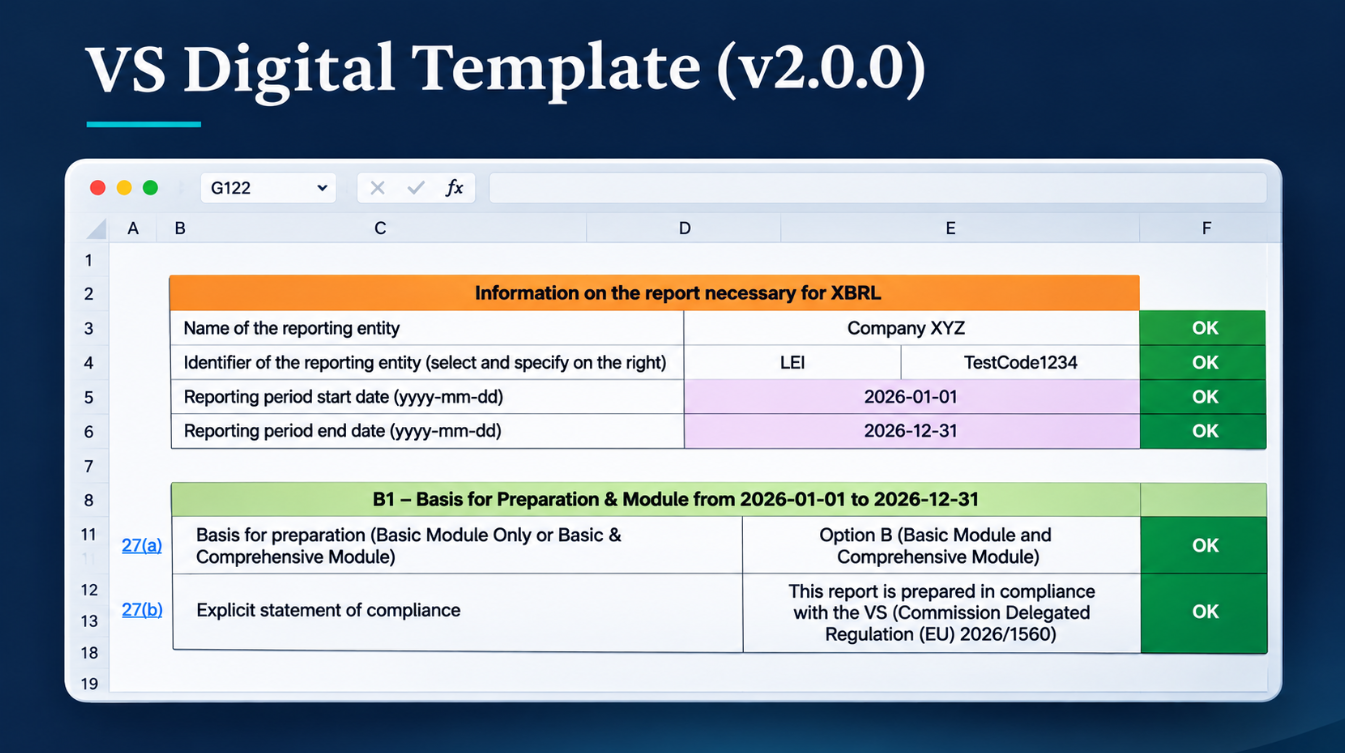
On 4 November 2026, EFRAG published updated tools to help companies prepare voluntary sustainability reports under the new Voluntary Standard (VS). The November release includes version 2.0.0 of the Excel-based VS Digital Template and XBRL Taxonomy, together with an updated Digital Template to XBRL Converter.
These tools have been updated to reflect the final VS adopted by the European Commission. They are designed for voluntary reporting, rather than mandatory reporting under the full ESRS.
For companies, the reporting process is relatively straightforward:
- Complete the Excel template. Companies enter their sustainability information, including energy use, greenhouse gas emissions, workforce data and governance disclosures. They choose either Option A (Basic Module) or Option B (Basic and Comprehensive Modules). The template includes automatic calculations and checks for missing or inconsistent information.
- Convert the completed file into a digital report. Once the Excel template has been checked, companies can upload it to EFRAG's free online converter. The converter creates an Inline XBRL report that people can read and software systems can process automatically.
- Use the report to share sustainability information. The resulting report provides a standardised format for exchanging ESG data with banks, customers and other business partners. Companies can also download a machine-readable dataset for use in other systems.
The XBRL Taxonomy works behind the scenes. It defines how each reported datapoint is identified digitally, allowing different systems to recognise the same information. Companies using EFRAG's Excel template do not need to work with the taxonomy directly.
The November update also makes the reporting process more flexible. Companies can now:
- Include comparative figures by uploading a template or compatible report from an earlier reporting period.
- Use Word (DOCX) files for longer explanations, including formatted text, tables and images.
- Combine supporting PDF documents with the digital report, including information incorporated by reference.
- Add introductory text, footnotes and selected visual elements to the report.
The tools are free and available in 11 languages. EFRAG also provides a migration tool for transferring information from older VSME templates into the new VS version. Because some disclosure requirements have changed, companies should check the transferred information before using it in their reports.
What Preparers Should Check Before Using the Tools
EFRAG's Digital Template does not include a GHG emissions calculator. Companies need to calculate emissions separately, while the fuel converter's default parameters should be checked against local conditions and the fuels actually used.
Before XBRL conversion, preparers should review the workbook's validation results. A COMPLETE status indicates that the built-in checks have been satisfied, but does not confirm the accuracy of the reported data.
The Excel workbook also contains named ranges linked to the XBRL Taxonomy and formulas used for validation. Modifying these elements may prevent successful conversion.
For groups preparing both consolidated and individual entity reports, separate templates are required. The tool cannot generate both reporting outputs from a single workbook.
EFRAG plans to maintain the Digital Template, taxonomy and converter at least until June 2027.
Supporting Materials
VS Digital Template and XBRL Taxonomy Explanatory Note (PDF)
VS Digital Template Version 2.0.0 (XLSX)
Mock-up example of pre-filled VS Digital Template Version 2.0.0 (XLSX)