TNFD Updates Its Recommendations and LEAP Guidance
Autumn 2026 brought several significant developments for nature-related reporting, from updated TNFD recommendations and revised LEAP guidance to new findings on corporate adoption and investor use. Together, these publications show how nature-related disclosure practices are evolving and where implementation challenges remain.
In October 2026, the Taskforce on Nature-related Financial Disclosures (TNFD) published updated disclosure recommendations and version 2.0 of its LEAP assessment guidance. The updates finalise previously provisional nature-related metrics, introduce guidance on environmental crime and refine the assessment of dependencies, impacts, risks and opportunities.
TNFD also confirmed that it has completed its programme of developing guidance on nature-related assessment and disclosure. Its next priorities include supporting international standard-setting and the application of its existing framework.
What Has Changed in the TNFD Recommendations?
The October 2026 recommendations retain the existing structure of 14 recommended disclosures across four pillars: Governance, Strategy, Risk and Impact Management, and Metrics and Targets.
The TNFD metrics architecture provides a structured basis for measuring and disclosing nature-related issues, connecting an organisation’s dependencies and impacts on nature with the risks and opportunities they create. It combines globally applicable and sector-specific metrics to support consistent assessment and reporting (Figure 1).
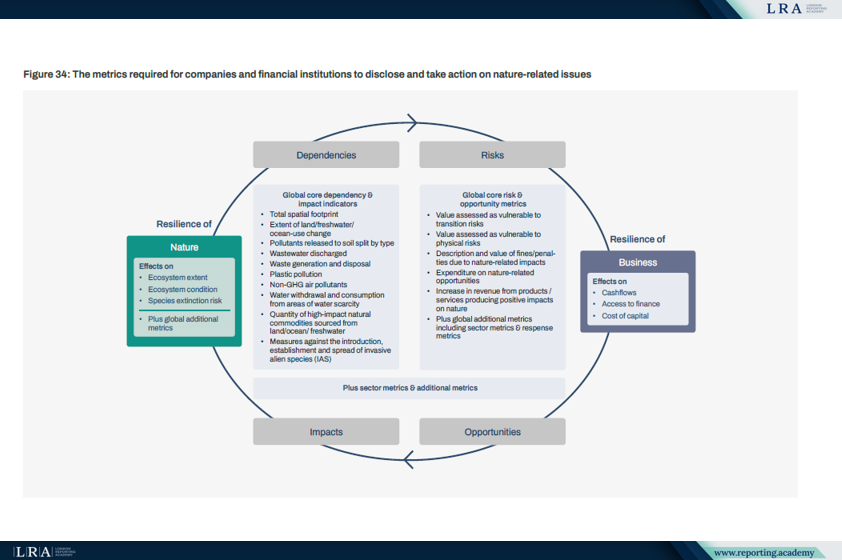
Figure 1. TNFD metrics for nature-related dependencies, impacts, risks and opportunities. Source: Recommendations of the Taskforce on Nature-related Financial Disclosures, October 2026.
The main updates to the TNFD recommendations since September 2023 cover two areas.
First, TNFD has finalised its disclosure metrics for invasive alien species (IAS) and the state of nature, replacing provisional indicators following further technical development and pilot testing.
The finalised core global metrics are:
- C4.0 – Invasive alien species: the proportion of activities with high IAS-related impact potential that are covered by appropriate measures to reduce the probability of introducing, establishing and spreading invasive alien species.
- C5.0 – Ecosystem extent: the area, losses and gains in the extent of natural and semi-natural ecosystems, by ecosystem type.
- C5.1 – Ecosystem condition: changes in ecosystem condition, including changes in the area of ecosystems by condition class, considering ecosystem structure, function and composition.
- C5.2 – Species extinction risk: measures of the contribution of sites or landscapes and seascapes to global species extinction risk.
The additional global metrics A4.0 and A5.0 also address invasive alien species and the state of nature.
According to TNFD, finalising these indicators completes its metrics architecture.
Second, the recommendations now incorporate implementation guidance on environmental crime. This applies to disclosures covering board oversight, management responsibilities, strategy, risk and impact management, and metrics and targets.
Organisations applying TNFD should therefore consider relevant environmental crime issues within their existing assessment and disclosure processes.
LEAP 2.0: More Detailed Assessment Guidance
Alongside the recommendations, TNFD released version 2.0 of Guidance on the Identification and Assessment of Nature-related Issues: The LEAP Approach, updating the September 2023 guidance.
The four phases remain unchanged: Locate, Evaluate, Assess and Prepare. Together, they provide a structured approach to identifying nature-related issues, evaluating dependencies and impacts, assessing risks and opportunities, and preparing responses and disclosures (Figure 2).
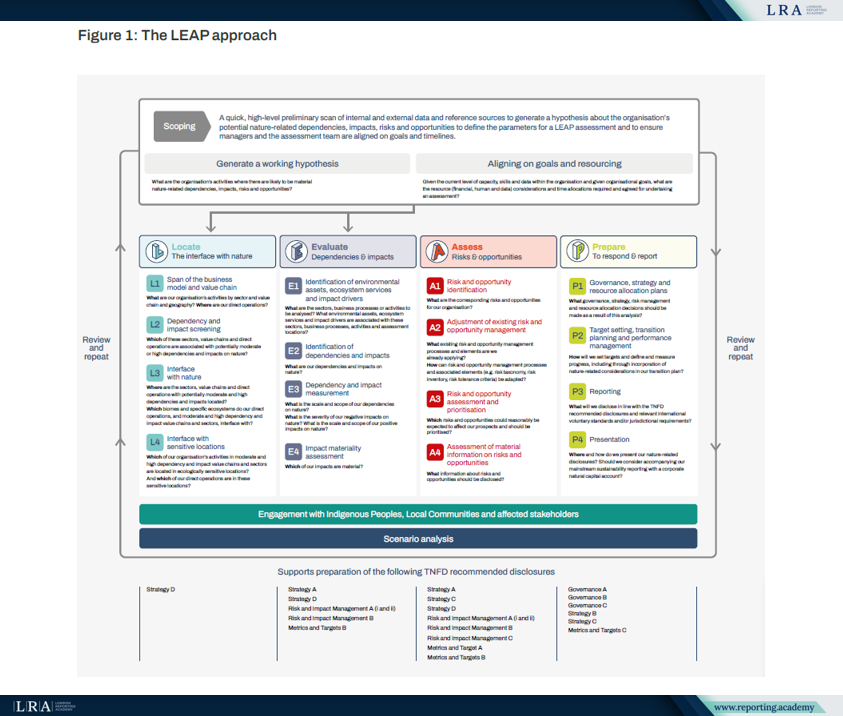
Figure 2. The TNFD LEAP approach. Source: Guidance on the Identification and Assessment of Nature-related Issues: The LEAP Approach, Version 2.0, October 2026.
The revised guidance provides additional methodological detail on measuring the state of nature across land, freshwater and ocean ecosystems, assessing invasive alien species, and identifying and evaluating nature-related risks and opportunities.
LEAP 2.0 also provides guidance on integrating nature into transition planning and assessing nature-related issues in financial institutions' portfolios. Environmental crime and collaboration across landscapes and seascapes receive further attention.
Another area of development is interoperability with the Science Based Targets Network (SBTN). The guidance explains how LEAP assessments can be aligned with SBTN's science-based target-setting methods, supporting a more coordinated approach to nature-related assessment and target setting.
For reporting teams, these refinements affect how nature-related information is assessed before disclosure, particularly where ecosystem condition, geographic exposure or portfolio-level risks require more detailed analysis.
LEAP remains an optional assessment approach. Organisations can use equivalent internal processes to support TNFD-aligned disclosures. The TNFD recommendations themselves remain voluntary unless relevant requirements are established separately by a jurisdiction.
TNFD's Next Priorities: ISSB, GRI and ISO
With the October publications, TNFD has completed its planned guidance development work on the assessment and disclosure of nature-related issues.
The organisation will now concentrate on supporting the use of its framework, training and capacity building, addressing implementation barriers and contributing to international standard-setting.
This includes continued cooperation with the International Sustainability Standards Board (ISSB) and the Global Reporting Initiative (GRI) on incorporating relevant TNFD recommendations into corporate reporting standards.
TNFD will also contribute to the International Organization for Standardization (ISO) initiative to develop an international standard based on the LEAP assessment approach.
TNFD 2026 Status Report: Adoption and Remaining Challenges
The practical context for TNFD's next phase is documented in its September 2026 Status Report, which examined how companies and financial institutions are using the recommendations and assessment guidance.
TNFD's analysis identified more than 1,000 organisations across 56 countries and areas publishing disclosures aligned with at least one of its 14 recommended disclosures. However, the report also identifies persistent difficulties in nature-related assessment. Among respondents to the TNFD survey on nature-related risk assessment (n = 206), 69% cited difficulties in measuring and quantifying dependencies and impacts, while the same proportion reported challenges in linking these to business risks, including financial effects.
The report also examined how investors use LEAP assessments. Among 40 surveyed investors that had conducted such assessments, 73% used the results for stewardship activities and 60% for risk management. Only 23% used them for capital allocation decisions.
While nature-related assessments are increasingly used in stewardship and risk management, their application in capital allocation remains limited. Improving the measurement of nature-related issues and their connection to financial risks remains a practical challenge for reporting teams and investors.