IFRS Foundation Launches Practical IFRS S1 and IFRS S2 Implementation Resource
As companies move from preparing for IFRS S1 and IFRS S2 to applying them in practice, implementation questions are becoming more specific. The latest TIG materials show where uncertainty is concentrating and how the IFRS Foundation is addressing those questions through published responses and technical discussion.
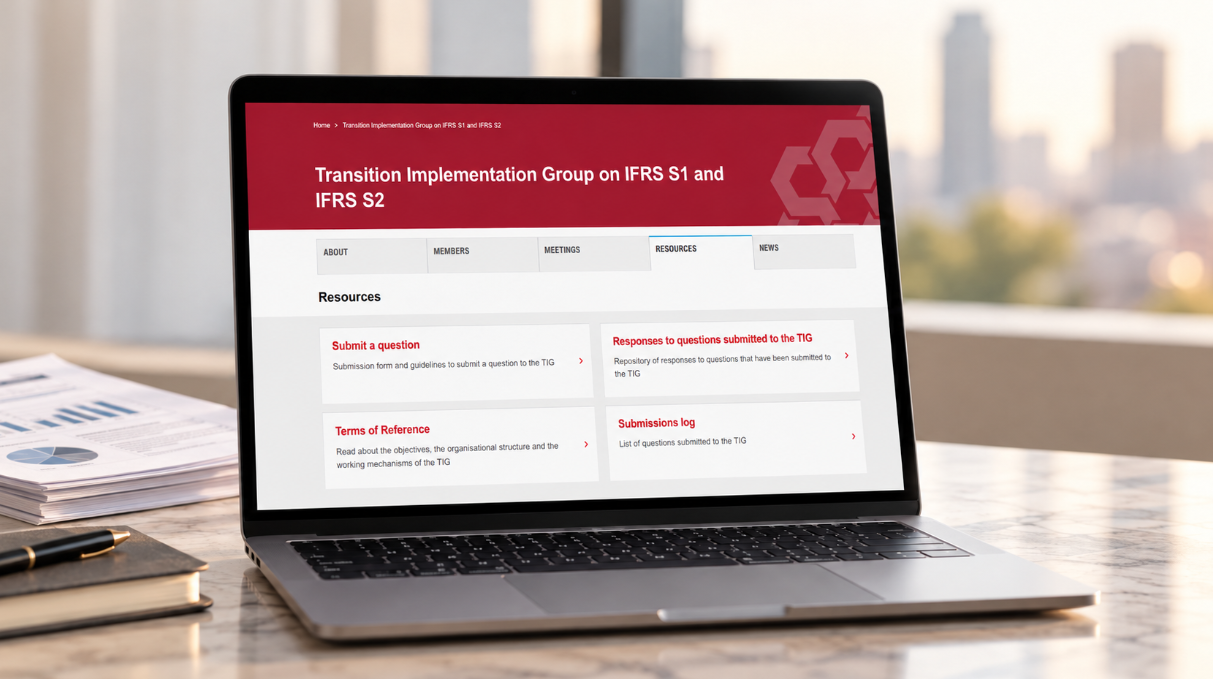
The IFRS Foundation has created a dedicated resource bringing together practical questions submitted to the Transition Implementation Group on IFRS S1 and IFRS S2 (TIG) and responses provided through the implementation process.
The accompanying submissions log contains 37 questions received by 7 July 2026. The questions come from stakeholders applying IFRS S1 and IFRS S2 and focus on practical issues that arise during implementation.
How the TIG Process Works
The International Sustainability Standards Board (ISSB) established the TIG to provide a public forum for discussing implementation questions arising from IFRS S1 and IFRS S2. The group also helps the ISSB determine whether further action is needed in response to those questions.
Stakeholders can submit potential implementation questions for consideration. IFRS Foundation staff evaluates the submissions and prioritises issues for TIG discussion. Questions selected for discussion should relate to IFRS S1 or IFRS S2, have the potential to result in diversity in practice and be relevant to a wide group of stakeholders.
Some questions are answered directly by the IFRS Foundation based on existing IFRS S1 or IFRS S2 requirements, while others are discussed through TIG agenda papers and meeting summaries. The submissions log records each question, its status and any related TIG meeting or agenda paper.
Reporting Periods and Timing
Several submissions address how sustainability-related financial disclosures align with financial reporting. One asks whether emissions data must follow the same reporting period as the financial statements.
In its published response, the IFRS Foundation points to IFRS S1 requirements for sustainability-related financial disclosures to cover the same reporting period as the related financial statements. IFRS S2 allows value-chain information from a different reporting period in specific circumstances.
Another submission asks whether quarterly financial reporting also requires quarterly sustainability reporting. The IFRS Foundation response explains that IFRS S1 does not set interim reporting frequency; this may instead be determined by jurisdictions, regulators, stock exchanges or other relevant authorities.
How Disclosures Can Be Organised
Preparers have also asked how much flexibility IFRS S1 and IFRS S2 allow in report structure.
The published responses explain that IFRS S1 does not prescribe a single format. Sustainability-related financial disclosures must form part of general purpose financial reports and be presented clearly and coherently.
Where ISSB-required disclosures appear alongside other sustainability information, the required information must remain clearly identifiable and not be obscured. The Standards do not require paragraph-by-paragraph references to IFRS S1 or IFRS S2.
Scope 3 and Financed Emissions
GHG accounting features prominently in the submissions. For Scope 3, IFRS S2 requires an entity to consider the 15 categories in the Greenhouse Gas Protocol Corporate Value Chain (Scope 3) Accounting and Reporting Standard (2011) and identify those relevant to its value chain. Materiality then determines the related disclosures.
Questions about how to apply the GHG Protocol Corporate Standard itself fall outside the TIG's remit and are referred to the GHG Protocol.
Financial-sector submissions cover financed emissions, including asset management, insurance activities and measurement methods. One question asks whether entities must use the Partnership for Carbon Accounting Financials (PCAF) methodology. The IFRS Foundation response states that IFRS S2 does not require a specific PCAF methodology for measuring financed emissions.
Some GHG implementation challenges also informed later standard-setting work. The submissions log notes that questions raised through the TIG were among the issues considered when the ISSB proposed targeted amendments to IFRS S2 in April 2025.
Reporting Entity and Compliance
Other submissions address the reporting boundary and the mechanics of claiming compliance.
A March 2026 question asks whether the reporting-entity example in IFRS S1 determines which entities are required to apply ISSB Standards.
The IFRS Foundation response explains that the ISSB Standards do not determine which entities must report. Where an entity applies the Standards, its sustainability-related financial disclosures must cover the same reporting entity as the related financial statements. If those financial statements cover a consolidated group, the sustainability-related financial disclosures cover the same group.
Another submission concerns the statement of compliance under IFRS S1, including its wording and whether IFRS S2 requires a separate statement. The published response states that the Standards do not prescribe particular wording for the statement of compliance. The statement relates to compliance with all applicable requirements of IFRS Sustainability Disclosure Standards rather than requiring a separate statement for IFRS S2.
What Counts as a Climate-related Target?
The July 2026 TIG meeting addressed a question about the meaning of "targets" in IFRS S2.
The submission asks whether the disclosure requirements apply only to GHG emissions targets, only to measures explicitly described as targets, or only to targets approved by a particular governance or management body.
In the staff view discussed at the July 2026 TIG meeting, climate-related targets are not limited to GHG emissions targets. A commitment, objective or other measure can fall within the target requirements even where an entity does not use the word "target". IFRS S2 also does not make classification as a target dependent on approval by a particular governance or management body.
The assessment requires judgement based on the disclosure objective and requirements in IFRS S2, including whether the measure relates to a climate-related risk or opportunity, provides information about performance and enables progress to be monitored or measured. Materiality then determines which information about identified targets needs to be disclosed.
Using the TIG Materials
Preparers can use the submissions log to check whether a similar question has already been raised and then follow the related published response, agenda paper or meeting summary.
Responses reflect the Standards as they applied when each question was reported to the TIG and do not reflect changes introduced by the December 2025 Amendments to Greenhouse Gas Emissions Disclosures. Earlier GHG-related responses should therefore be checked against the requirements applicable to the relevant reporting period.
The amendments are effective for annual reporting periods beginning on or after 1 January 2027, with earlier application permitted.