ISSB Proposes Targeted Taxonomy Update
The proposed update focuses on the digital treatment of Scope 3 Category 15 and financed-emissions disclosures. It also revises how industry classifications are represented for commercial banking and insurance activities.
The International Sustainability Standards Board (ISSB) has proposed changes to the IFRS Sustainability Disclosure Taxonomy 2024 following amendments to IFRS S2 Climate-related Disclosures issued in December 2025. The proposal addresses how revised greenhouse gas emissions disclosures should be represented in digitally tagged reports.
What the ISSB Is Proposing
IFRS Sustainability Disclosure Taxonomy 2024 – Proposed Update 1 Amendments to Greenhouse Gas Emissions Disclosures was published in July 2026. The consultation closes on 28 September 2026.
The update concerns the digital taxonomy used to tag disclosures prepared under the ISSB Standards, allowing information to be searched, extracted and compared electronically.
The underlying amendments responded to specific application challenges identified during implementation of IFRS S2. They provide additional relief and clarify existing relief relating to greenhouse gas emissions, particularly Scope 3 Category 15 and financed emissions.
The IFRS S2 amendments apply to annual reporting periods beginning on or after 1 January 2027.
Tagging the Category 15 Limitation
Amended IFRS S2 allows an entity to limit its measurement and disclosure of Scope 3 Category 15 emissions to financed emissions. When applying this relief, the entity may exclude emissions attributable to derivatives.
The entity must then explain what it has treated as a derivative and describe the financial activities excluded from its Category 15 measure. The ISSB proposes a single text element to tag both parts of this explanation.
Separating Category 15 and Financed Emissions
Where an entity includes Category 15 emissions in its Scope 3 measurement, amended IFRS S2 requires disclosure of total Category 15 emissions and the financed-emissions subtotal included in that amount.
The ISSB proposes a new logical table using the existing absolute gross Scope 3 greenhouse gas emissions element. The structure would distinguish total Scope 3 emissions, Category 15-Investments and financed emissions.
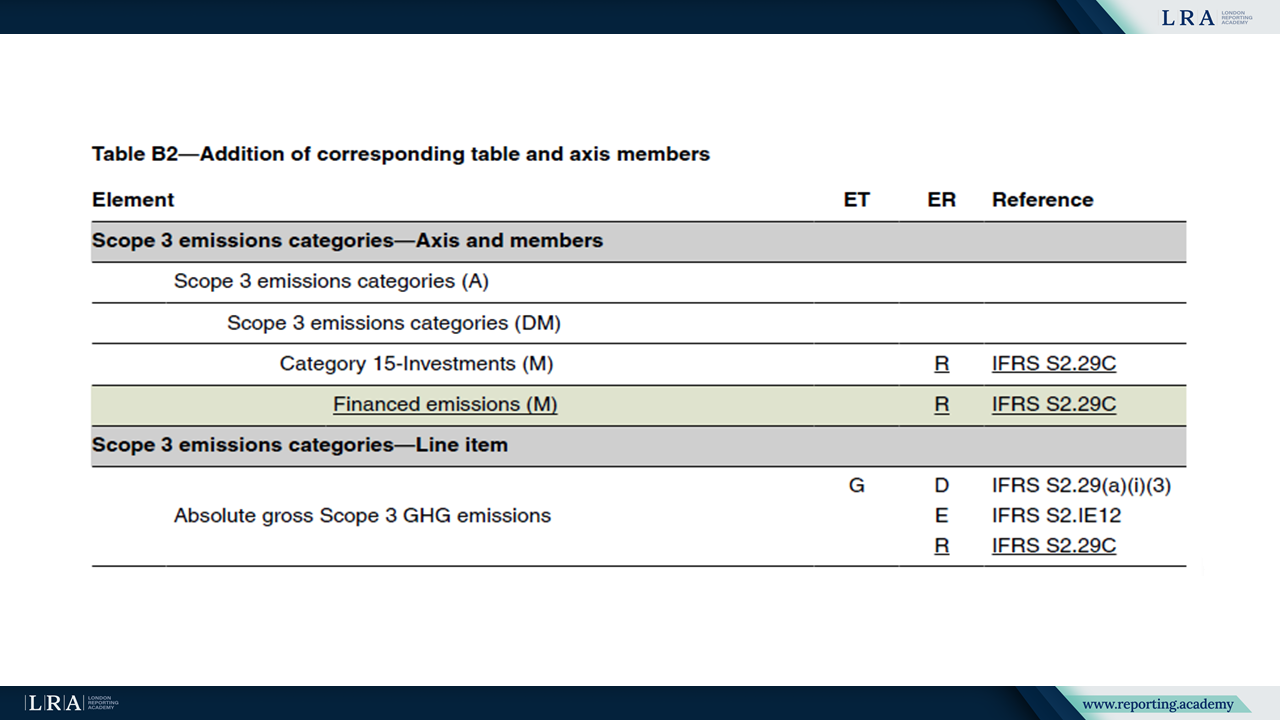
Source: Proposed taxonomy structure for Scope 3 Category 15 and financed emissions, IFRS Sustainability Disclosure Taxonomy 2024 – Proposed Update 1 Amendments to Greenhouse Gas Emissions Disclosures
This table exists for taxonomy modelling and does not prescribe the layout of the human-readable report. Entities could use the same digital tags regardless of how the figures are presented.
How Financed Emissions Are Classified by Industry
Entities engaged in commercial banking or insurance activities are required to break down their financed-emissions information by industry. IFRS S2 previously required this breakdown to follow the Global Industry Classification Standard (GICS).
Under the amended Standard, GICS is no longer mandatory. An entity must instead select an industry-classification system that classifies its investees or counterparties in a way that enables users to understand its exposure to climate-related transition risks.
The entity must disclose which classification system it has used and explain how its selection fulfils that objective.
To reflect this flexibility, the ISSB proposes replacing the GICS-specific axis in two financed-emissions taxonomy tables with a general “Industry” axis. It also proposes a new text element for tagging the selected classification system and the explanation for its use.
Changes Covered by Existing Elements
Two other IFRS S2 amendments do not require new taxonomy elements.
One clarifies the jurisdictional relief from applying the Greenhouse Gas Protocol: A Corporate Accounting and Reporting Standard (2004) where only part of an entity is required to use another measurement method. The other introduces jurisdictional relief from using global warming potential values from the latest Intergovernmental Panel on Climate Change assessment report.
The ISSB concluded that existing taxonomy elements already capture the related disclosures. These include elements covering alternative greenhouse gas measurement methods and the broader approach used to measure emissions.
The proposal also updates references affected by the renumbering of IFRS S2 paragraphs. Separate transition elements are not proposed because existing taxonomy structures can tag revised comparative information.
What Reporting Teams Need to Resolve
Before tagging, teams need documented decisions on whether the entity will apply the Category 15 limitation, how derivatives will be treated, which financial activities will be excluded and which industry-classification system will be used.
Where Category 15 emissions are included in the Scope 3 measurement, data must distinguish total Scope 3 emissions, total Category 15 emissions and the financed-emissions subtotal. Narrative explanations should align with the quantitative disclosures and the proposed digital tags.