


Disclosure focus
This disclosure asks an organisation to explain the actions it is taking, and the resources it is putting behind them, to address the material impacts, risks and opportunities linked to resource use and circular economy. In practice, the report should show what is being done, why those actions were chosen, and how they are being supported through people, budgets, systems or other resources.
The practical focus is on whether the response is real and proportionate across the business, not just limited to a few showcase initiatives. Organisations should think about coverage across operations, sites, product lines and value chain activities where relevant, and make clear where action is already in place, where it is planned, and where gaps remain.
This LRA educational guidance supports disclosure preparation. For the exact requirements, always refer to the official EFRAG source.
Before you start
A quick mental checklist before you prepare this disclosure — tick each as you settle it.
Preparation
Key datapoints to prepare
+ Show E5-2 sub-elements (LRA working checklist)
Set out the circular-economy actions you are taking.
Describe the steps you use to improve how efficiently resources are used.
State the capital and operating spend you have set aside for these actions.
Give the expected timing for delivery.
List the actions you are taking to cut waste.
How to prepare it
1Set the reporting boundary first: decide which parts of the business, sites, activities and time period are in scope for the circularity, resource-efficiency and waste-reduction actions you will describe.
2Agree the definitions you will use for each action type, so the team applies one consistent meaning when classifying initiatives as circular, efficiency-focused or waste-cutting.
3Gather the underlying support for each item, such as project records, budgets, approvals, implementation plans, progress updates and any other internal material that shows the action exists and is being tracked.
4Compile the disclosure content in a clear format: list the actions, state the planned timing, and show the capital and operating resources set aside for them, using figures where available and narrative where the point is qualitative.
5Record anything you left out or changed in approach, including scope limits, classification judgments, restatements or updates from prior reporting, so a reviewer can see why the final version looks the way it does.
6Check the draft against the official source and the underlying evidence, then correct any gaps, mismatches or wording issues before sign-off.
Request the data
Request the actions and spend tracker from the programme owner
Translate the disclosure into an internal business question — then adapt it to your organisation's own language.
What actions are in place to improve material use and waste outcomes, when will they happen, and what budget has been set aside for them?
Use your organisation’s own programme names, project labels, and budget headings first, then map them to the reporting categories. Keep the request in the language the owner already uses internally, and check the source material before sign-off.
Weak request
Please provide the ESRS E5:E5-2 actions and resources disclosure, including circular initiatives, resource efficiency measures, waste reduction actions, timeline, and CapEx/OpEx.
Why it fails: This uses framework wording that many operational owners will not recognise, so it is harder to answer quickly and may produce a report-shaped response instead of the underlying project and budget data. It also does not tell the owner which internal tracker, labels, period, or boundary to use.
Better request
Please send the current project list or tracker for our materials, waste, and efficiency work for [period] and [boundary]. For each item, include the internal project name, what it is meant to change, the timing, and any capital or operating spend set aside. Use your team’s own labels, and I will map them into the reporting pack.
Industry examples
Draft your disclosure
Notes that turn data into a disclosure
LRA training templates — adapt them to your organisation, and check the official source before sign-off.
Method note
We describe the figures using the organisation’s own working definitions for circular initiatives, efficiency measures and waste-cutting actions, and we separate planned timing from resources assigned to delivery.
Context note
Taken together, the data show the scale, timing and funding of the organisation’s work to use materials more efficiently and reduce waste through circular practices.
Fluctuation statement
If the figures move materially from one period to the next, the reporter can explain whether this reflects changes in the number of actions, the delivery timetable, or the level of funding committed.
Content index entry
E5-2 Actions & Resources — [location / page] / [notes]
Download Centre
Preparation tools & forms
Professional preparation tools for E5-2 — free with an LRA Community membership. Register once (it's free) and every download unlocks, together with the Disclosure Library, templates and the LRA AI-assistant.
Free · Community members
Assurance readiness
For each claim, check the evidence
Evidence pack to prepare
Common reporting gaps
The information is presented without a date or as-at point.The scope or boundary of the statement is left undefined.Key terms are used inconsistently across the report.Material changes since the previous period are not disclosed.Assertions are made without supporting detail or a source record.Boilerplate is used that does not actually answer what is asked.
Common gaps
Mistakes to avoid when collecting the data
Wrong owner
Chasing the sustainability team alone means the action details and spend figures never get checked with the people who actually run the circularity, efficiency, or waste work.
Framework language only
Asking for answers in disclosure jargon instead of the business’s own project names leaves operational teams unsure which initiatives, budgets, or dates to pull together.
Scope not pinned down
If the team does not agree which sites, business units, or activities are in scope, the action list and resource figures can be built from different boundaries.
Wrong period basis
Pulling figures from a different reporting window or update cut-off than the one used for the disclosure leads to actions and spend that do not line up.
Mixed counting basis
Combining one-off project costs with recurring operating spend, or mixing planned and actual amounts, makes the resource allocation impossible to compare cleanly.
Source labels lost
Copying numbers without keeping the original project codes, budget lines, or document names breaks the trail back to where each action and cost came from.
Populations merged
Putting separate workstreams together, such as waste cuts and resource-efficiency projects, hides which figures belong to each action type.
No evidence trail
Collecting the data without saving the supporting files, dates, and sign-off names leaves no way to show who checked the figures before they were used.
Where judgement is often needed
Set the reporting perimeter after buy-ins and exits
Use the business units and sites that sit inside the current reporting perimeter for the period, and explain any step-change caused by a purchase, sale, closure, or transfer so readers can see why the action list or spend moved.
Choose one country rulebook for like-for-like labels
Where the same initiative is described differently in different markets, map local labels to one internal naming approach and disclose the mapping so the action is counted once and described consistently.
Decide whether fringe operations are in or out
For joint sites, leased premises, pilot lines, or other borderline operations, state the inclusion rule you used and explain any exclusions so the scope of actions and spend is clear.
Fix the timing basis before you total the year
State whether you are reporting actions and spend when approved, started, delivered, or paid, and apply that basis consistently so readers can compare periods without hidden timing shifts.
Separate measured amounts from management estimates
If some resource figures come from invoices, system records, or meter data while others are modelled or estimated, label the method used and explain the main assumptions behind the estimates.
Round in a way that still reconciles
Apply one rounding approach across the disclosure and make sure the rounded figures still tie back to the underlying totals, explaining any small differences caused by rounding.
Aggregate sensitive location data before sharing it
When site-level detail could expose personal or commercially sensitive information, combine the data to a higher level and say what was grouped together and why.
Keep the action categories stable unless you explain the change
If you move an initiative between circularity, efficiency, or waste-reduction buckets, disclose the reason for the reclassification and avoid double counting the same work in more than one place.
State how shared programmes are split across teams or entities
Where one programme supports several business units, products, or legal entities, explain the allocation method used for actions, timelines, and spend so the same work is not counted twice.
Examples
Illustrative examples
Synthetic, written by LRA — not from a company report, not text from any standard.
Illustrative (synthetic) example — Food processing
We set out the main circular-economy actions we are taking across our operations and supply chain, with a focus on using materials more efficiently and cutting avoidable waste. - We have three active initiatives: redesigning packaging to use less material, increasing reuse of process water, and expanding take-back arrangements for selected product lines. - During the year, we allocated £2.4 million of capital spend and £0.8 million of operating spend to these actions, and we expect the current programme to run through 2027.
This example shows how to describe practical circular-economy work in plain language, while linking it to both efficiency and waste-cutting measures and giving a clear delivery timeframe plus the resources committed.
Illustrative (synthetic) example — Household goods manufacturing
Our group is progressing a set of circularity projects aimed at reducing material use and keeping products and components in circulation for longer. - The current work includes lighter-weight product design, higher recycled-content input trials, and a repair-and-return service for selected items; these measures are intended to reduce scrap and lower disposal volumes. - We have committed £1.1 million of capital investment and £0.6 million of operating budget to the programme, which is scheduled to be delivered in phases from 2025 to 2028.
This example illustrates how a reporter can describe a portfolio of circular initiatives, explain the resource-saving and waste-reduction effect in business terms, and state both the planned timing and the spend attached to delivery.
How companies report E5-2 in practice
Real reports where this topic is disclosed. These are report practice, not exact disclosure templates to copy.

Italgas S.p.A.
Gas Utilities · Italy · 2025
Italgas S.p.A.'s 2025 Integrated Annual Report provides coverage on actions and resources related to the circular economy, with specific initiatives mentioned on page 143. The report also addresses the reduction and prevention of pollution, including a commitment to waste reduction as part of the HSEQE Policy on page 118. However, the disclosure on efficiency devices and related energy efficiency activities on page 124 is unclear, and no further detailed information on this aspect is found elsewhere in the report.
Coca-Cola HBC AG
Food and Beverage Processing · Switzerland · 2024
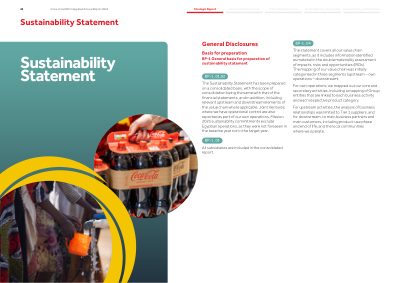
Coca-Cola HBC AG’s Sustainability Statement 2024 provides detailed coverage of key actions, resources, and progress related to the circular economy, particularly on page 81, where these elements are explicitly disclosed. Additional references to resource use and circular economy actions are found on pages 80 and 68, with some context on pollution prevention downstream noted on page 62, although this is not a clear or direct disclosure. Notably, there is no quotable evidence found elsewhere in the report for other narrative items related to this disclosure.
Aena S.M.E., S.A.
Air Transportation — Airport Services · Spain · 2025
Aena S.M.E., S.A.'s 2025 Sustainability report includes references to actions and resources related to resource use and the circular economy, as noted on page 69, but these mentions do not constitute a clear disclosure of specific datapoints such as processes to identify and assess material resource use impacts (p.69). The report also references policies related to resource use and circular economy on the same page, yet lacks detailed or quotable evidence for comprehensive disclosure in this area. Notably, several expected datapoints are not found or clearly addressed in the report, indicating gaps in explicit reporting on resource use and circular economy metrics.
✓ LRA AI Assistant · Human-in-the-loop

Ask Study Studio AI assistant about this disclosure
Get practical answers for your reporting context. Your first two answers are free — join LRA Community for free to continue without a limit.
TryHow do I prepare E5-2?What data do I need to collect?Where can I see a real-report example?What mistakes should I avoid?
2 free answers
Check your understanding
Scenarios to work through
A packaging business has three live projects this year: a refill pilot, a switch to lighter materials, and a warehouse waste-sorting trial. The sustainability team has draft notes, but the finance team has not yet linked any budget lines to the projects.
QHow should the preparer decide what to include for the action description and the funding information?
Reveal model answer →Hide answer ↑List the practical steps the business is taking to cut material use and waste, and make clear which of those steps are circular in nature, which are aimed at using resources more efficiently, and which are focused on reducing waste. Then connect each action to the money set aside for it, separating investment spending from operating spending where that distinction is relevant, and only include amounts that are actually assigned to those plans.
Why this matters · Describe the real measures in plain business language and tie them to the resources set aside for delivery.
A manufacturer has approved a two-year programme to redesign one product line, but the engineering team expects the first changes to start next quarter while the full rollout will finish later. The draft report currently says only that the company is “working on improvements”.
QWhat timing detail should the preparer add so the reader can understand the plan properly?
Reveal model answer →Hide answer ↑State when the work starts, what happens first, and when the main stages are expected to finish. If the programme runs over more than one reporting period, show the sequence clearly rather than using a vague statement that the work is ongoing.
Why this matters · Give a clear timetable so the reader can see when the action is expected to happen.
A retailer has several waste-cutting measures: better stock planning, reusable transport crates, and staff training to reduce damaged goods. The draft disclosure groups everything under one heading and gives one total budget, but the project owners say the measures are not all the same type.
QHow should the preparer separate the actions and the related spending?
Reveal model answer →Hide answer ↑Break the measures into the different kinds of activity the business is carrying out, so the reader can see which ones are about circular practices, which ones improve how materials are used, and which ones reduce waste. Then show the related spending in a way that matches those actions, rather than hiding everything in one combined figure.
Why this matters · Separate distinct measures and match the funding to the specific work being done.
A food producer has already spent money on a compostable packaging trial and has also set aside future operating costs for staff training and supplier engagement. The reporting team is unsure whether to mention both the money already spent and the money still planned.
QWhat should the preparer do when presenting the resources linked to the actions?
Reveal model answer →Hide answer ↑Include the resources that have been committed or allocated for the measures, whether they have already been spent or are planned for later, and make the split between capital-type spending and day-to-day spending clear where that helps the reader understand the commitment. The point is to show the scale of support behind the actions, not just the cash already used.
Why this matters · Show both committed and planned support, with a clear split between investment and operating spend where relevant.
Framework references
Related framework references
How this disclosure maps across the major reporting frameworks.
Primary
Related & explore
FAQ
Questions this page answers
How do I prepare an E5-2 disclosure using this page step by step?+−
Use the page’s plain-language explainer and the step-by-step ‘how to prepare’ section to work from scope through to draft output. It is designed to help you organise the disclosure, not to replace your own reporting judgement.
What datapoints do I need to gather for E5-2 on this page?+−
The page says to prepare five datapoints: circular economy actions, efficiency measures, waste cut actions, delivery timetable, and budget and spend. Use those as the starting list for data collection and drafting.
How should I set the scope and methodology for the E5-2 data on this page?+−
The page gives a step-by-step preparation flow, so use that to define what is in scope, who owns each datapoint, and how the figures and narrative will be assembled. It does not provide a fixed methodology, so you need to apply your own internal approach consistently.
Who should own the E5-2 disclosure work and evidence pack?+−
The page is useful for assigning ownership because it separates the datapoints, the preparation steps, and the assurance evidence pack. In practice, the ESG lead can coordinate, while data owners provide the underlying records and sign-off support.
What evidence do I need to make an E5-2 disclosure assurance-ready?+−
The page includes an evidence pack with five items and six assurance claims to verify, each framed around claim, risk, and evidence. Use those to build a file that shows where the data came from and how it was checked.
What are the common mistakes to avoid when drafting E5-2 on this page?+−
The page lists common reporting gaps and mistakes, so use that section as a pre-submission check. It is especially useful for spotting missing datapoints, weak support, or a draft that does not line up with the evidence pack.
How do I use the Prep & Assurance workbook for E5-2?+−
The Download Centre includes a Prep & Assurance workbook in .xlsx format, which is intended to help you organise the disclosure work and evidence. Use it alongside the page’s preparation steps and assurance checklist to build a draft and track completion.
What can I take from the synthetic example disclosures for E5-2?+−
The page includes synthetic illustrative examples, including a quantitative table, to show how a disclosure might be presented. Treat them as examples only and make sure any figures you prepare are internally consistent and based on your own data.
How do I turn E5-2 data into a draft narrative and content index line?+−
The draft-output section gives visualisation ideas, narrative starters, and a content-index line to help you convert prepared data into report text. Use those prompts to shape a clear draft, then check it against the evidence pack and common gaps list.
Where can I find real company examples for E5-2 reporting on this page?+−
The page has a ‘From company reports’ table that links to published reports where the topic is disclosed. Use it for reference only when you want to see how others have presented similar information.
More questions this page can help with
E5-2 circular economy actions what data should I collect before drafting?E5-2 efficiency measures how do I evidence them for assurance?E5-2 waste cut actions what should be in the evidence pack?E5-2 delivery timetable how should I present timing in the draft?E5-2 budget and spend what level of detail does the page suggest?E5-2 common reporting gaps what mistakes do teams usually make?E5-2 Prep & Assurance workbook how do I use the xlsx download?E5-2 printable Library Card pdf what is it for?E5-2 assurance claims what are the six claims to verify?E5-2 synthetic example disclosure can I copy the structure?E5-2 narrative starters how do I turn them into report text?E5-2 company reports table where are the real examples linked?
How this library is built
312 published reports indexed
63171 pages with page-level citations
247 practitioner guides
Free · LRA Community
Get your E5-2 tools — free
Your preparation tools are free for LRA Community members and students. Register once (it's free) and your download starts right away — plus the Disclosure Library, templates and the LRA AI-assistant.
✓
You're in — your download is starting
Your file is downloading now. Your Community Cabinet — with the Disclosure Library, templates and the LRA AI-assistant — is ready too.
Open your Cabinet →