Updated GRI-CDP Mapping Refines Climate Disclosure Links
Companies preparing CDP 2026 responses may already hold much of the relevant climate and energy data through GRI reporting. The updated GRI-CDP mapping shows where that data can be used, and where it cannot.

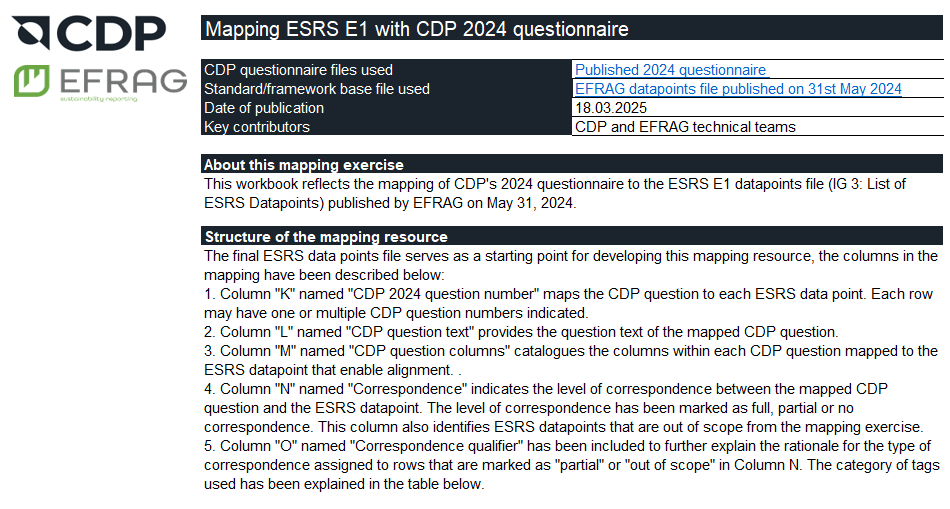
On 28 April 2026, Global Reporting Initiative (GRI) published an updated mapping between CDP’s 2026 corporate questionnaire and the GRI 102: Climate Change and GRI 103: Energy Standards. The resource gives companies preparing a CDP 2026 response a clearer view of which GRI climate and energy data points can support the questionnaire.
The key issue is correspondence: where the link is full, where it is partial and where CDP’s general questions do not cover the GRI requirement.
How the Correspondence Works
The resource maps CDP’s 2026 full corporate questionnaire against GRI 102: Climate Change 2025 and GRI 103: Energy 2025. GRI presents the update as a response to growing demand for more streamlined climate reporting, with the aim of making disclosure more aligned and decision-useful.
The mapping lists GRI disclosure titles and requirement IDs, identifies the corresponding CDP questions and columns, and assigns a correspondence status. GRI also says the updated mapping expands coverage of climate-related disclosures, including actions and land-related emissions and removals.
The scope has clear limits. The mapping runs from GRI to CDP, not the other way around. It covers general CDP questions only, while sector-specific and requester-specific data points are outside its stated scope.
Where Correspondence Is Strongest
The GRI 102 tab maps 141 GRI requirement-level data points, identified by IDs such as 102-1-a. Of these, 68 are marked full correspondence, 38 partial correspondence, 33 no correspondence and two N/A. Full correspondence indicates that CDP has explicit questions, response options or guidance aligned with the GRI requirement; partial correspondence means CDP covers only part of it.
The qualifier and comment columns make that status more useful. They show whether a partial match reflects an additional GRI requirement, a difference in approach or scope, or a condition attached to the CDP response option.
Correspondence is strongest around greenhouse gas metrics. Scope 1, Scope 2 and Scope 3 emissions are largely linked to CDP questions, as are GHG emissions intensity and many requirements on emissions reduction targets and progress.
Other climate topics need closer review. All 20 GRI 102-3: Just transition data points are marked as no correspondence. Climate adaptation is mostly partial or not mapped, and GHG removals include no-correspondence data points on storage pools, intended use, people, biodiversity and methodology. Carbon credits show a mixed picture: several project and cancellation fields correspond, while stakeholder consultation, human rights, biodiversity and trade-offs are partial or not mapped.
The GRI 103 tab maps 29 GRI requirement-level data points: 10 full correspondence, 7 partial correspondence and 12 no correspondence. Energy consumption within the organisation maps better for totals and renewable versus non-renewable breakdowns. Upstream and downstream energy consumption, energy intensity, and several methodology or measurement requirements have no correspondence.
What This Means for CDP Preparation
For companies preparing a CDP submission, the mapping can reduce rework where GRI evidence already exists for measured emissions, energy use and selected targets. For CDP scoring, the questionnaire response has to be completed by the relevant deadline, rather than treated as an open-ended reporting process.
The same logic also sets a boundary. Where the mapping shows partial or no correspondence, companies should not rely on a GRI data point alone to complete the CDP response, or assume that a CDP answer fully covers the GRI disclosure.