UK SRS S1 and S2 Now Published
UK Sustainability Reporting Standards have been in development since May 2024, when the UK government set out the framework for assessing IFRS S1 and IFRS S2 for UK use. For now, UK SRS S1 and UK SRS S2 are available for voluntary use and do not set a fixed effective date; yet the requirements already provide a UK baseline for what sustainability-related and climate-related financial information should be disclosed, and how it should be structured.
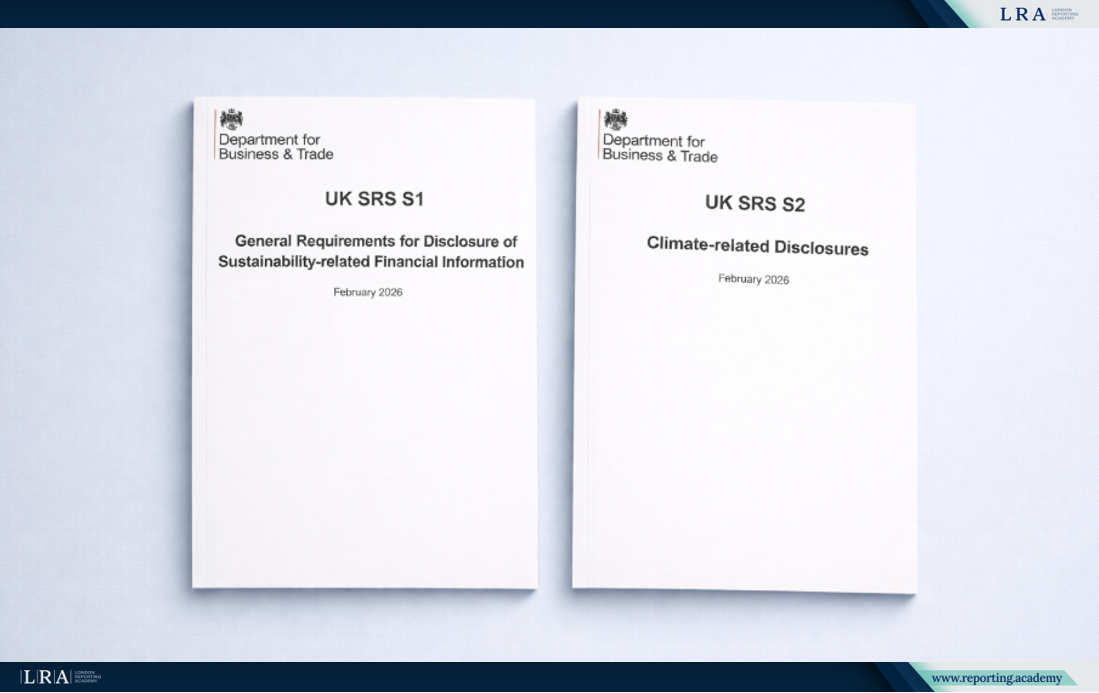
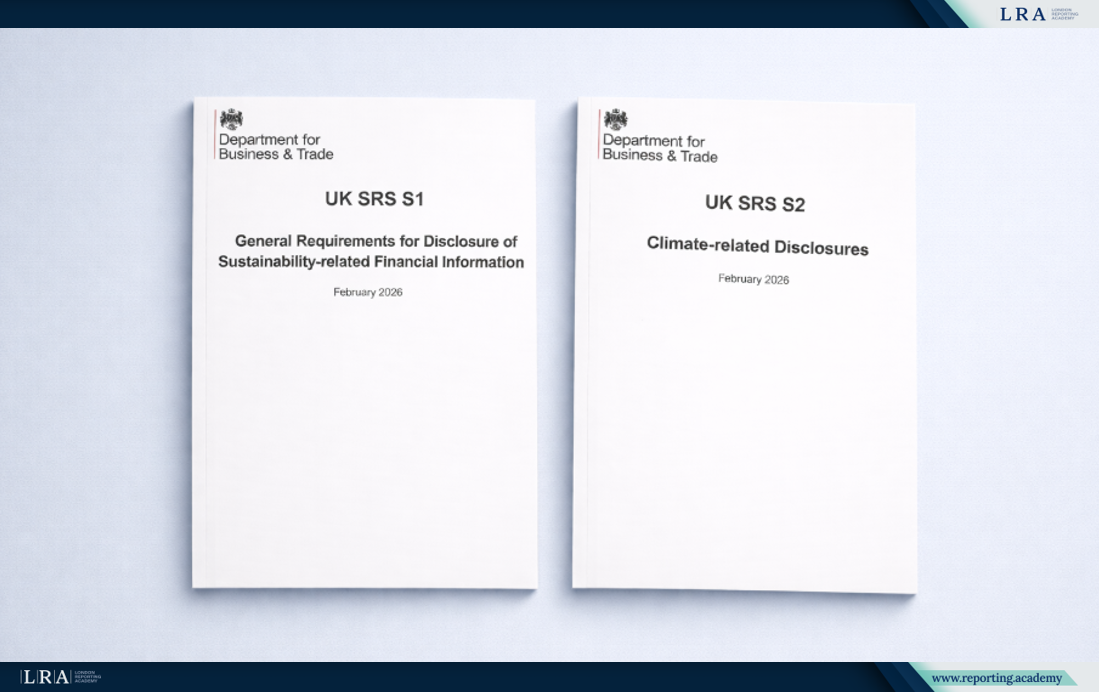
UK SRS S1 and UK SRS S2 were published in late February 2026 for use in the United Kingdom of Great Britain and Northern Ireland. They set out the UK version of the requirements for sustainability-related and climate-related financial disclosures in general purpose financial reports. In parallel, the Financial Conduct Authority (“the FCA”) has launched a consultation on proposed amendments to the sustainability disclosure framework for UK-listed issuers, including how it proposes to incorporate UK SRS into the Listing Rules.
What UK SRS S1 and S2 Cover
UK Sustainability Reporting Standards are issued by the Secretary of State for Business and Trade and have not been prepared or endorsed by the International Sustainability Standards Board. UK SRS S1 sets general requirements for disclosure of sustainability-related financial information, while UK SRS S2 sets climate-related disclosures.
Both Standards focus on information that is useful to primary users of general purpose financial reports when they make decisions about providing resources. The lens is the effect of sustainability-related and climate-related risks and opportunities on cash flows, access to finance, or cost of capital over the short, medium or long term.
UK SRS S2 addresses climate-related physical risks, transition risks and climate-related opportunities. It is explicit that matters that could not reasonably be expected to affect an entity’s prospects sit outside its scope.
Scope and Timeline
The Standards include “Application and transition” appendices that set first-time application provisions, including relief from comparative information in the first annual reporting period of application. UK SRS S2 also permits continued use of a pre-existing greenhouse gas measurement method in the first annual reporting period, where the entity used a method other than the Greenhouse Gas Protocol in the immediately preceding period.
The Standards do not set a fixed effective date: they are available for voluntary use immediately, and any mandatory effective date would be set in regulation or legislation if reporting requirements are introduced.
UK SRS S1 requires entities to apply UK SRS S1 and UK SRS S2 at the same time, but it permits an exception that allows climate-only reporting.
Where application is required under UK law or regulation, the Standards state that application is subject to UK rules and legislation, including the Companies Act 2006 and requirements determined by the Financial Conduct Authority.
Why it Matters for Reporting
UK SRS S1 anchors how sustainability-related financial information is selected, structured and connected to the financial statements. It sets an expectation of coherence, meaning disclosures should be presented so users can relate sustainability-related risks and opportunities to the entity’s financial statements.
This affects how sustainability narrative, metrics, and financial reporting judgements are connected.
UK SRS S2 brings climate transition planning and financial effects into the core disclosure package. Strategy disclosures extend beyond describing risks and opportunities to covering their current and anticipated effects on the business model and value chain, and on strategy and decision-making, including a climate-related transition plan. Disclosures also address effects on financial position, financial performance and cash flows over the relevant time horizons.
What this Means in Practice
In practice, selected implications for preparers centre on governance responsibilities, core climate metrics (including Scopes 1–3), and disclosure processes such as cross-referencing.
On governance and process, UK SRS S2 requires disclosures about how responsibilities for climate-related risks and opportunities are reflected in mandates and role descriptions, how the governance body is informed, and how it oversees targets and monitors progress. The Standard also draws a line to remuneration policies, requiring disclosure of whether and how they are linked.
On data and controls, UK SRS S2 requires disclosure of absolute gross greenhouse gas emissions for Scope 1, Scope 2 and Scope 3. Those emissions are measured in accordance with the Greenhouse Gas Protocol unless a jurisdictional authority or an exchange on which the entity is listed requires a different method. The Standard requires explanations of measurement approaches, inputs and assumptions, and disclosure of key changes during the period.
Scope 2 reporting includes location-based emissions and, where contractual instruments exist, information about them only if it informs users’ understanding of Scope 2 emissions. This requires organisations to identify whether contractual instruments exist and whether information about them is necessary to inform users’ understanding of Scope 2 emissions.
Scope 3 reporting requires disclosure of which categories are included, aligned to the Greenhouse Gas Protocol Corporate Value Chain (Scope 3) Accounting and Reporting Standard (2011). UK SRS S2 includes an explicit permission for Scope 3 Category 15: an entity may limit Category 15 to financed emissions only and may exclude emissions attributable to derivatives, with explanatory disclosures about what it treated as a derivative.
Transition provisions influence the sequencing of first-time application disclosures. UK SRS S2 includes a relief from disclosing Scope 3 greenhouse gas emissions, including related financed emissions information for certain financial activities. The Standards specify disclosures about the use of transition provisions alongside statements about what has been applied.
UK SRS S1 also frames practical consequences for cross-referencing. Where information is incorporated by cross-reference, it must be available on the same terms and at the same time as the sustainability-related financial disclosures. Responsibility for that information sits with the authorising body or individuals.
Key UK–ISSB differences to note
Several UK drafting choices soften mandatory “reference points” in the ISSB text.
In IFRS S1, entities are required to refer to and consider SASB disclosure topics and SASB metrics. UK SRS S1 makes those references optional through “may refer to and consider”. That is a direct change in how prescriptive the baseline is when identifying what to disclose and which metrics to use.
IFRS S2 requires entities to refer to and consider industry-based disclosure topics and metrics in the Industry-based Guidance on Implementing IFRS S2. UK SRS S2 treats that guidance as optional when identifying climate-related risks and opportunities, and it similarly treats industry-based metrics as optional reference points.
Compliance mechanics also differ around “climate-first” reporting. IFRS S1 permits climate-only reporting as a transition relief in the first annual reporting period, with disclosure that the relief was used. UK SRS S1 permits climate-only reporting as an exception to simultaneous application, but it states that an entity using that provision is not permitted to assert compliance with UK SRS S1 and must disclose use of the provision instead.
The UK legal overlay is explicit. Where UK law or regulation requires application, the Standards state that the application of UK SRS, including the operation of some transition provisions, is subject to UK rules and legislation.
Interoperability
Where no UK Sustainability Reporting Standard specifically applies to a sustainability-related risk or opportunity, UK SRS S1 permits entities to refer to and consider the Global Reporting Initiative Standards and the European Sustainability Reporting Standards. This is allowed only to the extent these sources support the objective of UK SRS S1 and do not conflict with UK Sustainability Reporting Standards.
For preparers, this permits the use of existing reporting sources where no UK Sustainability Reporting Standard applies, subject to the stated conditions.
What Sustainability Reporting Professionals Should Pay Attention to
The published Standards provide the reference text needed to plan implementation. Sustainability reporting professionals will need to evidence connectivity to the financial statements, build repeatable processes for Scope 1–3 and financed emissions data, and decide how they will treat Industry-based Guidance and SASB references under the UK “may” drafting.
This means that compliance statements, transition choices, and cross-referencing controls need to be addressed when designing reporting processes.
If an organisation is considering climate-only reporting, UK SRS S1’s restriction on asserting compliance with UK SRS S1 is a central disclosure and governance consideration.