GHG Protocol and ISO Plan a Joint Corporate Standard
The update sets out the proposed structure of the future corporate standard and the Scope 2 questions that are still open.
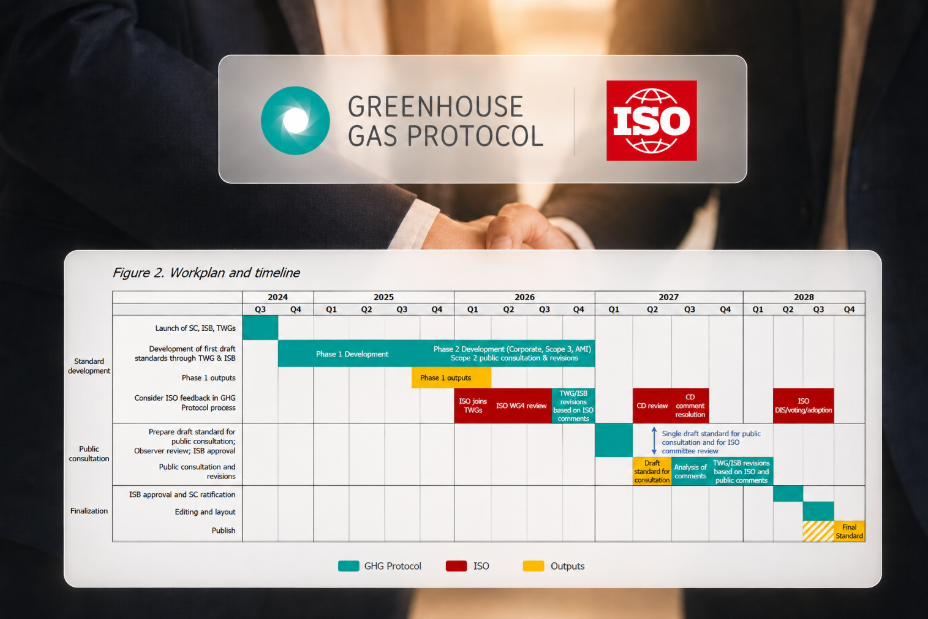
GHG Protocol has issued a new Standard Development Plan for the Corporate Accounting and Reporting Standard, Version 3.0. The July 2026 plan brings its corporate standards into one development process with the International Organization for Standardization (ISO) and sets out an estimated timetable for a consolidated draft. The plan does not introduce any new accounting or reporting requirements.
The proposed model would consolidate the current suite of entity-level standards into a single standard comprising multiple parts.
One Plan for Corporate GHG Accounting
The plan, dated 29 July 2026, combines and supersedes four development plans published in December 2024. Corporate Standard Version 3.0 is expected to integrate the current Corporate Standard, Scope 2 Guidance, Scope 3 Standard and outputs from the Actions and Market Instruments workstream. Through the GHG Protocol–ISO partnership, this consolidated GHG Protocol content is intended to be harmonised with ISO 14064-1.
The future standard is intended for organisations preparing annual GHG emissions reports, regardless of size, sector or country. The revision seeks greater coherence across the GHG Protocol suite, better interoperability with disclosure and target-setting systems, clearer requirements and easier verification.
The current GHG Protocol standards remain in use, whether applied voluntarily or through programmes and regulations that refer to them. The plan notes that IFRS S2 requires emissions disclosures in accordance with the current GHG Protocol Corporate Standard, while ESRS E1 requires companies to consider the requirements and principles of the Corporate Standard, Scope 2 Guidance and Scope 3 Standard.
The Purpose of the GHG Protocol–ISO Partnership
The future standard is expected to be jointly published and co-branded by GHG Protocol and ISO, although its title has not been finalised. The partnership aims to reduce fragmentation and duplication between the two systems, improve consistency across jurisdictions and make corporate GHG reporting easier to apply and verify. For organisations that use both GHG Protocol and ISO 14064-1, a joint standard could reduce the need for parallel accounting and reporting processes.
ISO is involved throughout the development process, including through participation in the GHG Protocol technical working groups and as an observing entity to the Independent Standards Board (ISB). The proposed standard will then proceed through the respective review and approval processes of GHG Protocol and ISO.
A consolidated draft is expected to enter public consultation in the second quarter of 2027, with publication anticipated in the fourth quarter of 2028. A pilot phase, if added, would extend the timetable.
A Two-Part Structure
The plan proposes Part 1, General Requirements and Physical GHG Inventory, and Part 2, Actions and Market Instruments. The structure remains subject to change, and either part may be divided further.
Part 2 would address how companies account for and report actions, investments and market instruments alongside the physical inventory. A possible multi-statement structure would cover physical emissions from operations and value chains, market-based emissions linked to market instruments, and the emissions impact of actions and investment decisions calculated using consequential methods and reported through a GHG impact statement.
Preliminary feedback showed strong support for the overall approach, although the detailed requirements remain under development.
Scope 2 Decisions Remain Open
The Scope 2 consultation ran from 20 October 2025 to 31 January 2026 and received nearly 1,100 responses from 56 countries. The proposal retained dual reporting through the location-based method and, where contractual information exists, the market-based method.
For the location-based method, it proposed an updated emission factor hierarchy and use of the most precise accessible factor. Feedback was mixed, although most respondents supported defining an accessible factor as free, publicly available and obtained from a credible source.
For the market-based method, the proposal included hourly matching for larger organisations, exemptions below a future threshold and deliverability requirements. Hourly matching and deliverability received low support in the form presented, especially from companies and industry groups. The feedback reflected different views on whether the method should record procurement choices or link claims more closely to when and where electricity is consumed and to clean generation.
Other proposals, including revised residual mix rules, Standard Supply Service (SSS) guidance and a fossil-based fallback, received moderate support but also raised implementation concerns. The ISB has not selected a final model and has requested further work on multiple market-based reporting approaches.
Where the Requirements Will Sit
The consolidated standard will be the normative document containing the requirements for organisations applying the standard. Separate guidance for the Corporate Standard, Scope 2, Scope 3 and Actions and Market Instruments will explain how to apply those requirements but will not introduce additional “shall” statements.
The guidance documents are expected after publication of the consolidated standard. This means the core requirements may be published before the full implementation guidance is available.