


Disclosure focus
This disclosure asks an organisation to explain the targets it has set for resource use and circular economy matters, and how those targets are meant to drive action. In practice, the report should make clear what the target is, what it covers, the time horizon, and how progress will be tracked. The emphasis is on showing that the target is specific enough to be meaningful and connected to the organisation’s actual impacts and priorities.
The practical focus is usually on whether the target applies across the whole organisation or only to selected activities, sites, product lines, or value-chain areas. Readers should be able to see the scope, any exclusions, and whether the target is a company-wide commitment or a more limited pilot or flagship initiative. The key point is to help users judge how representative the target is and how far it can be relied on as evidence of broader performance.
This LRA educational guidance supports disclosure preparation. For the exact requirements, always refer to the official EFRAG source.
Before you start
A quick mental checklist before you prepare this disclosure — tick each as you settle it.
Preparation
Key datapoints to prepare
+ Show E5-3 sub-elements (LRA working checklist)
Set the starting point used for the target.
State the circularity goal, such as the share of recycled input.
Specify what the target covers.
Set out the target figure or figures.
Give the time period for achieving it.
How to prepare it
1Set the reporting boundary first: decide which parts of the business, activities, and value chain are included in the target setting, and make that scope clear in your working papers.
2Define the target itself in business terms: state what outcome is being tracked, including any circularity measure such as recycled input, and make sure the metric is described consistently across all supporting files.
3Pin down the starting point: identify the baseline used for comparison, note the period or reference point chosen, and keep the source records that support that starting position.
4Fix the timing: record the intended milestone or end date for the target, and check that the timeline is aligned with the way the target is described elsewhere in the disclosure.
5Gather the underlying evidence and build the disclosure: assemble the figures or narrative that support the target value, scope, baseline, and timeline, and keep the calculations or source documents together so the final wording can be traced back.
6Explain any limits or updates, then verify against the official source: document exclusions, assumptions, or changes in approach, and review the completed disclosure against the ESRS text to confirm nothing material has been missed or misstated.
Request the data
Request the target details and supporting evidence
Translate the disclosure into an internal business question — then adapt it to your organisation's own language.
What targets has the business set for materials, packaging, waste or circularity, and what are the baseline, scope and timing for each one?
Use the organisation’s own language first — for example, the terms your teams use for materials, packaging, waste, reuse, recycling or circularity — then map those terms to the reporting disclosure. Keep the request in business terms, not framework wording, and check the source material before sign-off.
Weak request
Please provide the ESRS E5 targets disclosure information, including target values, scope, baseline, timeline and circularity targets.
Why it fails: This uses framework language that many operational teams will not use day to day, so it is harder to route, answer and evidence. It also does not tell the owner what internal artefacts to pull, what naming to use, or what context is needed to interpret the target properly.
Better request
Please send the latest target tracker or approved plan for [topic] covering [period]. For each target, include the internal name, what it covers and excludes, the starting point and year, the end point, the timing, any interim milestones, the source file or system, and who owns and approved it. Use your team’s own terms first, and we will map them for reporting.
Industry examples
Draft your disclosure
Notes that turn data into a disclosure
LRA training templates — adapt them to your organisation, and check the official source before sign-off.
Method note
Explain the basis used for each target by stating what was measured, which parts of the business or value chain were included, the starting figure used for comparison, and the date or period chosen as the reference point.
Context note
Describe what the figures mean in practice by linking each target to the company’s circularity priorities, showing how far the business aims to move from the starting position and what success would look like by the end date.
Fluctuation statement
If the numbers changed, note whether the shift came from a revised ambition, a wider or narrower scope, a different starting figure, or a change in timing, and say whether the update makes the target more or less demanding.
Content index entry
E5-3 Targets — [location / page] / [notes]
Download Centre
Preparation tools & forms
Professional preparation tools for E5-3 — free with an LRA Community membership. Register once (it's free) and every download unlocks, together with the Disclosure Library, templates and the LRA AI-assistant.
Free · Community members
Assurance readiness
For each claim, check the evidence
Evidence pack to prepare
Common reporting gaps
The information is presented without a date or as-at point.The scope or boundary of the statement is left undefined.Key terms are used inconsistently across the report.Material changes since the previous period are not disclosed.Assertions are made without supporting detail or a source record.Boilerplate is used that does not actually answer what is asked.
Common gaps
Mistakes to avoid when collecting the data
Wrong owner
Chasing the sustainability team alone can miss the people who hold the target register, the baseline file, or the delivery plan in their own systems.
Framework language first
Asking for the data in ESRS-style terms can confuse colleagues, so they give a policy answer instead of the business wording used in day-to-day tracking.
No clear boundary
Pulling figures without fixing which sites, products, or activities sit inside the target can mix in items that should stay out.
Wrong timing basis
Using the reporting year by habit can distort the record if the target was set against a different start point or review date.
Mixed counting basis
Combining percentages, counts, and value measures in one extract can make the target look comparable when the underlying basis is not the same.
Source labels lost
Copying numbers into a new file without keeping the original names, version marks, or source notes makes it hard to trace what each figure came from.
Separate groups merged
Putting different target populations into one line can hide that some measures apply to one business unit, product set, or geography only.
Missing evidence trail
Saving the number without the supporting note, date, and approver leaves no clear record of how the target data was checked before sign-off.
Where judgement is often needed
Set the target boundary after acquisitions or disposals
Use the same business perimeter for the target, the starting point and the progress tracking, and if a buy-in or sale changes that perimeter, explain the adjustment and the date from which the revised scope is used.
Handle country-by-country definitions consistently
Where local operating units use different product, waste or material definitions, choose one internal rule for the target and explain any mapping or conversion used so the group view stays comparable.
Decide how to treat sites or teams near the edge of scope
State whether marginal operations, joint arrangements, leased assets or small subsidiaries are included or left out, and explain the practical rule used to draw that line.
Fix one baseline method and say if estimates were used
Describe whether the starting figure comes from measured data, modelled values or a mix of both, and explain any assumptions, proxies or later restatements that affect the comparison point.
Choose a clear timing basis for the target date
Explain whether the deadline is tied to a calendar year, a financial year or another internal cycle, and make clear how interim milestones are aligned to that chosen clock.
Explain how circularity measures were calculated
For measures such as recycled content or similar ratios, set out the numerator and denominator used, the source of the inputs and any exclusions so readers can see how the percentage was built.
Show how rounding affects the reported target
If percentages, dates or quantities are rounded, say the rounding rule and make sure the rounded figures still reconcile to the underlying calculation without changing the substance of the target.
Aggregate sensitive operational data before disclosure
When site-level detail could expose confidential or personal information, combine the figures at a higher level and explain the aggregation approach and any material data gaps it creates.
Examples
Illustrative examples
Synthetic, written by LRA — not from a company report, not text from any standard.
Illustrative (synthetic) example — consumer electronics manufacturing
We have set a 2030 target to raise recycled material in the plastics we buy for casings and internal parts to **60% by weight**, measured across our own operations and the upstream suppliers that feed our product assembly lines. - Our starting point was **18% recycled input in 2024**. - The target covers **all virgin plastic purchases for our consumer-device range**, excluding packaging and third-party accessories. - We will track progress annually against the 2024 base year and expect to reach the goal by **31 December 2030**.
This example shows how a reporter can describe a circularity goal in plain language by stating the target level, what part of the business it applies to, the starting point, and the date by which it should be achieved. The figures are synthetic and internally consistent.
Illustrative (synthetic) example — food and beverage processing
We are working towards using **45% recycled fibre by weight** in the paperboard we purchase for our own-brand cartons, with the aim applying to the cartons sourced for our European and UK production sites. - Our reference point is **12% recycled fibre in 2023**. - The plan covers **all carton board bought for our branded retail packs**, but not labels or transport packaging. - We intend to deliver this change by **the end of 2028**, and we will compare each year’s result with the 2023 starting level.
This example illustrates a second, different reporter describing the same kind of disclosure with a different scope and baseline. It remains synthetic, and the percentages are consistent with the stated totals and dates.
How companies report E5-3 in practice
Real reports where this topic is disclosed. These are report practice, not exact disclosure templates to copy.
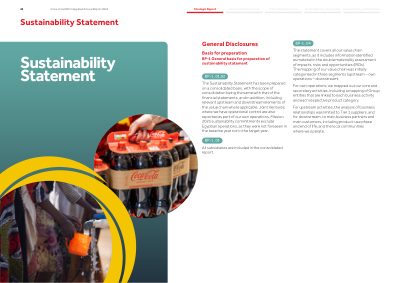
Coca-Cola HBC AG
Food and Beverage Processing · Switzerland · 2024
Coca-Cola HBC AG’s Sustainability Statement 2024 includes a reported update on emissions reduction targets, moving the baseline year from 2017 to 2019 for mid-term 2030 goals (p.49). The report also discusses voluntary targets promoting circular economy practices and annual target setting to track progress (p.85). However, the disclosure lacks clear, detailed baseline data and specific metrics related to target application periods and absolute or relative values, with only unclear contextual information provided on page 132.

Bakkafrost P/F
Food Production — Animal Source · Faroe Islands · 2025
Bakkafrost P/F’s 2025 Integrated Annual Report includes reported baseline values for targets, with the base year identified as 2025 (p.100), and specifies a percentage of recycled materials in resource inflow at 8% to 10% (p.128). The report also references various targets related to renewable electricity, Scope 1 and 2 emissions reductions, feed conversion ratios, biodiversity impacts, and health and safety, though detailed quantitative data or progress updates on these are not clearly presented in the provided excerpts. Notably, no comprehensive narrative or additional quotable evidence was found to elaborate on these disclosures.

Sanoma Oyj
Education Services · Finland · 2025
Sanoma Oyj’s 2025 Annual Report provides reported values on GHG emission reduction targets with a base year of 2021 and progress data for 2025, including milestones and target years up to 2030 (pp. 95-96). The report details that targets are set for 2030 and progress is tracked annually, with a specific aim to reduce Scope 3 emissions by 38% compared to the 2021 baseline (p. 94). However, the report does not include ESRS-aligned measurable, time-bound outcome-oriented targets related to biodiversity and ecosystems (p. 101), and some narrative items relevant to the disclosure are not found.
✓ LRA AI Assistant · Human-in-the-loop

Ask Study Studio AI assistant about this disclosure
Get practical answers for your reporting context. Your first two answers are free — join LRA Community for free to continue without a limit.
TryHow do I prepare E5-3?What data do I need to collect?Where can I see a real-report example?What mistakes should I avoid?
2 free answers
Check your understanding
Scenarios to work through
A packaging business has set a goal to lift the share of recycled feedstock in its plastic bottles from 18% to 35% by 2030. The draft note says only that the business has a recycling goal, without saying what it covers or where the starting point came from.
QWhat extra detail should the preparer add so readers can understand the target properly?
Reveal model answer →Hide answer ↑The note should spell out the target value, the part of the business or material stream it applies to, the starting measurement used for comparison, and the date by which the business plans to reach it. If the target is about circular use of materials, that should be made clear in plain language rather than left implied.
Why this matters · A target is only understandable when the goal, its coverage, the baseline and the deadline are all stated together.
A manufacturer has a company-wide waste reduction target, but the operations team measured the baseline using only one plant while the target is meant to cover all three plants. The sustainability draft currently mixes those figures without explanation.
QHow should the preparer handle the mismatch between the starting point and the intended coverage?
Reveal model answer →Hide answer ↑The preparer should align the baseline with the same scope as the target, or clearly explain any difference if the starting figure comes from a narrower set of activities. Readers need to see what population the target covers and what exact starting point it is being compared against.
Why this matters · The starting figure and the target must be drawn from the same scope, or any difference must be made explicit.
A consumer goods group has a target to increase recycled content in packaging, but the draft only says 'long term' and gives no year or milestone. The team also has an internal slide showing a 2028 checkpoint, but it has not been carried into the report.
QWhat should the preparer do before finalising the disclosure?
Reveal model answer →Hide answer ↑The preparer should include the time horizon for the target, and if there are interim dates or checkpoints that are part of the plan, those should be presented in a way that makes the timeline clear. A vague phrase such as 'long term' is not enough on its own to show when the business expects to get there.
Why this matters · A target needs a clear time frame so readers can judge when progress is meant to happen.
A furniture maker has set a target to use 60% recycled wood input by 2032. The draft mentions the percentage but does not explain whether the figure relates to all wood purchased, only certified suppliers, or a specific product line.
QWhat decision should the preparer make about the wording of the target?
Reveal model answer →Hide answer ↑The preparer should describe the target in a way that makes the circularity measure understandable, including what material flow or product set the percentage refers to. If the target is about recycled input, the disclosure should make that link explicit and avoid leaving the reader to guess the basis of the percentage.
Why this matters · For circularity goals, the metric must be tied to the relevant material flow or product group so the percentage has a clear meaning.
Framework references
Related framework references
How this disclosure maps across the major reporting frameworks.
Primary
Related & explore
FAQ
Questions this page answers
For E5-3, what data do I need to gather before I start drafting the disclosure?+−
The page says to prepare five datapoints: target values, target coverage, starting point, delivery timetable and circular input share. Use those as the core inputs before you draft the narrative or table.
How do I use the step-by-step preparation section for E5-3 in practice?+−
Use it as a working checklist to move from scoping and data collection to a draft disclosure. The page is designed to help you prepare the disclosure, not just describe it.
Who should own the E5-3 data collection and sign-off in my organisation?+−
The page is aimed at sustainability and ESG managers, HR or data owners, and assurance reviewers, so ownership should sit with the people who can source, check and evidence the five datapoints. It is useful to assign clear responsibility for each input and for the final review.
What should I include in the evidence pack for E5-3 assurance readiness?+−
The page includes an evidence pack with five items to support assurance readiness. Use it to assemble the documents and records that back up the datapoints, methodology and final draft.
What are the six assurance claims I need to verify for E5-3?+−
The page lists six assurance claims with a claim, risk and evidence view. Use those claims to test whether your disclosure is supported, consistent and ready for review.
What are the most common mistakes people make when reporting E5-3?+−
The page has a section on common reporting gaps and mistakes. It is there to help you spot missing data, weak evidence or unclear drafting before you finalise the disclosure.
How do I turn the E5-3 data into a draft disclosure?+−
The page includes a draft-output section with visualisation ideas, narrative starters and a content-index line. Use those prompts to turn the prepared datapoints into a clear first draft.
Can I use the synthetic example disclosure on the E5-3 page as a template?+−
Yes, as a worked illustration only. The example is synthetic, so use it to understand structure and presentation, then replace it with your own internally consistent data.
What does the E5-3 workbook download help me do?+−
The Download Centre includes a Prep & Assurance workbook in .xlsx format. It is there to help you organise the preparation, evidence and assurance checks in one place.
How is the printable Library Card useful when preparing E5-3?+−
The Download Centre also includes a printable Library Card in .pdf format. Use it as a quick reference while you are gathering data, checking gaps and building the draft.
Where can I find real company examples for E5-3 reporting?+−
The page has a 'From company reports' table that links to published reports where the topic is disclosed. Use it to see how others present the topic in practice, but treat it as reference material rather than a template.
More questions this page can help with
E5-3 circular input share: what should I check before I calculate it?E5-3 target coverage: how do I describe the scope clearly in the draft?E5-3 starting point: what evidence should support the baseline figure?E5-3 delivery timetable: how do I present milestones without overcomplicating the disclosure?E5-3 evidence pack: what documents should I keep for audit trail purposes?E5-3 common mistakes: how do I avoid weak or incomplete reporting?How do I use the E5-3 visualisation ideas in a board pack or report draft?What should an assurance reviewer look for in an E5-3 draft based on this page?How do I use the E5-3 content-index line in a sustainability report?What is the best way to assign data ownership for E5-3 across teams?Can the E5-3 synthetic example help me structure my own table?What is included in the E5-3 plain-language explainer before I start drafting?
How this library is built
312 published reports indexed
63171 pages with page-level citations
272 practitioner guides
Free · LRA Community
Get your E5-3 tools — free
Your preparation tools are free for LRA Community members and students. Register once (it's free) and your download starts right away — plus the Disclosure Library, templates and the LRA AI-assistant.
✓
You're in — your download is starting
Your file is downloading now. Your Community Cabinet — with the Disclosure Library, templates and the LRA AI-assistant — is ready too.
Open your Cabinet →