Revised ESRS Under Review: Key Points from the ECB Staff Opinion
An ECB staff opinion on the revised ESRS highlights the intended simplification, while flagging where reliefs and phase-ins could undermine consistency, comparability and risk-relevant disclosures for investors and supervisors.
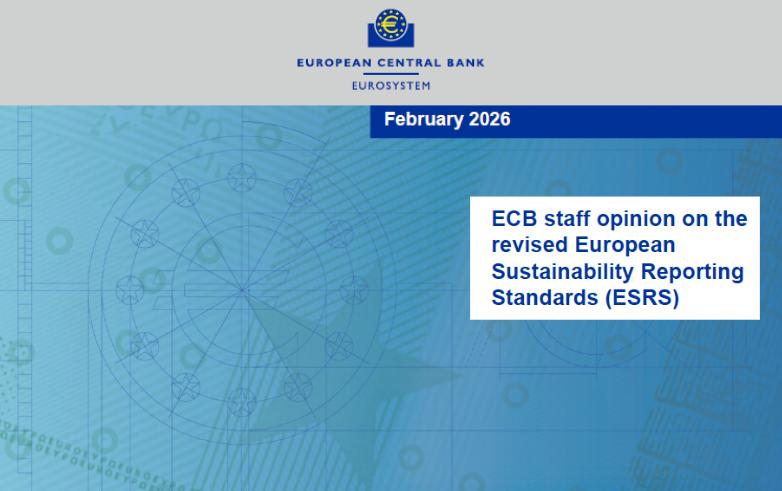
In February 2026, ECB staff published an opinion on the draft revised European Sustainability Reporting Standards (ESRS), focusing on ESRS 1, ESRS 2, ESRS E1 and ESRS E4. The document follows the European Commission’s request of 16 December 2025 for input on the draft revised ESRS issued by EFRAG on 3 December 2025, under the Accounting Directive as amended by the Corporate Sustainability Reporting Directive (CSRD). ECB staff position the revised ESRS as part of a simplification effort, while underlining that simplification should not dilute the CSRD objective of creating a reliable and comparable sustainability data ecosystem.
Simplification Gains and the Balance Test
ECB staff acknowledge a very significant simplification and point to structural changes intended to improve usability. These include a clearer distinction between disclosure requirements and application requirements, alongside improved visibility of the materiality-of-information filter. In operational terms, the revised architecture is presented as a way to help reporting entities navigate what is required, what is explanatory, and what can be filtered out through materiality. The opinion nevertheless frames simplification as a balance test, because flexibility can also create gaps in coverage and reduce comparability if applied too broadly or too permanently.
Reliefs, Phase-ins and the Risk of Data Blind Spots
A central theme in the opinion is the scale of cross-cutting flexibility measures under the revised ESRS, including permanent reliefs and phase-ins, as well as explicit and implicit exemptions for the financial sector. ECB staff consider that these changes could reduce transparency for investors and constrain the availability and comparability of financial risk-relevant information, particularly under ESRS E1 (Climate change) and ESRS E4 (Biodiversity and ecosystems).
ECB staff recommend time-limiting key reliefs linked to metrics and data quality, including a three-year time limit (phase-out) for the “undue cost or effort” relief for metrics, as well as for the relief allowing partial-scope reporting where sufficiently robust data are not available without undue cost or effort. They also note that extending the “undue cost or effort” relief to all metrics goes beyond its scope under IFRS/ISSB and therefore hampers interoperability.
To protect fair presentation, ECB staff call for guardrails that clarify reliefs as exceptional and duly justified, and that require consideration of the compound effect when more than one relief and/or phase-in is used. In this context, they suggest deleting paragraph 2 of ESRS 1 AR 6, which ex ante concludes that using reliefs is not detrimental to fair presentation regardless of circumstances.
Interoperability with International Standards
The opinion supports efforts to strengthen interoperability with international standards, while noting that European policy objectives remain paramount. ECB staff describe interoperability in terms of alignment between ESRS and global reporting frameworks such as IFRS/ISSB, the Global Reporting Initiative (GRI) and the Taskforce on Nature-Related Financial Disclosures (TNFD), which can reduce reporting costs for undertakings, especially those operating across jurisdictions, and support integration and comparison of reporting systems. ECB staff nevertheless highlight a potential tension where some newly proposed reliefs go beyond IFRS/ISSB and therefore constitute a loss of interoperability. In that framing, widening differences between EU and international disclosure requirements can weaken cross-jurisdictional comparability.
Appropriateness for Banks and the Value Chain Dimension
For credit institutions, ECB staff emphasise that many ESG impacts, risks and opportunities are concentrated in the downstream value chain, reflecting the activities of clients that banks finance. The opinion therefore pays particular attention to how the revised ESRS interact with double materiality assessment, because the methodology used to determine material topics shapes which disclosures appear and which do not. ECB staff argue that added flexibilities, such as not collecting information from the value chain or using a brief top-down approach to decide non-materiality, need guardrails so that they do not lead to non-identification of material impacts, risks and opportunities.
The opinion also points to the need for banks to define appropriate value chain metrics where material value chain impacts, risks and opportunities have been identified, given that topical metrics are otherwise focused on own operations.
Data Hierarchy, Directly-collected Data and the Use of Estimates
ECB staff regret the deletion of the concept of a data hierarchy that existed in ESRS Set 1 and recommend its reintroduction as a mechanism supporting high-quality disclosures and adequate risk differentiation. In the context of identifying material impacts, risks and opportunities in the value chain and reporting on value chain metrics, ECB staff note that the revised ESRS put directly-collected data on an equal footing with estimates. They contrast this with ESRS Set 1, which established an explicit preference for directly-collected data, while allowing estimates such as sector-average data and other proxies when an undertaking could not collect information after making reasonable efforts. ECB staff also criticise the revised wording that allows direct data or estimates to be used “depending on practicability and reliability considerations related to the necessary input”, stating that this would lead to a loss of consistency and harmonisation, runs contrary to commonly used best practices for data management and removes incentives to improve data quality.
Anticipated Financial Effects and Decision-useful Forward-looking Data
On ESRS 2, ECB staff support retaining anticipated financial effects (AFEs) as quantitative disclosures. The opinion cautions against adding a further three-year phase-in for quantitative AFEs on top of the existing three-year phase-in, because this would extend the overall phase-in to six years for Wave 1 companies. ECB staff link quantitative AFE disclosures to informed decision-making and to the financial materiality perspective embedded in the CSRD. In that context, additional delays are presented as inconsistent with the objective of providing timely transparency to investors, particularly where forward-looking information informs the assessment of resilience and risk.
Takeaway for Sustainability Reporting Users
Overall, the ECB staff opinion treats the revised ESRS as a more workable draft, while stressing that extensive reliefs and prolonged phase-ins could weaken comparability. For users of sustainability statements, the document highlights areas where the revised standards may be tested in practice. These include continuity of core datasets, the extent to which value chain coverage is preserved, and the availability of forward-looking financial effects. As the revised ESRS move towards adoption, the opinion suggests that the credibility of simplification will be measured by whether key disclosures remain sufficiently consistent, comparable and risk-relevant to support analysis across entities and over time.