ISSB Issues Targeted Amendments to IFRS S2
The ISSB has published targeted amendments to IFRS S2 Climate-related Disclosures, refining how entities disclose greenhouse gas emissions in areas that have proved challenging in practice. The package focuses on Scope 3 Category 15, financed emissions disaggregation and certain jurisdictional reliefs, with an effective date of 1 January 2027 and early application permitted.

On 11 December 2025, the IFRS Foundation reported that the International Sustainability Standards Board (ISSB) had issued targeted amendments to the greenhouse gas (GHG) emissions disclosure requirements in IFRS S2 Climate-related Disclosures. The IFRS Foundation states that the amendments respond to application challenges that were identified as companies began to apply IFRS S2, and to feedback from the ISSB’s consultation earlier in 2025. The changes are described as reliefs and clarifications intended to support application of IFRS S2 while keeping investor information needs in focus and minimising disruption to jurisdictions adopting or otherwise using ISSB Standards.

Source: Targeted amendments to IFRS S2 – At a glance
Scope 3 Category 15 and Financed Emissions
A key change concerns Scope 3 Category 15 (investments). An entity is permitted to limit measurement and disclosure of Category 15 GHG emissions to its financed emissions, as defined in IFRS S2. The amendments clarify that loans and investments include loans, project finance, bonds, equity investments and undrawn loan commitments, and that financed emissions for asset management activities include emissions attributed to assets under management. For the purpose of this limitation, an entity is permitted to exclude GHG emissions attributable to derivatives. If an entity applies the limitation, it explains what it has treated as a derivative and describes the financial activities excluded from its measure of Scope 3 Category 15 GHG emissions, including activities associated with derivatives. If an entity has included Category 15 GHG emissions in its measure of Scope 3 GHG emissions disclosed in accordance with IFRS S2, it discloses the total Category 15 GHG emissions and the subtotal of financed emissions included in that total.
Industry Classification for Disaggregation of Financed Emissions
For disaggregation of financed emissions by industry, the amendments permit the use of industry classification systems other than the Global Industry Classification Standard (GICS). The requirements focus on selecting a classification system that enables users to understand the entity’s exposure to climate-related transition risks, and on disclosing the system used together with information that enables users to understand how the selection fulfils this requirement. Where a system commonly used by other entities enables useful information with all else being equal, IFRS S2 requires the entity to prioritise that system. An entity that participates in both commercial banking and insurance activities need not use the same industry classification system for both activities.
Jurisdictional Reliefs on Methodology and Global Warming Potential
IFRS S2 requires measurement of GHG emissions in accordance with the Greenhouse Gas Protocol: A Corporate Accounting and Reporting Standard (2004) unless a jurisdictional authority or an exchange requires a different method, and the amendments clarify that this relief can apply in whole or in part. IFRS S2 also requires conversion of constituent greenhouse gases into CO2 equivalent using global warming potential values based on a 100-year time horizon from the latest Intergovernmental Panel on Climate Change assessment available at the reporting date. If emission factors used to estimate emissions have already converted constituent gases into CO2 equivalent values, the entity is not required to recalculate those emission factors using the specified global warming potential values. Where a jurisdictional authority or an exchange requires different global warming potential values, including where the requirement applies only to part of the entity, the entity is permitted to use the required values for that part for as long as the requirement applies.
Consequential Amendments to SASB Standards
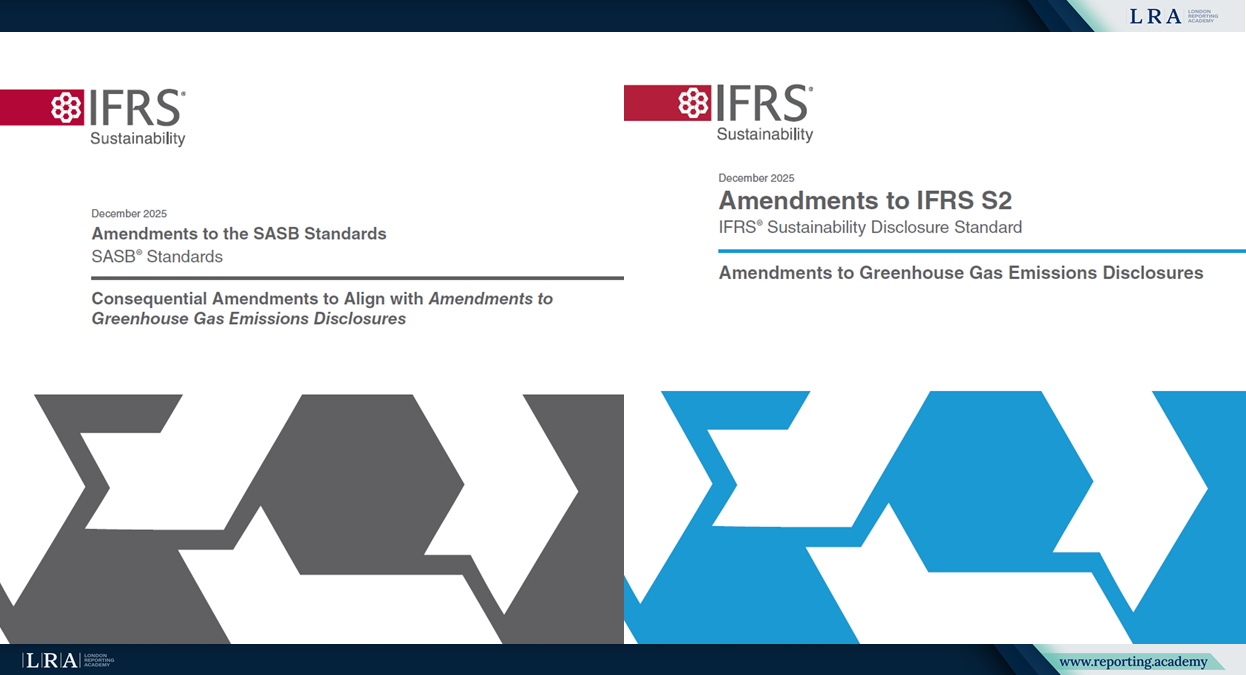
Alongside the IFRS S2 amendments, the ISSB issued consequential amendments to align financed emissions metrics in three SASB Standards with the amended IFRS S2 requirements. The affected standards are Asset Management & Custody Activities, Commercial Banks and Insurance. In specified financed emissions metrics, an entity is permitted to exclude GHG emissions attributable to derivatives, subject to explaining what it has treated as a derivative.
Effective Date and Application
The targeted amendments to IFRS S2 are effective for annual reporting periods beginning on or after 1 January 2027, with early application permitted. The consequential amendments to the SASB Standards are also effective for annual reporting periods beginning on or after 1 January 2027, with early application permitted.