Assessing Readiness for ISSB Standards: A New Framework for Jurisdictions and Its Implications for Reporting Organisations
As jurisdictions move from signalling intent to setting timelines for ISSB Standards adoption, approaches to assessing readiness and sequencing implementation are coming into sharper focus. The IFRS Foundation’s latest publications address this challenge.
In February 2026, the IFRS Foundation published the Jurisdictional Readiness Assessment Guide and its accompanying Tool as part of its Regulatory Implementation Programme. These resources are intended to help jurisdictions assess whether their markets are prepared for the adoption or other use of IFRS S1 General Requirements for Disclosure of Sustainability-related Financial Information and IFRS S2 Climate-related Disclosures. The Guide uses ‘adoption or other use’ to describe a spectrum of approaches, ranging from direct use of IFRS S1 and IFRS S2 to local requirements designed to deliver functionally aligned outcomes. Their publication coincided with the first meeting of the Jurisdictional Adopters Working Group, established to facilitate multilateral discussion on cross-border considerations and reduce fragmentation in sustainability-related financial disclosure requirements.
Background and purpose
Requirements aligned with ISSB Standards have come into effect in 19 jurisdictions, and nearly 40 have taken steps towards adoption or other use. The Foundation's Regulatory Implementation Programme describes four phases: becoming familiar with ISSB Standards, assessing the case for adoption, developing a roadmap and executing it. The Guide and Tool support phase two by offering a structured, evidence-based method for understanding market readiness before requirements are introduced.
Assessment outcomes are intended to inform four key decision areas identified in the Roadmap Development Tool: the regulatory process for introducing requirements (how), the scope of reporting entities (who), the substance of disclosure obligations (what) and the timing of application (when). The assessment can also support cost-benefit analyses and help identify capacity-building priorities.
Three domains of readiness
The Guide organises jurisdictional readiness into three mutually reinforcing domains. Ecosystem readiness covers the institutional and market infrastructure required to support high-quality disclosures, including regulatory architecture, reporting professionals and professional services, and information and data infrastructure. Preparer readiness addresses the capacity of entities to apply IFRS S1 and IFRS S2, assessed across maturity and specialist capacity, and familiarity with disclosure requirements and current reporting practices. Support system readiness considers how development partners, accountancy bodies and other stakeholders can help address identified gaps through capacity building and technical assistance.
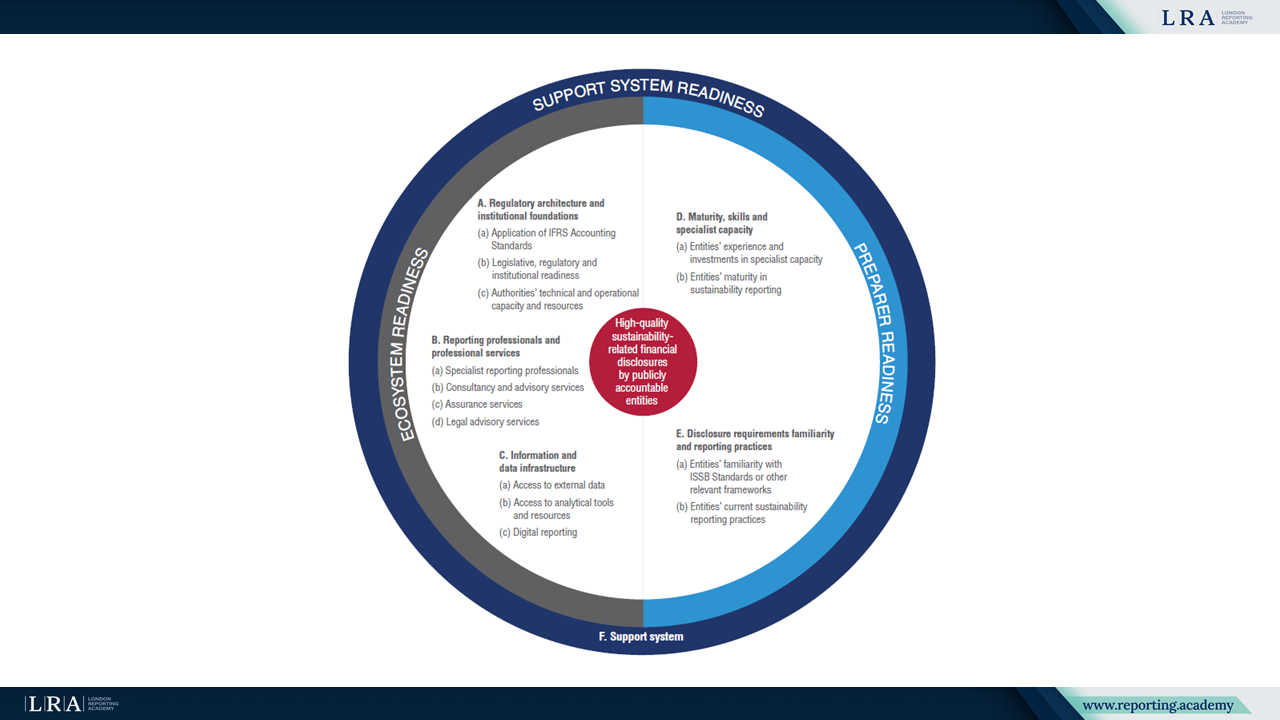
Source: Domains, assessment areas and matters for consideration, Jurisdictional Readiness Assessment Guide
The Tool is designed to assess readiness for high-quality sustainability-related financial disclosures by Publicly Accountable Entities (PAEs), with jurisdictions able to consider broader application separately. Assessments often begin with ecosystem readiness before moving to preparer readiness. The Guide also notes that strengthening the reporting ecosystem can have positive spillover effects beyond publicly accountable entities, including for small and medium-sized entities.
Technical implications for preparers
On information and data infrastructure, the Guide and Tool emphasise the availability of relevant datasets, emission factors, scenarios and sector benchmarks, alongside analytical tools and modelling capabilities that support sustainability-related financial disclosures. Digital reporting readiness is also considered, including familiarity with the IFRS Sustainability Disclosure Taxonomy and how it may be used alongside the IFRS Accounting Taxonomy. Both IFRS S1 and IFRS S2 include proportionality mechanisms intended to support implementation where comprehensive data availability may initially be constrained. The Guide treats understanding of these proportionality mechanisms as one element of preparer readiness.
Framework familiarity is assessed as a meaningful readiness indicator. The Guide also points to familiarity with IFRS Accounting Standards, CDSB Standards and CDP questionnaires as relevant reference points when assessing readiness. It notes that CDP climate questionnaires began aligning with IFRS S2 in 2024. The Guide treats prior use of the TCFD recommendations, SASB Standards, the Integrated Reporting Framework and GRI Standards as a relevant indicator when assessing readiness for ISSB Standards. It also notes that familiarity with ESRS and GRI Standards may provide a foundation in terms of processes and data capabilities, while emphasising that ISSB Standards are investor-focused and that broader-scope frameworks are designed to meet the needs of stakeholders beyond investors.
Implications for reporting organisations
For reporting teams, readiness assessments are intended to inform decisions on the timing, scope and sequencing of disclosure requirements, including which entities are in scope as jurisdictions determine their approach. At the governance level, the assessment considers entities’ governance arrangements for identifying, assessing and managing sustainability-related risks and opportunities as a baseline indicator of preparer readiness. On assurance, the Tool references International Standard on Sustainability Assurance (ISSA) 5000 and the International Ethics Standards for Sustainability Assurance (IESSA), noting that the availability of qualified assurance providers is a component of ecosystem readiness. Organisations that engage with these standards ahead of any jurisdiction-level assurance mandate may be better prepared for the transition.