For SEC filers & U.S.-listed issuers

Certified Sustainability Reporting for U.S. Companies Course

4.9/5 average satisfaction score across all LRA courses
Delivered in English · inline translation into 20+ languages

Mentor-led sustainability reporting programme for U.S. companies — SEC Climate Disclosure Rules, California SB 253 & SB 261, SASB, IFRS S1 & S2, TCFD, plus EU CSRD/ESRS for multinational groups with European exposure. Delivered by Dr. Ross Kurinko and senior practitioners.

4.9/5 Student Rating SEC · California SB 253/261 · SASB IFRS S1/S2 · TCFD · CSRD/ESRS 9,600+ Graduates worldwide 15+ Years ESG Experience

sustainability reporting for U.S. companies — U.S. regulations + global standards in one programme.

This Certified Sustainability Reporting Course is purpose-built for U.S.-listed issuers, SEC filers and U.S. operations of multinational groups. Built on 15+ years of ESG-reporting practice across global and U.S. engagements, it integrates the U.S. regulatory landscape — SEC Climate Disclosure Rules and California Climate Laws (SB 253 & SB 261) — with the voluntary frameworks investors actually read (GRI, SASB, IFRS S1/S2, TCFD), and EU CSRD/ESRS for groups with European exposure.

Dual-track positioning

U.S. regulatory + global / EU frameworks, in one curriculum

U.S. regulatory

SEC Climate Disclosure Rules (federal filers) · California SB 253 (Climate Corporate Data Accountability Act) · California SB 261 (Climate-Related Financial Risk Act) · SASB (industry-specific metrics, widely used by U.S. issuers)

Global + EU frameworks

GRI · IFRS S1 & S2 (ISSB global baseline) · TCFD · CSRD / ESRS (for U.S. groups with EU operations, listings or supply chains)

7 themes covered
Reporting fundamentals · Reporting concepts and principles · GRI & SASB voluntary frameworks · U.S. regulatory — SEC & California climate laws (SB 253 & 261) · IFRS S1, S2 and TCFD · CSRD/ESRS European standards · ESG reporting in practice — data collection, drafting and design
Regulatory status note: The SEC Climate-Related Disclosure Rule has been through court challenges and rulemaking iterations — the course tracks its current operational status and the practical reporting expectations U.S. filers face. California SB 253 is moving into implementation (first Scope 1 & 2 reporting due 10 Aug 2026); SB 261 enforcement is currently paused pending appeal. The mentor sequences sessions around the regulatory state that matters for your filing context.
Built for U.S. reporters

From Wall Street to Sacramento — reporting that satisfies your SEC filer status, your California operations and your global investors.

No basic. No advanced. Just U.S.-filer ready.

U.S. sustainability reporting is uniquely fragmented: federal SEC rules, state-level mandates (notably California), voluntary frameworks investors expect (SASB, GRI), the ISSB global baseline (IFRS S1/S2), and EU CSRD/ESRS pulling on multinationals with European exposure. The course exists for one outcome — be able to publish ESG disclosures that satisfy your regulator, your investors and your auditor across all of those at once.

The difference is in how you get there. The mentor-led programme calibrates to your filing status (SEC-registered or private), your California exposure, your sector's SASB profile, your EU footprint and your data maturity. A Delaware-incorporated SEC filer with no California operations follows a different path than a multinational group with California operations and an EU subsidiary.

"U.S. sustainability reporting is not 'one framework with rules to memorise'. It's a patchwork of federal, state, voluntary and cross-border requirements — and the practitioner judgement is in how you stitch them together without building two parallel reporting machines."
What sets this course apart

Five reasons it's not another U.S. sustainability-reporting explainer.

Federal + state + global, integrated

A dedicated module on U.S. regulatory frameworks (SEC Climate Rules and California SB 253/261), another on voluntary frameworks (GRI & SASB), a third on the ISSB global baseline (IFRS S1/S2 + TCFD), and a fourth on EU CSRD/ESRS — all in one curriculum, not five separate courses.

Practical alignment work

Most U.S. sustainability-reporting courses pick a side — SEC compliance, or voluntary frameworks, or California. This one walks through how to satisfy all of them with one disclosure architecture: reduce rework, structure outputs for seamless reuse across federal filings, California reporting, investor communications and EU exposure.

Sector-aware (SASB-based) templates

You leave with the working artefacts: SASB-derived industry materiality reference, GRI cross-mapping checklist, SEC-filing narrative framework and California SB 253 inventory management plan. Templates calibrated to your sector and filing context.

Human-in-the-loop — every session

The programme is mentor-led, not self-paced. Personalised one-to-one Zoom sessions with Dr. Ross Kurinko or a senior LRA mentor. We use the AI-powered LRA Study Studio to accelerate learning, but the judgement calls — on filing status, materiality, jurisdictional choices — stay human.

U.S. case work, not generic global theory

Real-life examples from American companies — SASB-aligned disclosures, SEC filings, California submissions and multinational reports — drawn from the practitioner experience behind the curriculum. Not a global course with a U.S. sticker.

Choose your format

Two mentor-led routes, both deeply personalised.

Same expert curriculum and templates — different depth of mentor time and draft review.

1:1 Expert Mentorship

The core mentor-led programme.

Up to 10 one-to-one Zoom sessions of 1.5 hours with Dr. Ross Kurinko or a senior LRA mentor — calibrated to your filing status (SEC-registered or private), California exposure, sector's SASB profile, EU footprint and data maturity. Covers the full 7-theme curriculum end-to-end. Subject to mentor availability.

5 × 1.5h mentor sessions · 12 months Studio access · Templates: SASB industry reference, GRI cross-mapping, SEC narrative framework, SB 253 IMP · LRA team support
£999+ VAT where applicable
Enrol & Pay
1:1 Expert Mentorship — Applied Practice

More mentor time, line-by-line review.

Everything in the core mentorship, plus extended mentor time and line-by-line review of your actual disclosure drafts — SEC narrative, California SB 253 inventory management plan, SB 261 risk report, and the bridging work to IFRS / CSRD. Best for issuers with an active filing cycle. Subject to mentor availability.

10 × 1.5h mentor sessions · line-by-line draft review · 12 months Studio access · all templates · LRA team support
£1,995+ VAT where applicable
Enrol & Pay
For teams

Train your team — sustainability + finance + legal + IR — together.

Custom U.S. sustainability-reporting programmes for sustainability, finance, controllership, legal/compliance and investor relations teams — delivered online, on-site, in London, or as a hybrid programme. Price on request.

View corporate programmes →
How each route works

The same U.S. ESG programme, shaped to four professional paths.

From day one to diploma — what the journey looks like on each route.

Guided Flex

Independent learning, support-desk-backed.

Best for: professionals who want the complete reporter programme around a busy schedule.

  • Onboarding — tell the Studio your role, sector, jurisdiction and reporting context.
  • Studio access — your full programme curriculum + read-mode access to every other LRA course.
  • Core learning — lessons, applied exercises and structured assessments.
  • Expert support desk — the LRA support team replies via the platform, typically within one business day.
  • Verifiable diploma — your U.S. ESG Reporting diploma, verifiable for life.
Enrol in Guided Flex →
Live Cohort

Studio first, cohort layered on.

Best for: professionals who want peer learning and scheduled live sessions with senior LRA mentors.

  • Onboarding — tell the Studio your role, sector, jurisdiction and reporting context.
  • Start in the Studio today — no waiting for the next intake to begin.
  • Core diploma path — progress through the 7 themes at your pace.
  • Cohort intake — join the next scheduled cohort (Oct 2026 / Mar 2027).
  • Live sessions + cohort recognition — twice-weekly mentor sessions; your diploma is updated to show cohort participation.
Reserve a cohort seat →
1:1 Expert Mentorship

Up to 10 mentor sessions — flagship depth.

Best for: professionals leading an actual sustainability report this cycle — needs the most dedicated mentor time of any LRA course. Subject to mentor availability.

  • Studio onboarding — tell the Studio your role, sector, jurisdiction and reporting context.
  • Mentor kickoff — dedicated session to map your reporting context and goals.
  • Personalised plan — your mentor calibrates focus areas and pace across all 7 themes.
  • Up to 10 × 1.5h private sessions — Zoom time with Dr. Kurinko or a senior LRA mentor; line-by-line draft review.
  • Diploma + mentorship recognition — your U.S. ESG Reporting diploma is updated to show 1:1 expert mentorship.
Choose 1:1 Expert Mentorship →
Corporate Programme

Bespoke programme for your team.

Best for: sustainability, finance and reporting teams aligning on the complete reporting cycle together.

  • Request a quote — share scope, team size and reporting context.
  • Scope alignment — we map the U.S. ESG programme to your sector and disclosure cycle.
  • Custom programme design — modules, exercises and cases built around your team.
  • Delivery — online, on-site, Canary Wharf London or hybrid blend.
  • Team diplomas — per-learner credentials, each showing Corporate Programme participation.
Discuss a programme →
Want the full learning model? Dive into onboarding, the Study Studio, human support, certificates and the full delivery model on a dedicated page.
How We Deliver Our Courses →
London Reporting Academy
Study Studio · U.S. ESG

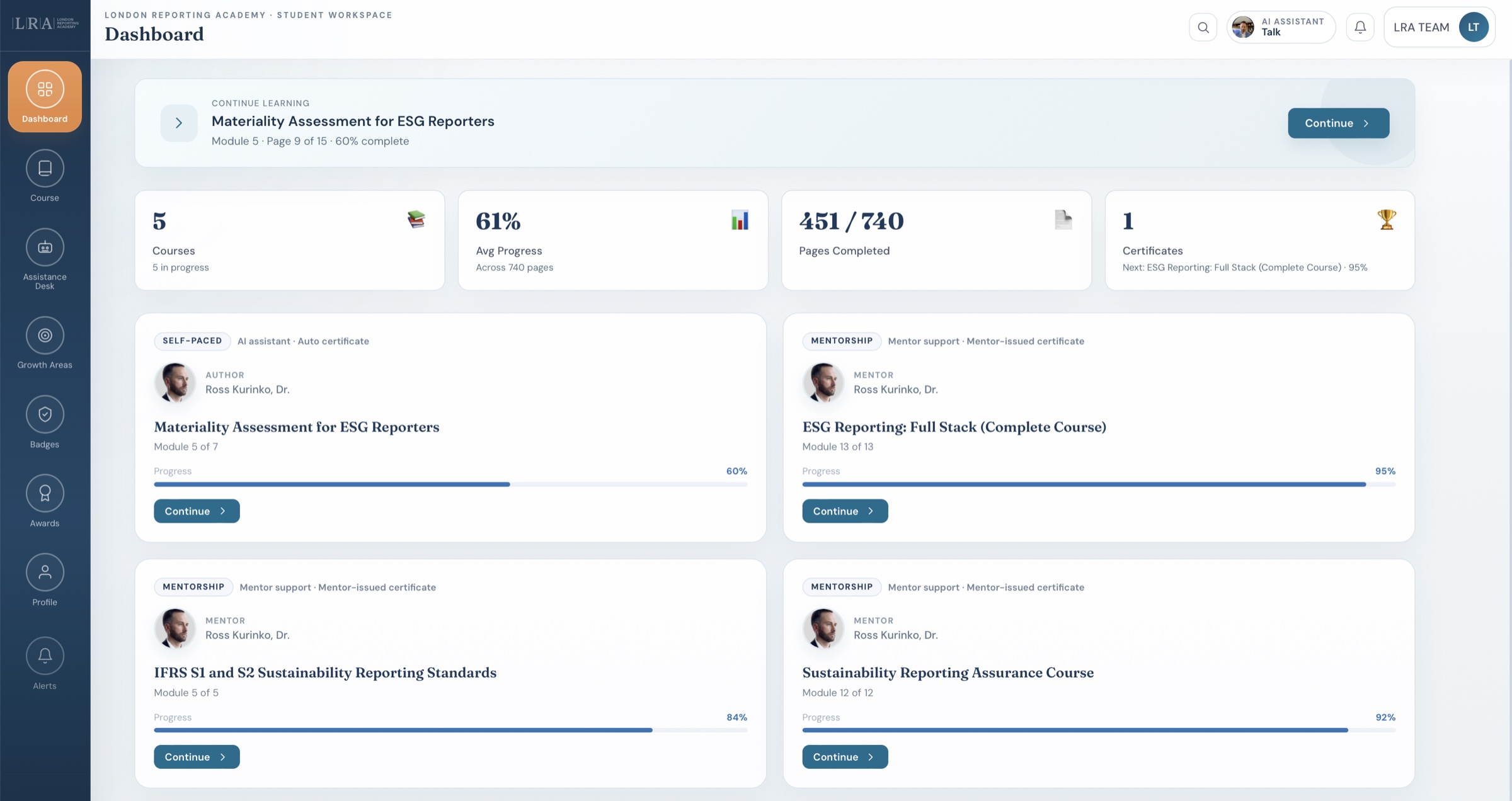
Your reporter workspace — U.S. regulations + global standards in one Studio.

The U.S. programme runs inside the AI-powered LRA Study Studio: three full courses — GRI, ESRS and IFRS S1 / S2 — plus read-mode access to Assurance and Materiality. The U.S. regulatory layer (SEC, California SB 253/261, SASB) is delivered live by your mentor on zoom — coming to the platform soon.

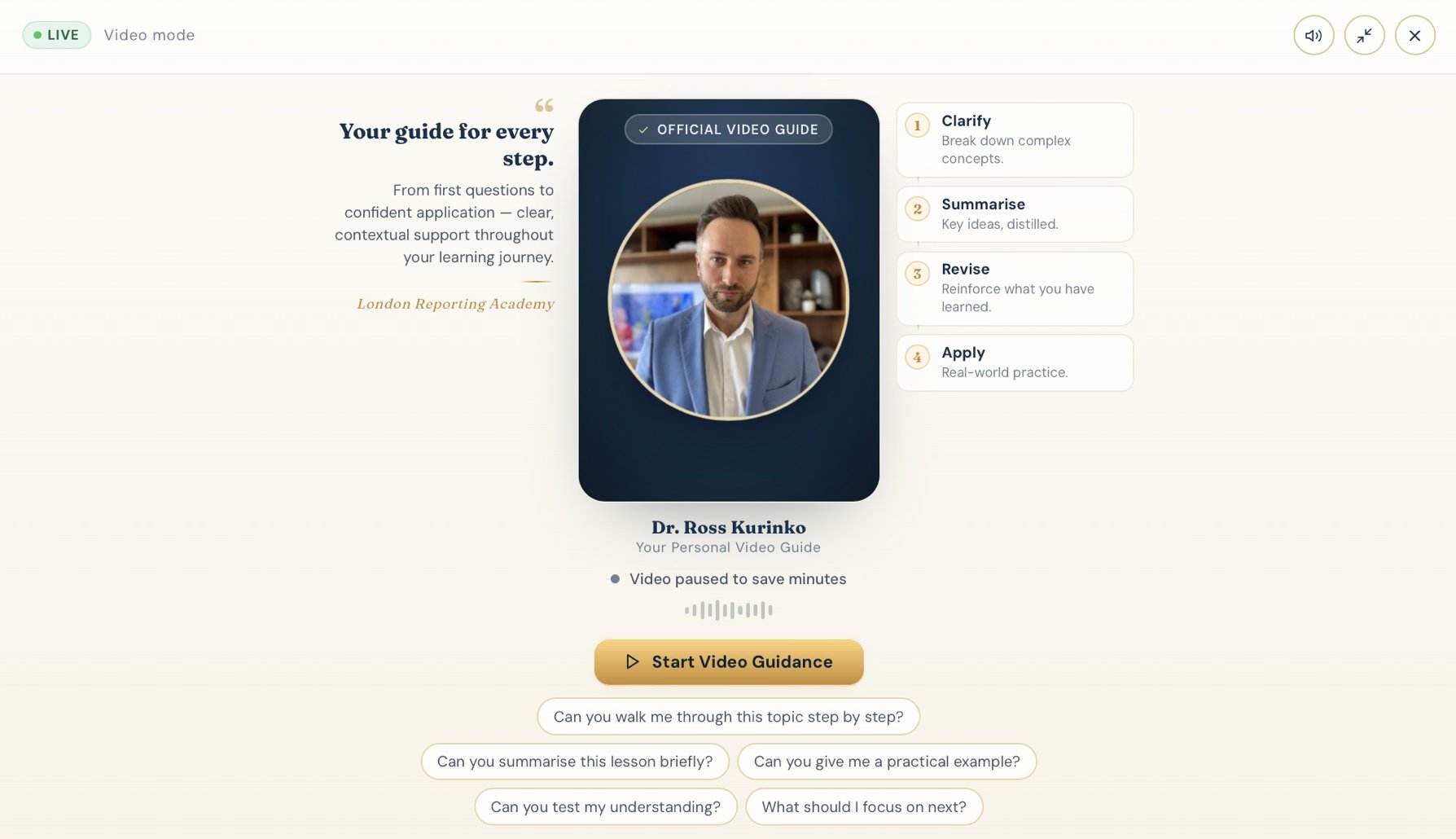
It is built for sustainability reporting — not generic online learning. The Studio combines expert-built reporting content, a specialist AI Tutor, Dr. Kurinko's AI Avatar, applied assessments, growth-area tracking and access to experienced ESG reporting professionals through the platform.

cabinet.reporting.academy/student/dashboard
Study Studio dashboard preview
Dr. Ross Kurinko AI avatar AI Avatar
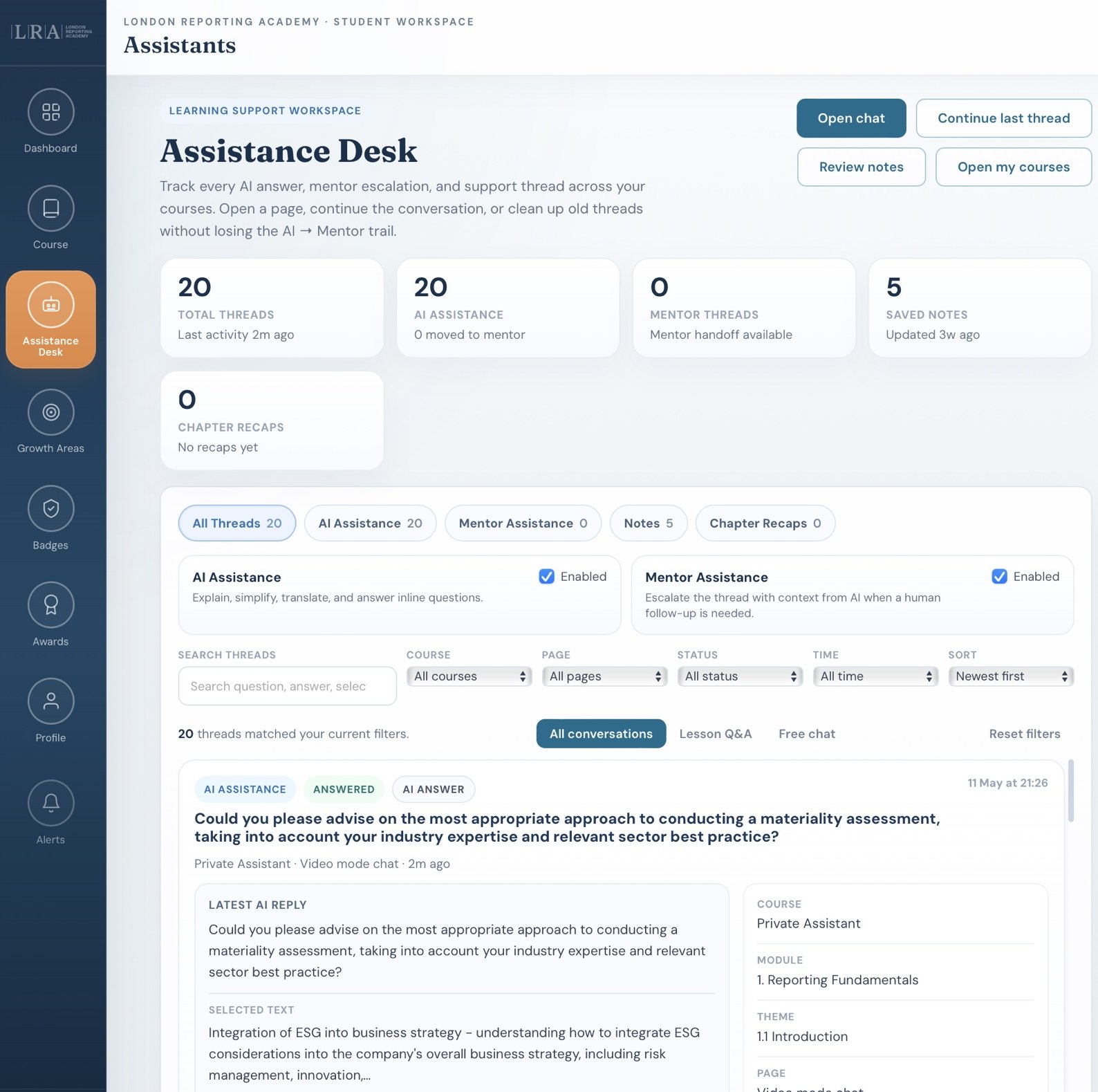
Assistance Desk Assistance Desk
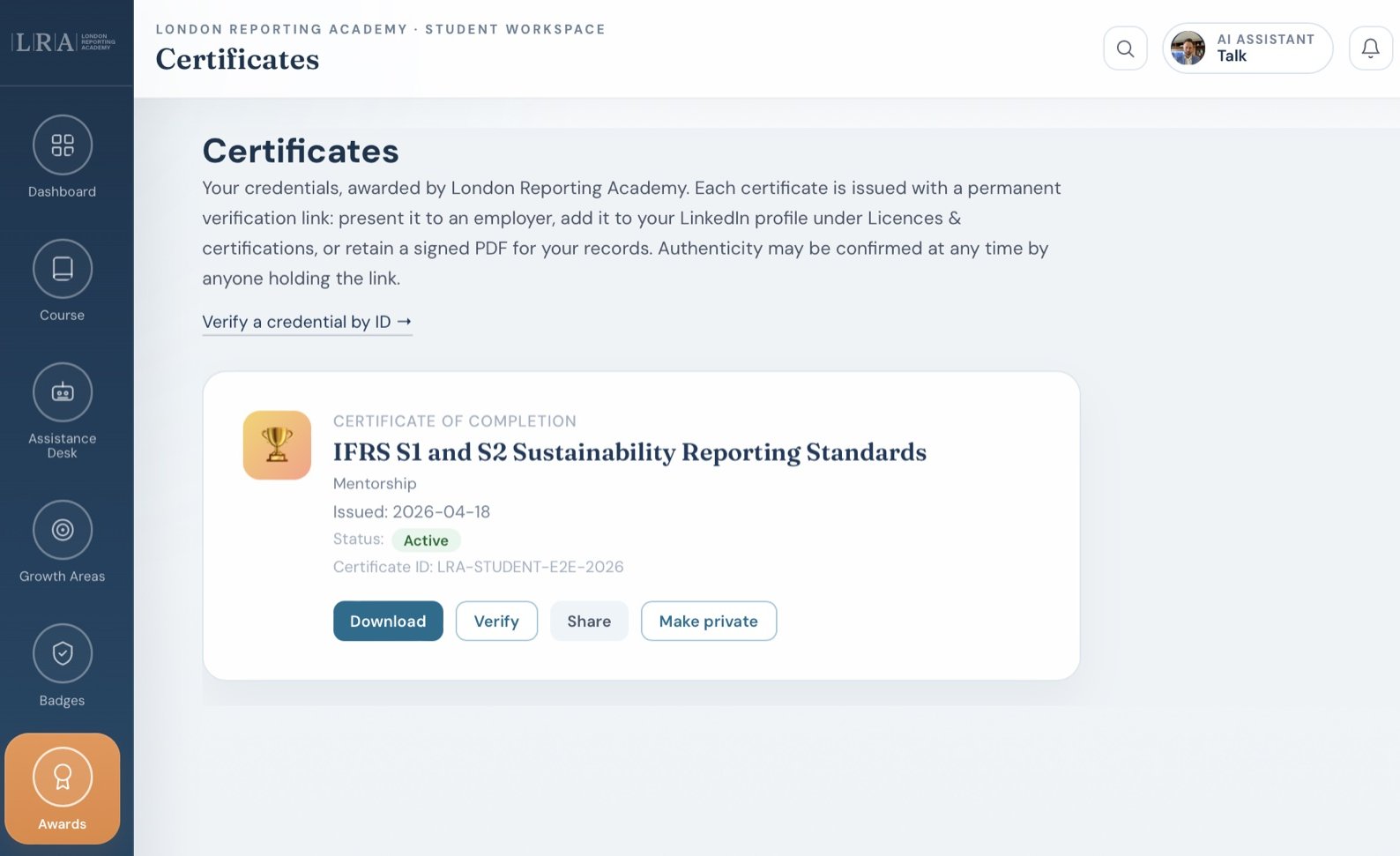
Verifiable certificate Certificates

Your dashboard, your AI Tutor, your progress — across GRI, ESRS, IFRS, Assurance and Materiality.

What the Studio helps you do
  • Move between standards seamlessly — switch between GRI, ESRS and IFRS courses, plus read-mode Assurance and Materiality, as your reporting needs demand — same workspace, same AI Tutor, same dashboard.
  • Build the auditor's package — applied work across drafting, benchmarking, content mapping and design — anchored in your role and sector.
  • Close weak areas before they wobble your report — Mistake Coach turns weak topics into a focused revision path.
  • Get human support when judgment matters — through the Assistance Desk, experienced ESG reporting professionals can answer questions that require practical interpretation.
  • Read and reason in your language — highlight any sentence in any lesson and the AI Tutor translates it inline into 20+ languages — Arabic, Mandarin, Hindi, French, German, Japanese, Korean, Spanish and more.
How the course works

Practitioner-led mentorship, accelerated by AI.

Real filing artefacts, not theory

Every mentor session is anchored to a real reporting artefact — SASB materiality mapping, SEC narrative outline, California SB 253 Inventory Management Plan, IFRS S2 bridge, EU CSRD overlap analysis. You leave with publishable approaches, not lecture notes.

Live mentor on every session

Direct Zoom time with Dr. Kurinko or a senior LRA mentor — calibrated to your filing status, California exposure, sector and EU footprint. The mentor sequences sessions around your reporting cycle.

AI Tutor + AI Avatar accelerate every lesson

A frontier-model AI Tutor pinned to every Studio page — translate, simplify, exemplify, ask a follow-up. When text isn't enough, push-to-talk video walkthrough by Dr. Kurinko's official AI avatar.

Mistake Coach closes the gaps

Wrong answers and weak topics auto-surface into a focused revision path — gaps close before they show in your SEC filing, California submission or investor communications.

Course outline

7 themes — from reporting fundamentals to a publishable U.S. report.

Approximately 24 CPD hours / 32 academic hours of structured learning, plus mentor time on top. Typical completion 3–5 months at 4–6 hours per week.

Theme 01

Reporting fundamentals.

  • The strategic role of sustainability reporting for U.S. companies — investor, regulator and stakeholder expectations
Theme 02

Reporting concepts and principles.

  • Materiality, transparency, comparability, stakeholder inclusiveness — the conceptual foundation every framework rests on
Theme 03

GRI & SASB — voluntary ESG reporting frameworks.

  • GRI Standards for impact reporting; SASB industry-specific metrics — particularly important for U.S. issuers, given SASB's deep adoption in U.S. investor communications
Theme 04

Navigating U.S. regulatory frameworks — SEC & California climate laws.

  • SEC Climate-Related Disclosure Rule: filing status, scope, current operational state, practical reporting expectations
  • California SB 253 (Climate Corporate Data Accountability Act): GHG Protocol Scope 1/2/3 inventory, thresholds, first reporting due 10 Aug 2026
  • California SB 261 (Climate-Related Financial Risk Act): board-ready risk report, enforcement status, what to prepare anyway
California State Capitol — origin of SB 253 and SB 261

California State Capitol — where SB 253 and SB 261 became law

For Californian SB 253/261 deep-dive specifically — see the dedicated California Climate Regulation course.

Theme 05

IFRS S1, S2 and TCFD — climate-related reporting.

  • The ISSB global baseline (IFRS S1 / S2) and the TCFD recommendations — how they apply to U.S. issuers whose investors and lenders expect alignment, even where U.S. regulation lags
Theme 06

CSRD / ESRS — European ESG standards.

  • For U.S. multinationals with EU operations, subsidiaries, listings, suppliers or customers — what CSRD / ESRS asks of you, how it sits alongside SEC and California requirements
Theme 07

ESG reporting in practice — from data collection to report design.

  • Framing your reporting approach · data collection and controls · narrative drafting · visual design of the report · publication and post-report review — the practitioner-craft layer most courses skip
Upon completion

By the end, you will confidently.

  • Understand the strategic value of ESG reporting for U.S. businesses, investors and stakeholders — including the dynamics around SEC rule-making, California's leadership position and investor pressure.
  • Apply GRI and SASB voluntary frameworks — with particular depth on SASB industry materiality given its deep adoption in U.S. investor communications.
  • Navigate the SEC Climate Disclosure Rule — filing status, scope, practical reporting expectations in its current operational state.
  • Apply California SB 253 and SB 261 — GHG Protocol Scope 1/2/3 inventory under SB 253, board-ready climate risk report under SB 261, deadlines and enforcement context.
  • Integrate IFRS S1 & S2 and TCFD — into U.S. investor communications and group-level disclosure even where U.S. regulation lags.
  • Bridge to EU CSRD / ESRS — for multinational groups with European exposure, without building two parallel reporting machines.
  • Operate at practitioner depth — across sustainability, finance, IR and legal — leading or supporting your organisation's U.S. sustainability reporting cycle.
Who this is for

From SEC filers to U.S. subsidiaries.

Same curriculum, different starting points. Mentor sessions calibrate to your filing status, California exposure, sector and EU footprint.

U.S. public company ESG / Sustainability manager

Lead your organisation's SEC ESG disclosures, integrate California SB 253/261 if you operate there, build SASB-aligned investor communications and bridge to IFRS S2 / TCFD where investors expect it.

ESG consultant working with U.S. clients

Add the full U.S. sustainability-reporting toolkit to your advisory practice — SEC narratives, California compliance, SASB sector materiality, IFRS S2 bridging, CSRD overlap analysis — with sector-aware worked examples.

California-operating company ESG lead

Prepare for SB 253 first Scope 1 & 2 reporting due 10 Aug 2026, build SB 261-ready climate-risk reporting, and align both with SEC filings, SASB metrics and (for multinationals) EU CSRD requirements.

CFO, Controller, Finance Director

Get to working depth on what U.S. sustainability disclosure actually demands — board-grade vocabulary, regulatory clarity and the judgement to direct, challenge and sign off ESG reporting under SEC, California and SASB-driven investor communications.

Legal & Compliance Officer

Understand the regulatory architecture — SEC rule status, California enforcement posture, the SB 261 appeal context, the EU CSRD reach into U.S. groups — and advise the business on compliance choices and risk.

U.S. subsidiary of a multinational group

Align your U.S. reporting (SEC, California, SASB) with group-level CSRD / ESRS or IFRS S1 / S2 reporting — without building two parallel reporting machines or duplicating data work.

Investor Relations / Treasury / ESG Analyst

Read U.S. sustainability disclosures the way institutional investors actually read them — SASB-aligned, IFRS S2-aware — and prepare disclosures that hold up to investor and rating-agency scrutiny.

Ihre Vorteile

Six things most U.S. sustainability-reporting courses don't have.

Mentor-led by Dr. Kurinko

GRI Certified Global Trainer, PhD, University of Cambridge, 15+ years on FTSE 100 and Fortune Global 500 disclosures. Not a third-party content licence.

5 mentor sessions

On the core route — 5 × 1.5h mentor sessions. On Applied Practice — 10 × 1.5h with line-by-line draft review.

U.S.-specific templates

SASB industry materiality reference · GRI cross-mapping checklist · SEC narrative framework · California SB 253 IMP — ready to adapt to your sector and filing context.

Federal + state + global, integrated

SEC, California SB 253/261, SASB, IFRS S2, TCFD, CSRD/ESRS — covered in one curriculum with explicit alignment work. No five separate courses.

AI Tutor + AI Avatar

Frontier-model AI on every Studio page, anchored to your role and disclosure context. Push-to-talk video walkthrough by Dr. Kurinko's official AI avatar when text isn't enough.

Mistake Coach

Weak topics auto-surface into a focused revision plan — gaps close before they show in your SEC filing, California submission or investor communications.

Diploma

An internationally recognised credential.

The LRA diploma goes beyond methodological knowledge. It certifies that the graduate has demonstrated practical capability to deliver sustainability reporting for U.S. companies — SEC filings, California SB 253/261 compliance, SASB-aligned investor communications, IFRS S2 / TCFD bridges, and EU CSRD/ESRS integration where applicable.

Recognised among sustainability, finance, legal and assurance professionals across the U.S. and globally, the LRA diploma confirms that every graduate has gained and demonstrated the practical capability to work on real U.S. sustainability reporting engagements.

Globally verified

LRA-certified capability in U.S. sustainability reporting

  • Practical competence, not just methodology — graduates demonstrate the ability to deliver U.S.-ready ESG disclosures across federal, state, voluntary and global frameworks.
  • Real templates, expert review — every learner builds against the U.S.-specific templates; on Applied Practice, mentors review your SEC narrative, California submissions and investor communications line by line.
  • Alignment-aware — graduates structure U.S. outputs so they can be reused across SEC, California, SASB, IFRS and (where applicable) CSRD/ESRS — no duplicate reporting machine.
  • A recognised credential — fits sustainability managers, reporting leads, consultants, internal auditors, governance officers, CFOs, legal / compliance officers and IR teams.
  • Verification when it matters — credentials carry a QR code, a unique credential ID and a permanent verification link auditors, employers, procurement teams and counterparties can confirm on request. Counts toward the LRA International Diploma in Sustainability Reporting.
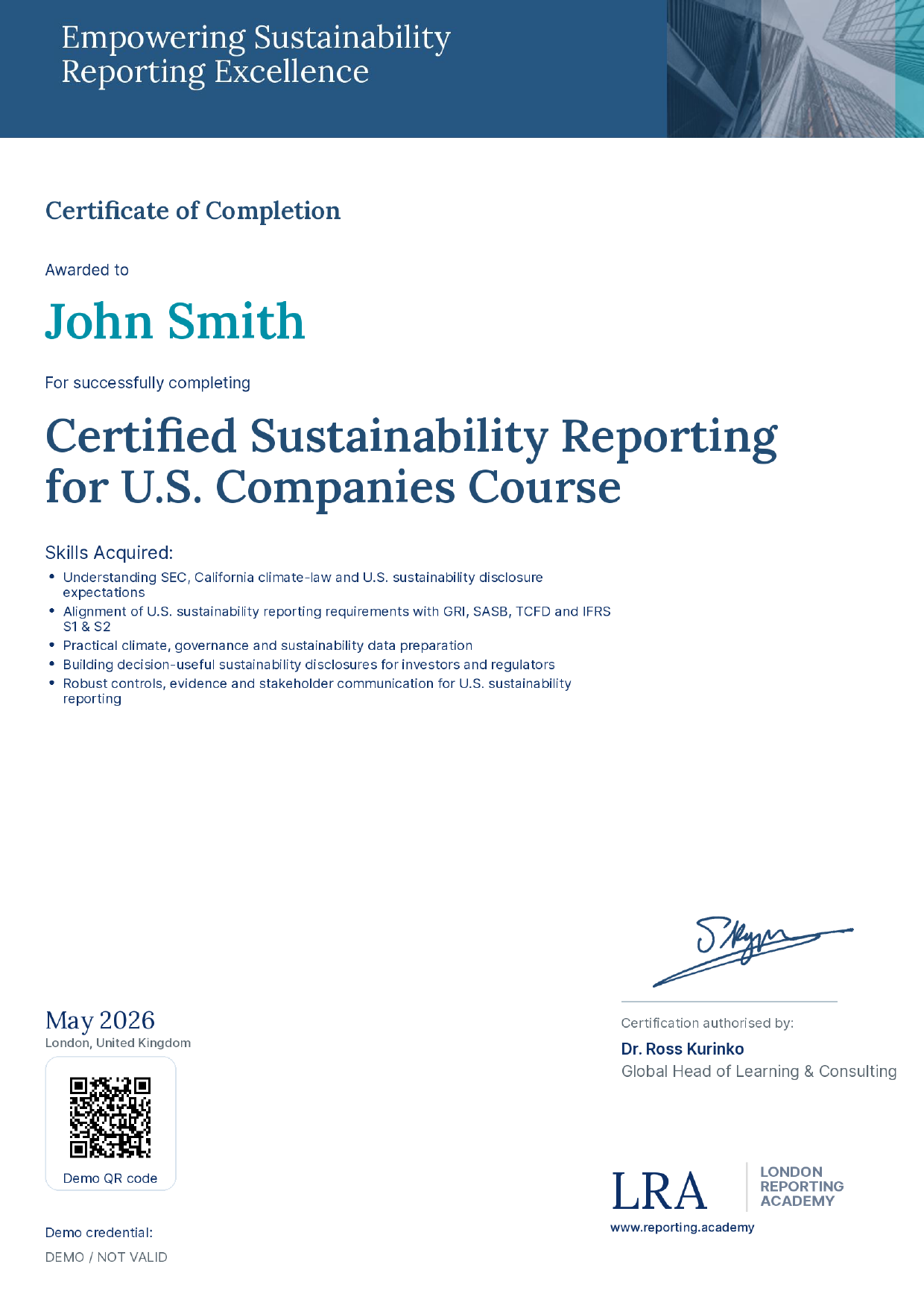
London Reporting Academy — sample certificate of completion
Dr. Ross Kurinko
Author and facilitator of the course
Dr. Ross Kurinko

Distinguished expert with 15+ years in sustainability, ESG, integrated ESG communications and corporate reporting. PhD, University of Cambridge · GRI Certified Global Trainer · Strategic ESG Advisor on IFRS S1 & S2, GRI and ESRS.

Throughout his career, he has been instrumental in establishing ESG governance frameworks and comprehensive disclosure systems — including engagements with U.S.-listed issuers and U.S. operations of multinational groups — and has guided over 20 prominent businesses and educated hundreds of professionals across FTSE 100 and Fortune Global 500 disclosures.

The LRA Alumni Club

Graduate once. Stay connected — for life.

Complete this programme on a Live Cohort, 1:1 Expert Mentorship, Applied Practice or Deep Review route and you join the LRA Alumni Club — a private network of LRA graduates with continuing access to expertise, peers and tangible benefits for life — no expiry. Reporting is a profession, not a one-time course — the Club is built to support your career, not just your enrolment.

01

Annual LRA Alumni Summit

Once a year, hybrid event (London + online): case studies from peer alumni, expert panels on emerging frameworks, and structured networking. Free attendance for Club members.

02

Quarterly peer benchmarking calls

Small-group calls with Dr. Kurinko and 6–12 alumni — we work through your real reports under NDA, compare approaches, debug edge cases. The kind of conversation reporting professionals can't get anywhere else.

03

Monthly office hours with Dr. Kurinko

60-minute Zoom Q&A every month — open to Club members. Bring a specific question from your current reporting cycle, get a direct, practitioner-grade answer.

04

Alumni-only Slack channel

A private workspace where alumni from every cohort exchange tips, share intel on new regulations, and ask peer questions. The kind of network you'd otherwise need to attend a year of conferences to build.

05

30% off any future LRA course — for life

30% off any LRA course, any format, any standalone — including the five new courses launching by end of 2026 and every LRA course after that. Stack credentials across the LRA portfolio at member pricing.

06

Early access to new courses

Four weeks of early access before every public launch — plus a vote on which frameworks LRA covers next. Alumni shape the curriculum.

07

Quarterly briefings on emerging regulations

Short, member-only video briefings on what's actually changing — ESRS amendments, IFRS S1/S2 updates, SB 253 enforcement, CSRD waves. Built so you stay current without doomscrolling LinkedIn.

08

Job board & talent network

LRA quietly maintains relationships with corporate ESG teams and consultancies. When they ask for trained reporters, Club members go on the shortlist. Featured Alumni Spotlight on LRA channels every quarter.

Routes that unlock the Club: Live Cohort · 1:1 Expert Mentorship · Applied Practice · Deep Review.

Guided Flex doesn't unlock Club membership — that's deliberate. The Club is designed for learners who chose an engaged format: live time, mentorship or applied work. It's a long-term commitment from LRA, so we reserve it for learners who made an equivalent commitment.

Trusted by professionals worldwide

Real participants. Real LinkedIn reviews.

Verified posts from sustainability practitioners who completed our programmes — open any to read the original LinkedIn comment in full.

Fees

Choose your U.S. sustainability reporting route.

All routes include the full 7-theme curriculum, the U.S.-specific templates, 12 months of Studio access and a verifiable LRA diploma. Prices exclude VAT where applicable.

Guided Flex
Coming SoonIndependent learning · support-desk-backed
Join waitlist
Live Cohort
Coming SoonOct 2026 / Mar 2027 intakes
Join waitlist
1:1 Expert Mentorship
£999+ VAT · 5 × 1.5h mentor sessions · subject to mentor availability
Enrol & Pay
1:1 Expert Mentorship — Applied Practice
£1,995+ VAT · 10 × 1.5h · line-by-line review · subject to mentor availability
Enrol & Pay
Applied Practice
Coming SoonLive cohort with applied project work
Join waitlist
Corporate Programme
On requestScope agreed during planning
Request a quote

The U.S. reporter network — for life. Completing this programme on Live Cohort, 1:1 Expert Mentorship, Applied Practice or Deep Review unlocks lifetime LRA Alumni Club membership — 30% off any future LRA course (5 new launches by end of 2026), monthly office hours with Dr. Kurinko, quarterly peer benchmarking calls under NDA, the annual Alumni Summit and an alumni-only Slack. U.S. reporters from SEC filers and California-exposed groups share notes there year-round. Guided Flex routes don't unlock the Club.

U.S. course — frequently asked

Course-specific questions — before you enrol.

Coverage, regulatory context, what you'll leave with — answered for this U.S. Sustainability course.

Given the back-and-forth on the SEC Climate Rule, is the course still relevant?

Yes — arguably more so. The SEC rule's operational status keeps shifting, but the underlying market expectation is stable: U.S. issuers are reporting climate-related disclosures one way or another, because California requires it, because investors and rating agencies expect it, and because U.S. multinationals face it through CSRD on the EU side. The course tracks the SEC rule's current state and the practical reporting expectations regardless.

Does this cover California SB 253 and SB 261 in depth?

Yes — Theme 04 covers both. SB 253 (the Climate Corporate Data Accountability Act) — GHG Protocol Scope 1/2/3 inventory, thresholds, first reporting due 10 Aug 2026. SB 261 (the Climate-Related Financial Risk Act) — board-ready risk report, enforcement status, what to prepare anyway.

If your focus is specifically California (not the broader U.S. sustainability-reporting architecture), see the dedicated California Climate Regulation course — it goes deeper into SB 253 / SB 261 only.

How is this different from the dedicated California course?

This U.S. course is broader. It covers SEC, California (SB 253 & 261), SASB, IFRS S2, TCFD and CSRD/ESRS — across 7 themes. The California course goes deeper into SB 253 / SB 261 only (10 themes focused on the California regime).

Take this U.S. course if you need the full U.S. sustainability-reporting architecture. Take the California course if California is your only focus or you want maximum depth on SB 253 / SB 261.

Does this work for a U.S. subsidiary of a non-U.S. multinational?

Yes — explicitly. Theme 06 covers CSRD/ESRS, and Theme 05 covers IFRS S1/S2 + TCFD. The mentor calibrates sessions so that U.S. subsidiaries can align local reporting (SEC, California, SASB) with consolidated group reporting under CSRD or IFRS — without building two parallel reporting machines.

Why SASB specifically? Other voluntary frameworks?

SASB is the voluntary framework U.S. investors most consistently read. Its industry-specific metrics are widely used in investor communications, are embedded in IFRS S2 (which inherited SASB-derived metrics), and are referenced in SEC rule-making. Theme 03 covers SASB alongside GRI for impact reporting — together they cover the two voluntary frameworks U.S. issuers most frequently combine.

Do I need prior ESG-reporting experience to start?

No. Themes 01 and 02 (Reporting Fundamentals; Reporting Concepts and Principles) build the foundation from the ground up. Practitioners with existing ESG-reporting experience — especially under SASB, GRI, IFRS S2 or CSRD — typically move faster through the early themes and spend their mentor time on the U.S.-specific applied work.

What templates will I get?

Four U.S.-specific templates:

  • SASB industry materiality reference
  • GRI cross-mapping checklist
  • SEC narrative framework
  • California SB 253 Inventory Management Plan

For an up-to-date list of what's in your enrolment, email lra@reporting.academy.

Who is the lead mentor?

Dr. Ross Kurinko or a senior LRA mentor, subject to mentor availability. The mentor kickoff session captures your filing status, California exposure, sector and EU footprint, and is used to sequence the 5 (or 10) sessions around your reporting context.

Your mentor engagement starts and finishes within six months of purchase. Studio access continues for the full 12-month term in parallel.

Is there an alumni programme — and what do I get?

Yes — the LRA Alumni Club. When you complete this course on an engaged format (Live Cohort, 1:1 Expert Mentorship, Applied Practice or Deep Review — including the mentor-only California, Middle East and U.S. routes) you become a member of the LRA Alumni Club for life — no expiry from the day you graduate. See the full Alumni Club section above.

What's inside the Club: 30% off any future LRA course in any format (including the 5 new courses launching by end of 2026 and every LRA course after that); the annual LRA Alumni Summit (London + online); quarterly peer benchmarking calls with Dr. Kurinko under NDA; monthly office hours; an alumni-only Slack channel; early access to new courses and a vote on what we cover next; member-only briefings on emerging regulations; and the LRA job board / talent network.

Guided Flex doesn't unlock the Club — that's deliberate. The Club is reserved for learners who chose an engaged format (live time, mentorship or applied work).

Should I take this course — or the Full Stack programme?

Take the Full Stack programme if this is your first reporting cycle — your company is doing CSRD, climate or sustainability reporting for the first time. Even if U.S. sustainability reporting looks like a "narrow" framework on paper, a first-time reporter needs more mentor time, broader context and the full reporter foundation. A single standalone course will leave gaps you'll only spot under deadline.

Also take Full Stack if you're new to sustainability reporting in general, or you're tackling a multi-framework programme (EU + global + jurisdictional) and want one enrolment that holds it all together — with four certificates and read-mode access to every other LRA course.

Take this standalone course if you've already delivered at least one reporting cycle and now want to deliver U.S. sustainability reporting — SEC climate rule, state-level mandates, investor expectations. You know the territory — you just want the focused practitioner mentorship on this specific standard.

Or take this standalone course if you have a functional background (finance, audit, risk, strategy, IR) and want to layer this reporting profile on top of it — e.g. a U.S. finance, IR, sustainability or legal lead at a SEC-registered or California-exposed entity tackling first or upgraded ESG disclosure. Your functional anchor gives you the structure a standalone course assumes.

Full Stack starts at the same entry point (from £999 Guided Flex, up to £3,495 Deep Review) as this standalone course (from £999 1:1 Expert Mentorship, up to £1,995 Applied Practice) but Full Stack includes four certificates — Full Stack diploma + ESRS + IFRS S1/S2 + official GRI Standards Certified — plus read-mode access to every other LRA course. See the Full Stack programme page for the full picture. Either way, completing on a Live Cohort, 1:1 Expert Mentorship, Applied Practice or Deep Review route makes you a member of the LRA Alumni Club — 30% off any future LRA course — for life (Guided Flex routes don't unlock Club membership).

Methodology question (assessment, certificate, refunds, languages)? See the cross-course FAQ at /how-we-deliver/#faq. Anything specific to this course? Email lra@reporting.academy.

Access starts on day one

Ready for U.S. sustainability reporting at practitioner depth?

Enrol on a mentor-led route and your kickoff session, the Studio, the U.S.-specific templates — and your route's human support — go live the same day. We're never AI-only.